Dow Jones Industrial Average backslides amid wavering sentiment
- The Dow Jones shed around 575 points on Thursday, as trade war fears resume.
- The more the Trump administration tries to soothe tariff fears, the worse things get.
- Market sentiment is still churning despite announced tariff delays and upbeat jobs data.

The Dow Jones Industrial Average turned tail and ran on Thursday, in tandem with the rest of the US equity indexes. United States (US) President Donald Trump continues to waffle on his own trade war rhetoric, exploring tariff exemptions and extensions on a sector-by-sector basis. However, the lack of clarity and consistency in policy that tends to get announced off-the-cuff via social media posting is beginning to weigh on market sentiment.
The Trump administration is continuing to pivot on its own tariff threats, granting a 30-day reprieve for the US automotive industry, which remains heavily reliant on foreign trade to produce its vehicles. Other industries, sectors, and businesses are up for making a case for why they should receive an exemption, at least for a little while, and the ongoing uncertainty around President Trump’s trade war rhetoric is sinking investor risk appetite.
US Nonfarm Payrolls (NFP) net job gains numbers for February are due on Friday, and Thursday’s Challenger Job Cuts number is providing little reason for traders to hope for a decent NFP print this week. Challenger firings reached their highest level since August of 2020 in February, climbing to 172K net terminations in key industries, strongly implying that a general slowdown is gathering speed.
Dow Jones news
Nearly the entire Dow Jones equity board is falling back on Thursday, with all but three listed securities trading into the red. Verizon Communications still managed to find some gains, climbing 1.2% to cross above $43 per share. Nvidia (NVDA) fell back once again, falling nearly 5% and dipping below $112 per share as the AI trade continues to fizzle out.
Dow Jones price forecast
Thursday is turning into a lunchbag letdown for bullish hopefuls, shredding the midweek rebound that has vanished as quickly as it disappeared. The Dow Jones is trading back into the 42,500 handle, with a near-term technical floor priced in at the 42,400 level.
The Dow Jones is poised to make contact with the 200-day Exponential Moving Average (EMA) near the 42,000 key figure, but only if selling pressure is able to push bids down another 500 points, a move that would likely require a shift in fundamentals... or a bad employment data print.
Dow Jones daily chart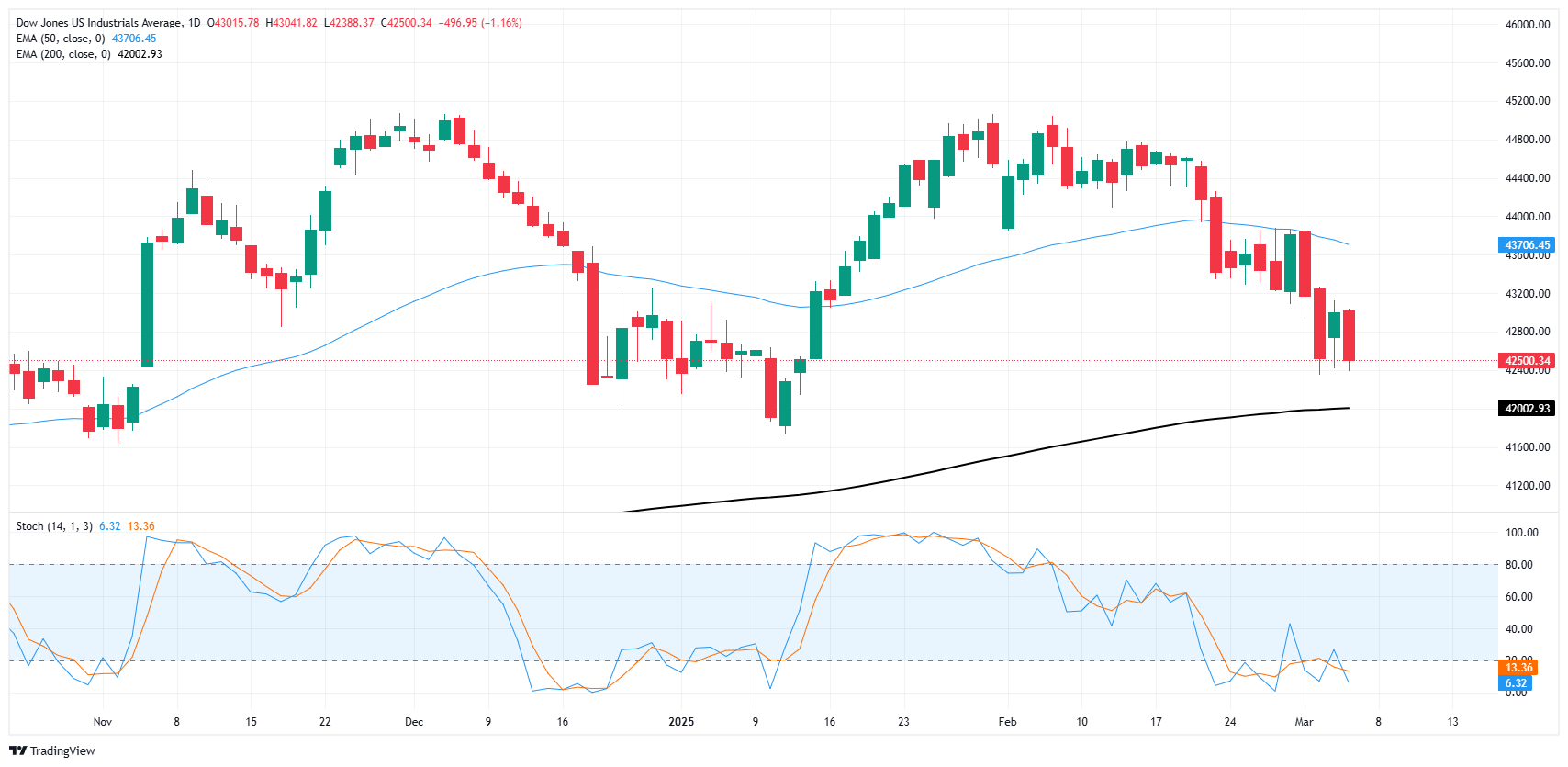
Tariffs FAQs
Tariffs are customs duties levied on certain merchandise imports or a category of products. Tariffs are designed to help local producers and manufacturers be more competitive in the market by providing a price advantage over similar goods that can be imported. Tariffs are widely used as tools of protectionism, along with trade barriers and import quotas.
Although tariffs and taxes both generate government revenue to fund public goods and services, they have several distinctions. Tariffs are prepaid at the port of entry, while taxes are paid at the time of purchase. Taxes are imposed on individual taxpayers and businesses, while tariffs are paid by importers.
There are two schools of thought among economists regarding the usage of tariffs. While some argue that tariffs are necessary to protect domestic industries and address trade imbalances, others see them as a harmful tool that could potentially drive prices higher over the long term and lead to a damaging trade war by encouraging tit-for-tat tariffs.
During the run-up to the presidential election in November 2024, Donald Trump made it clear that he intends to use tariffs to support the US economy and American producers. In 2024, Mexico, China and Canada accounted for 42% of total US imports. In this period, Mexico stood out as the top exporter with $466.6 billion, according to the US Census Bureau. Hence, Trump wants to focus on these three nations when imposing tariffs. He also plans to use the revenue generated through tariffs to lower personal income taxes.
Author

Joshua Gibson
FXStreet
Joshua joins the FXStreet team as an Economics and Finance double major from Vancouver Island University with twelve years' experience as an independent trader focusing on technical analysis.