Dow Jones Industrial Average rises 350 points after ADP jobs miss pins Fed rate cut hopes
- The Dow Jones rose over 300 points on Thursday, bolstered by rising hope for Fed rate cuts.
- US ADP jobs numbers came in well below expectations, sending rate cut expectations even higher.
- This Friday’s NFP jobs report will be a barn-burner for market participants.

The Dow Jones Industrial Average (DJIA) hit the bids running on Thursday, climbing over 300 points after disappointing ADP jobs data counterintuitively sent equity markets rallying. Softer-than-expected advance payroll figures implied that the US labor market may continue softening in the near term, bolstering market bets that the Federal Reserve (Fed) will be bullied into delivering an interest rate cut on September 17.
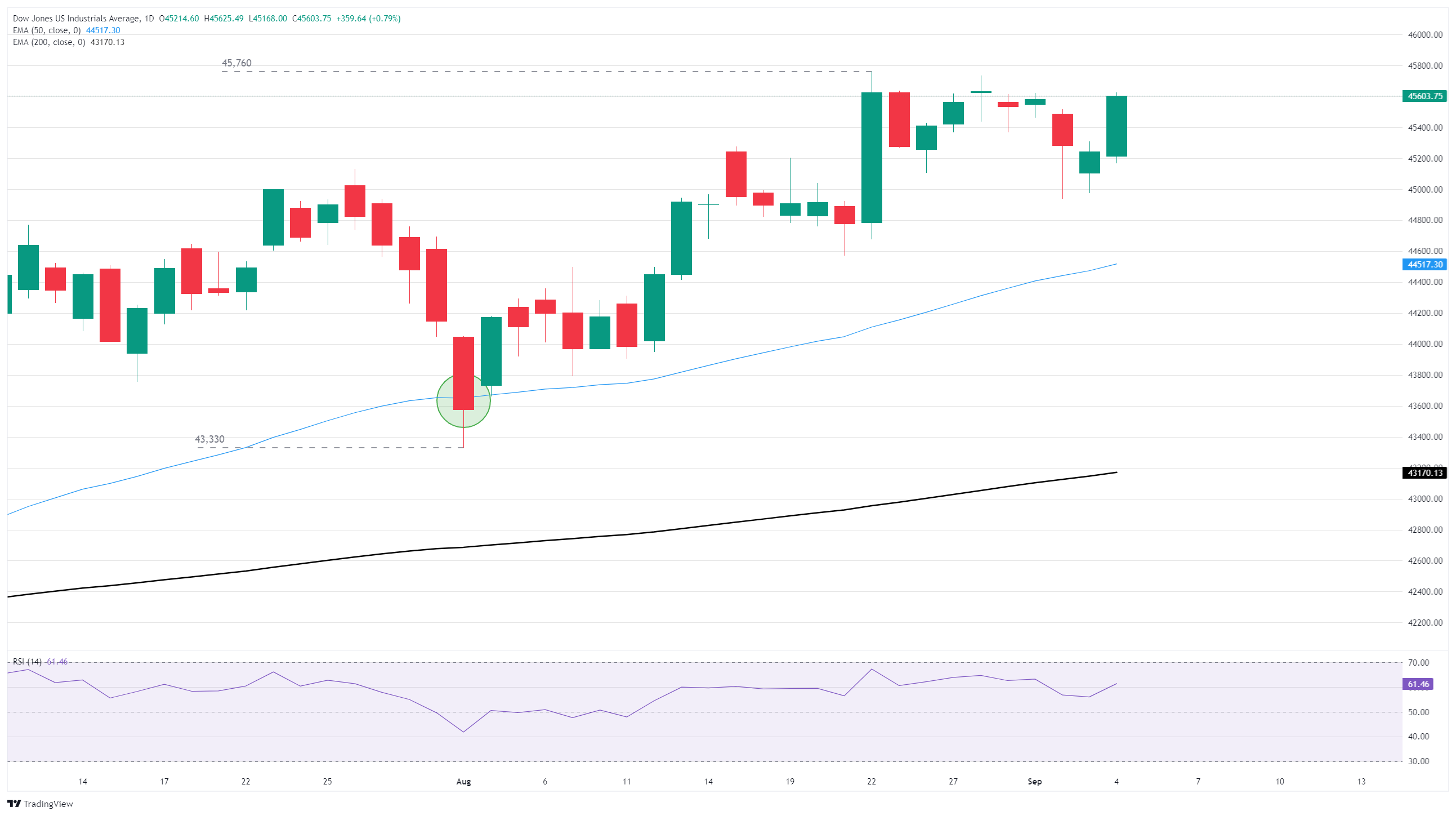
The Dow Jones still remains in the red for the week, but only slightly, within touch range of the week’s opening bids and trailing just behind the 45,600 level. The major index is poised for a fresh break toward new record highs above 45,760, but only if US Nonfarm Payrolls (NFP) data plays bullish ball on Friday.
ADP Employment Change numbers from August showed an even steeper slowdown in hiring than expected, clocking in at just 54K compared to the expected 65K and falling sharply from the previous 106K. Initial Jobless Claims also ticked higher, rising to 237K on a weekly basis, over and above the expected 230K, albeit slightly.
Markets find their Goldilocks data releases as ADP jobs decline, but PMIs climb
The Services Purchasing Managers Index (PMI) from the Institute for Supply Management (ISM) rose for a third straight month to 52.0 in August, adding further bullish support for equities on Thursday. Looking further into the report, overall firm responses were bullish on near-term activity outlooks because consumer demand remains steady, putting pressure on logistics and deliveries that are struggling to keep up.
However, the inventory sentiment segment showed a 28th consecutive month of expansion, implying that a lot of recent economic activity is owing to businesses hoping to fill warehouse space at the last minute before tariffs become a real problem. The backlog component also showed its lowest reading since mid-2009 as future orders dry up in the face of ongoing trade turmoil.
US wages and NFP net job additions are on the docket on Friday and will be drawing full-market attention for this iteration of the monthly figure. The NFP is expected to hold steady at 75K in August, a slight uptick from the previous month’s 73K. Softening US labor figures are viewed broadly as a requirement for the Federal Reserve (Fed) to resume cutting interest rates at its upcoming rate call on September 17, and investors are launching themselves into the bullish side ahead of Friday’s bumper employment report.
Dow Jones daily chart
Dow Jones FAQs
The Dow Jones Industrial Average, one of the oldest stock market indices in the world, is compiled of the 30 most traded stocks in the US. The index is price-weighted rather than weighted by capitalization. It is calculated by summing the prices of the constituent stocks and dividing them by a factor, currently 0.152. The index was founded by Charles Dow, who also founded the Wall Street Journal. In later years it has been criticized for not being broadly representative enough because it only tracks 30 conglomerates, unlike broader indices such as the S&P 500.
Many different factors drive the Dow Jones Industrial Average (DJIA). The aggregate performance of the component companies revealed in quarterly company earnings reports is the main one. US and global macroeconomic data also contributes as it impacts on investor sentiment. The level of interest rates, set by the Federal Reserve (Fed), also influences the DJIA as it affects the cost of credit, on which many corporations are heavily reliant. Therefore, inflation can be a major driver as well as other metrics which impact the Fed decisions.
Dow Theory is a method for identifying the primary trend of the stock market developed by Charles Dow. A key step is to compare the direction of the Dow Jones Industrial Average (DJIA) and the Dow Jones Transportation Average (DJTA) and only follow trends where both are moving in the same direction. Volume is a confirmatory criteria. The theory uses elements of peak and trough analysis. Dow’s theory posits three trend phases: accumulation, when smart money starts buying or selling; public participation, when the wider public joins in; and distribution, when the smart money exits.
There are a number of ways to trade the DJIA. One is to use ETFs which allow investors to trade the DJIA as a single security, rather than having to buy shares in all 30 constituent companies. A leading example is the SPDR Dow Jones Industrial Average ETF (DIA). DJIA futures contracts enable traders to speculate on the future value of the index and Options provide the right, but not the obligation, to buy or sell the index at a predetermined price in the future. Mutual funds enable investors to buy a share of a diversified portfolio of DJIA stocks thus providing exposure to the overall index.
Author

Joshua Gibson
FXStreet
Joshua joins the FXStreet team as an Economics and Finance double major from Vancouver Island University with twelve years' experience as an independent trader focusing on technical analysis.

















