Dow Jones Industrial Average holds steady as investors brace for Fed
- The Dow Jones remained largely unchanged on Monday following a rebalancing late last week.
- Equity markets are broadly gearing up for the wait to this week’s Fed rate call.
- An interest rate cut is priced in as a sure thing, with investors already looking ahead to more rate cuts.

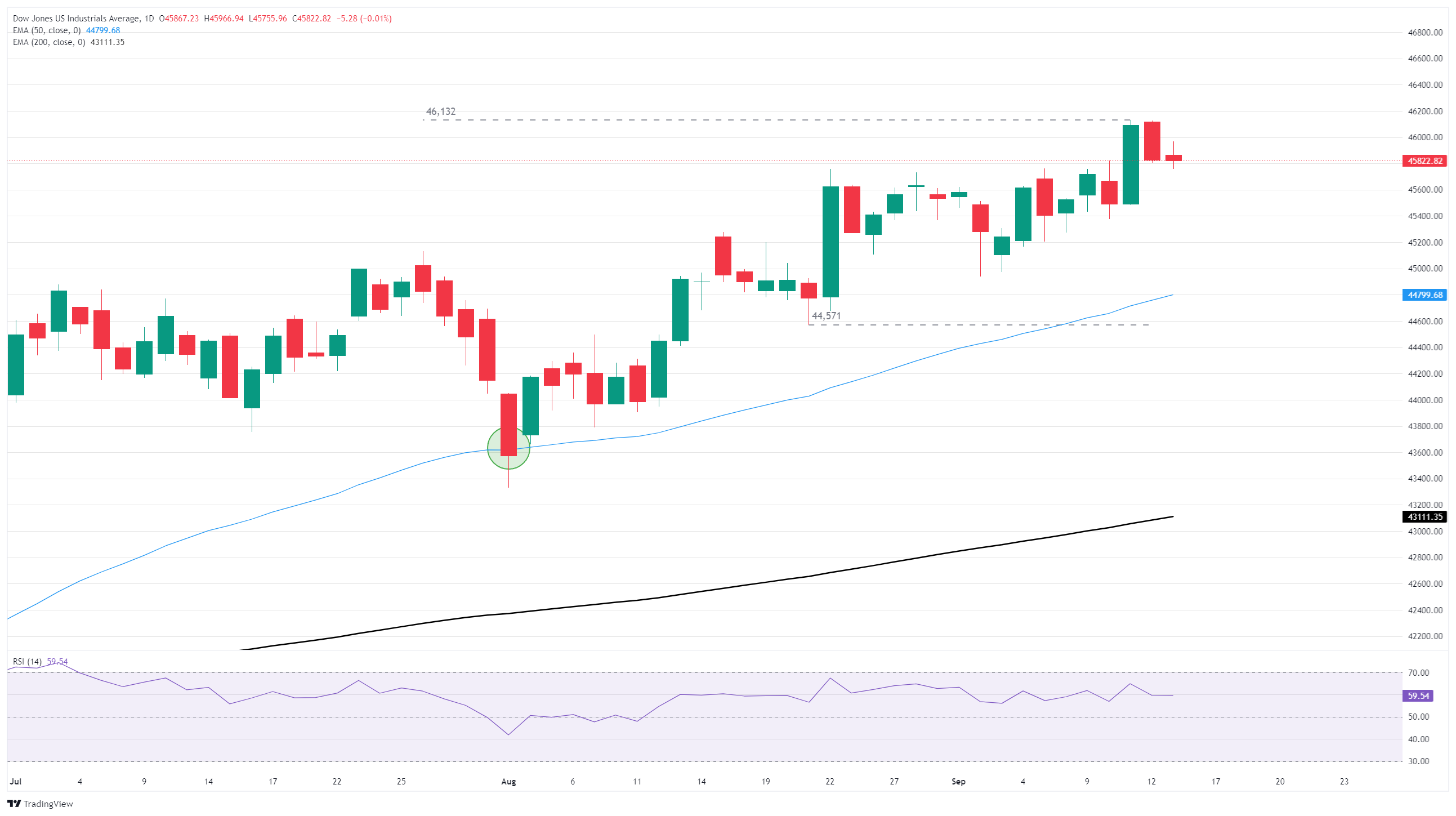
The Dow Jones Industrial Average (DJIA) stuck close to its opening bids on Monday, testing the waters near 45,860 as investors shuffle their feet ahead of the latest Federal Reserve (Fed) interest rate call slated for Wednesday. The Fed is fully expected to kick off another rate-cutting cycle on Wednesday.
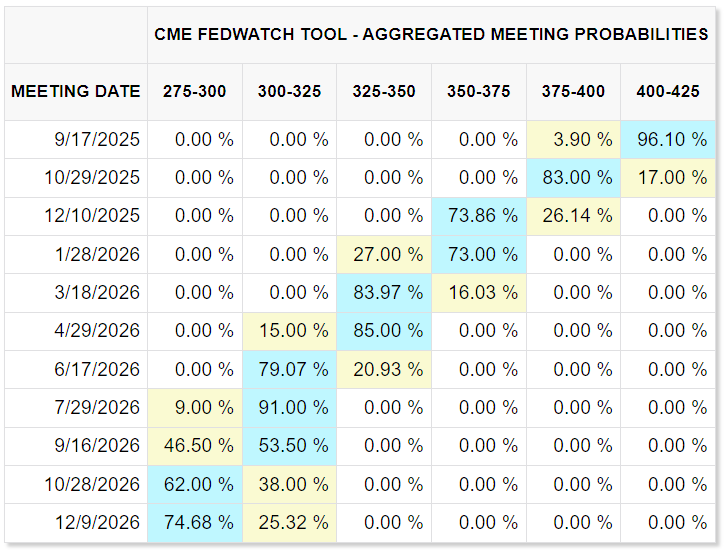
Traders will be looking to see if the Fed meets or exceeds market expectations for rate cuts through the remainder of the year when the Summary of Economic Projections (SEP), also known as the 'dot plot' of policymakers’ rate expectations, is also released during Wednesday’s rate call. Markets are betting that the Fed will deliver three rate cuts before the end of the year, with rate markets pricing in nearly 75% odds that the Fed will cut rates by 75 basis points before January, according to the CME’s FedWatch Tool.
Despite the market’s overall confidence that the Fed has finally been bullied into a fresh rate-trimming stance, investor apprehension is still on the rise, with markets piling into Gold ahead of the Fed’s key meeting. XAU/USD hit fresh all-time highs on Monday, tipping the scales toward $3,700 per ounce.
Read more Gold news: Gold hits $3,680, eyes $3,700 as Fed decision looms
US President Donald Trump declared that fresh trade talks between his administration and China are “going well” and teased that further progress had been made on a deal surrounding TikTok. Trump initially vowed to get TikTok outright banned in the US in 2020, citing privacy concerns and spying on US constituents by the Chinese government. Trump issued an executive order in August of 2020, demanding that ByteDance sell its stake in the online app to a US company, and has proceeded to routinely delay, suspend, and alter his own goalposts well into his second term.
US Retail Sales figures for August are due on Tuesday, but overall impacts are likely to be muted as markets keep both eyes locked on the Fed’s rate call on Wednesday. Monthly Retail Sales figures are expected to ease to 0.3% MoM from 0.5%. While markets are unlikely to react strongly, backsliding Retail Sales volumes will be the cherry on top of slumping jobs data and stubborn inflation metrics as recession fears continue to grow.
Read more stock news: Nvidia stock weakens at start of week as China applies pressure
Dow Jones daily chart
Fed FAQs
Monetary policy in the US is shaped by the Federal Reserve (Fed). The Fed has two mandates: to achieve price stability and foster full employment. Its primary tool to achieve these goals is by adjusting interest rates. When prices are rising too quickly and inflation is above the Fed’s 2% target, it raises interest rates, increasing borrowing costs throughout the economy. This results in a stronger US Dollar (USD) as it makes the US a more attractive place for international investors to park their money. When inflation falls below 2% or the Unemployment Rate is too high, the Fed may lower interest rates to encourage borrowing, which weighs on the Greenback.
The Federal Reserve (Fed) holds eight policy meetings a year, where the Federal Open Market Committee (FOMC) assesses economic conditions and makes monetary policy decisions. The FOMC is attended by twelve Fed officials – the seven members of the Board of Governors, the president of the Federal Reserve Bank of New York, and four of the remaining eleven regional Reserve Bank presidents, who serve one-year terms on a rotating basis.
In extreme situations, the Federal Reserve may resort to a policy named Quantitative Easing (QE). QE is the process by which the Fed substantially increases the flow of credit in a stuck financial system. It is a non-standard policy measure used during crises or when inflation is extremely low. It was the Fed’s weapon of choice during the Great Financial Crisis in 2008. It involves the Fed printing more Dollars and using them to buy high grade bonds from financial institutions. QE usually weakens the US Dollar.
Quantitative tightening (QT) is the reverse process of QE, whereby the Federal Reserve stops buying bonds from financial institutions and does not reinvest the principal from the bonds it holds maturing, to purchase new bonds. It is usually positive for the value of the US Dollar.
Author

Joshua Gibson
FXStreet
Joshua joins the FXStreet team as an Economics and Finance double major from Vancouver Island University with twelve years' experience as an independent trader focusing on technical analysis.

















