|

CSL Limited Elliott Wave technical forecast [Video]

ASX: CSL Elliott Wave technical analysis

Greetings, our Elliott Wave analysis today provides an update on the Australian Stock Exchange (ASX) featuring CSL LIMITED – CSL. According to our analysis, CSL may be advancing with wave ((iii)) - navy.

ASX: CSL Elliott Wave technical analysis one-day chart (Semilog Scale) analysis

  • Function: Major trend (Minute degree, navy).

  • Mode: Motive.

  • Structure: Impulse.

  • Position: Wave (3) - orange of Wave ((3)) - navy of Wave iii - gray of Wave ((iii)) - navy.

Details: Wave (3) - orange continues its upward momentum, targeting the 325.26 level. The price must stay above 294.81 to maintain this outlook.

Invalidation point: 294.81
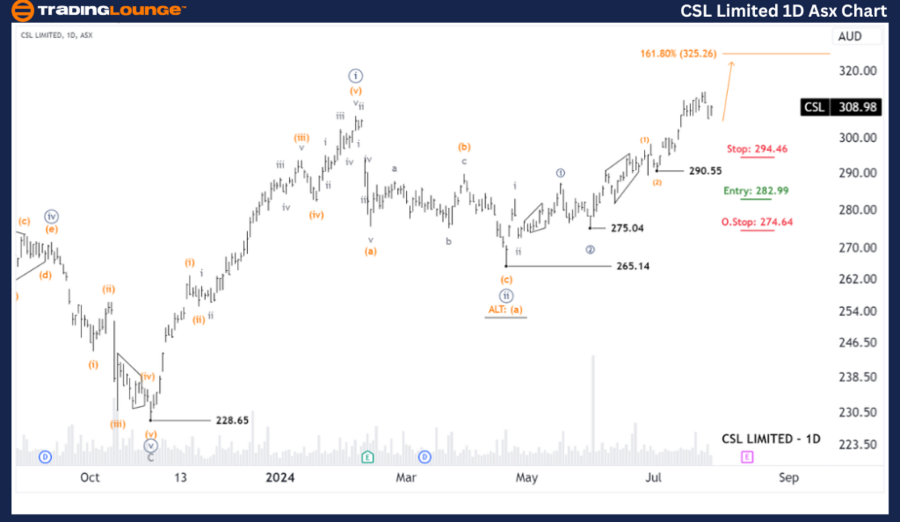
CSL

ASX: CSL Elliott Wave technical analysis four-hour chart analysis

  • Function: Major trend (Minuette degree, orange).

  • Mode: Motive.

  • Structure: Impulse.

  • Position: Wave (4) - orange of Wave ((3)) - navy of Wave iii - gray of Wave ((iii)) - navy.

Details: Wave (3) - orange is still expanding upwards, with a potential target of 325.26. The price should remain above 296.49 to sustain this analysis. The Long Trade position with CSL has yielded a good net profit and is expected to continue growing.

Invalidation point: 296.49
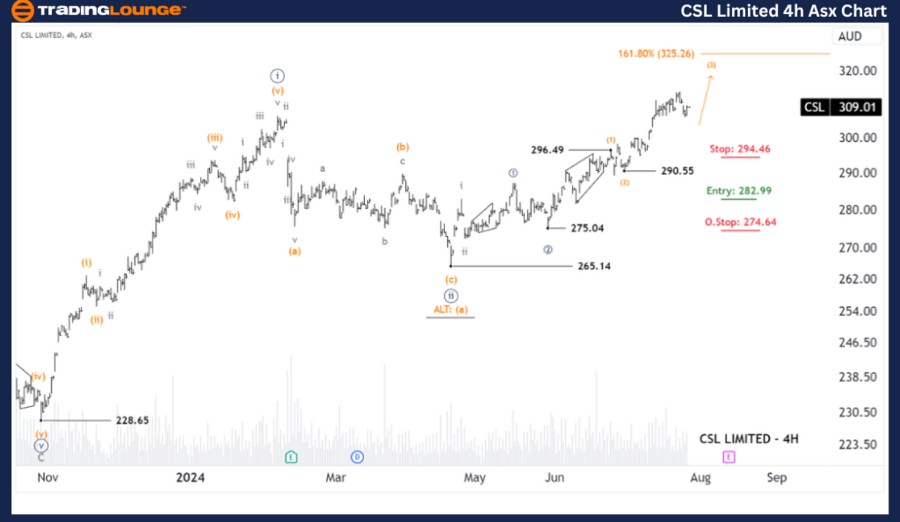
Chart

Conclusion: Our analysis, forecasting contextual trends, and short-term outlook for ASX: CSL LIMITED – CSL are designed to offer insights into current market trends and effective strategies for capitalizing on them. We provide specific price points as validation or invalidation signals for our wave count, which enhances the reliability of our perspective. By integrating these elements, we aim to deliver the most objective and professional view on market trends.

CSL Limited Elliott Wave technical forecast [Video]

Author

Peter Mathers

Peter Mathers

TradingLounge

Peter Mathers started actively trading in 1982. He began his career at Hoei and Shoin, a Japanese futures trading company.


More from Peter Mathers
Share:

Editor's Picks

AUD/USD bounces back toward 0.6950 on fresh USD supply

AUD/USD bounces back toward 0.6950 in the Asian session on Friday. The US Dollar retreats from 17-month highs as traders take profits off the table ahead of the all-important US Nonfarm Payrolls report. Meanwhile, the Australian Dollar draws support from reviving expectations of a November interest rate hike amid elevated global yields and inflation risks.


USD/JPY struggles near 158.00 as USD retreats ahead of NFP

USD/JPY is struggling for fresh impetus near 158.00, moving away from the top end of its weekly range in the Asian session on Friday, after hotter-than-expected Tokyo CPI and amid a broad US Dollar retreat. Traders reposition themselves ahead of US Nonfarm Payrolls.

Gold fades the earlier optimism; back below $4,200

Gold could not sustain the post-NFP bull run past the $4,200 mark per troy ounce, receding toward the $4,180 region at the end of the week. The precious metal’s inconclusive price action comes amid fresh selling pressure hurting the US Dollar as investors assess the latest NFP data.

Week ahead: Fed minutes in the spotlight amid bond market rout
The first full week of October and the final quarter of the year get underway with little fanfare in terms of the economic agenda. But far from being short on excitement, the coming week will test market nerves, as government bond yields continue to soar on growing worries that the energy crisis will only get worse, fuelling inflation.
CFTC Report: Speculators turn more defensive as Oil exposure falls
The week in one sentence: During the week leading up to September 29, long positions in crude oil were significantly reduced, while short positions in the Canadian Dollar went up. In addition, the positioning of the Australian Dollar and the Japanese Yen declined, while Coffee buying stood out against a more general background of defensiveness.
The Euro is near a one-year low: Inflation could trigger its rebound, not its fall

EUR/USD has fallen to its lowest level since May 2025. The pair hit 1.1312 on Wednesday and trades well below the January peak of 1.2082. The decline reflects a powerful combination of US Dollar strength, geopolitical uncertainty and renewed concerns about Europe's exposure to higher energy prices.