Crude Oil sticks to $70 with even commodity traders on edge of the upcoming Fed meeting
- Crude Oil flat while nervous traders look towards the Fed decision on interest rates on Wednesday.
- Overnight API US weekly crude oil stockpile data was a surprise build against all expectations.
- The US Dollar Index remains under pressure, trading at the lower boundary of September’s range.

Crude Oil edges lower and trades below $70.00 ahead of the US Federal Reserve (Fed) decision on interest rates later on Wednesday. Meanwhile, India’s government has removed the windfall tax on Crude Oil, Bloomberg reports. Additionally, despite expectations for a drawdown in the US weekly crude oil stockpile on the back of tropical storm Francine whipping out large portions of production in the US Gulf of Mexico, the overnight number from the American Petroleum Institute (API) was a build of 1.96 million barrels.
The focus on Wednesday will be on the Federal Reserve (Fed) interest rate decision. Market expectations are very split over the size of the initial rate cut, and investors wonder if the Fed will opt for a standard 25 basis points (bps) interest rate cut or 50 bps. The outcome later this Wednesday could be a volatile event.
At the time of writing, Crude Oil (WTI) trades at $69.68 and Brent Crude at $72.89.
Oil news and market movers: Thin margins hurt refiners
- Bloomberg reported that India had removed the windfall tax on Crude Oil effective Wednesday, according to a government notification. This comes after several producers already signalled to have financial issues, with two major refiners filing for bankruptcy in China on Tuesday, for example.
- Saipem has been awarded a new offshore contract worth approximately $2 billion for the development of the Marjan field in Saudi Arabia, according to a statement, Reuters reports.
- At 14:30 GMT, the Energy Information Administration (EIA) will release its weekly Crude Oil Stocks Change report. The expectation is a drawdown of 0.1 million barrels against the previous build of 0.833 million barrels.
Economic Indicator
EIA Crude Oil Stocks Change
The EIA Crude Oil stockpiles report is a weekly measure of the change in the number of barrels in stock of crude oil and its derivates, and it's released by the Energy Information Administration. This report tends to generate large price volatility, as oil prices impact on worldwide economies, affecting the most, commodity related currencies such as the Canadian dollar. Despite it has a limited impact among currencies, this report tends to affect the price of oil itself, and, therefore, had a more notorious impact on WTI crude futures.
Read more.Next release: Wed Sep 18, 2024 14:30
Frequency: Weekly
Consensus: -0.1M
Previous: 0.833M
Oil Technical Analysis: Devil will be in the detail
Crude Oil price will have several traders crossing their fingers, hoping the Fed will deliver a dovish message on Wednesday. A bigger 50 bps cut in borrowing costs and further rate cut projections in the Fed’s Summary of Economic Projections (SEP) will be perceived as oxygen for the much-battered Crude Oil price. Expect to see Crude Oil rally under the assumption that demand and growth will pick up again if the Fed delivers that ultra-dovish message without spooking the markets.
The first level to watch on the upside remains at $70.00 after it was tested on Tuesday but did not hold. Once a daily close above it, $71.46 returns to the table as the next level to look out for. Ultimately, a return to $75.27 is still possible but would likely come after a seismic shift in current balances.
On the other side, initial support should be very close, at $68.19, a triple bottom in the summer of 2023. Further down, the next level in line is $64.38, the low from March and May 2023. Should that level face a second test and snap, $61.65 becomes a target, with $60.00 as a psychologically big figure just below it, at least tempting to be tested.
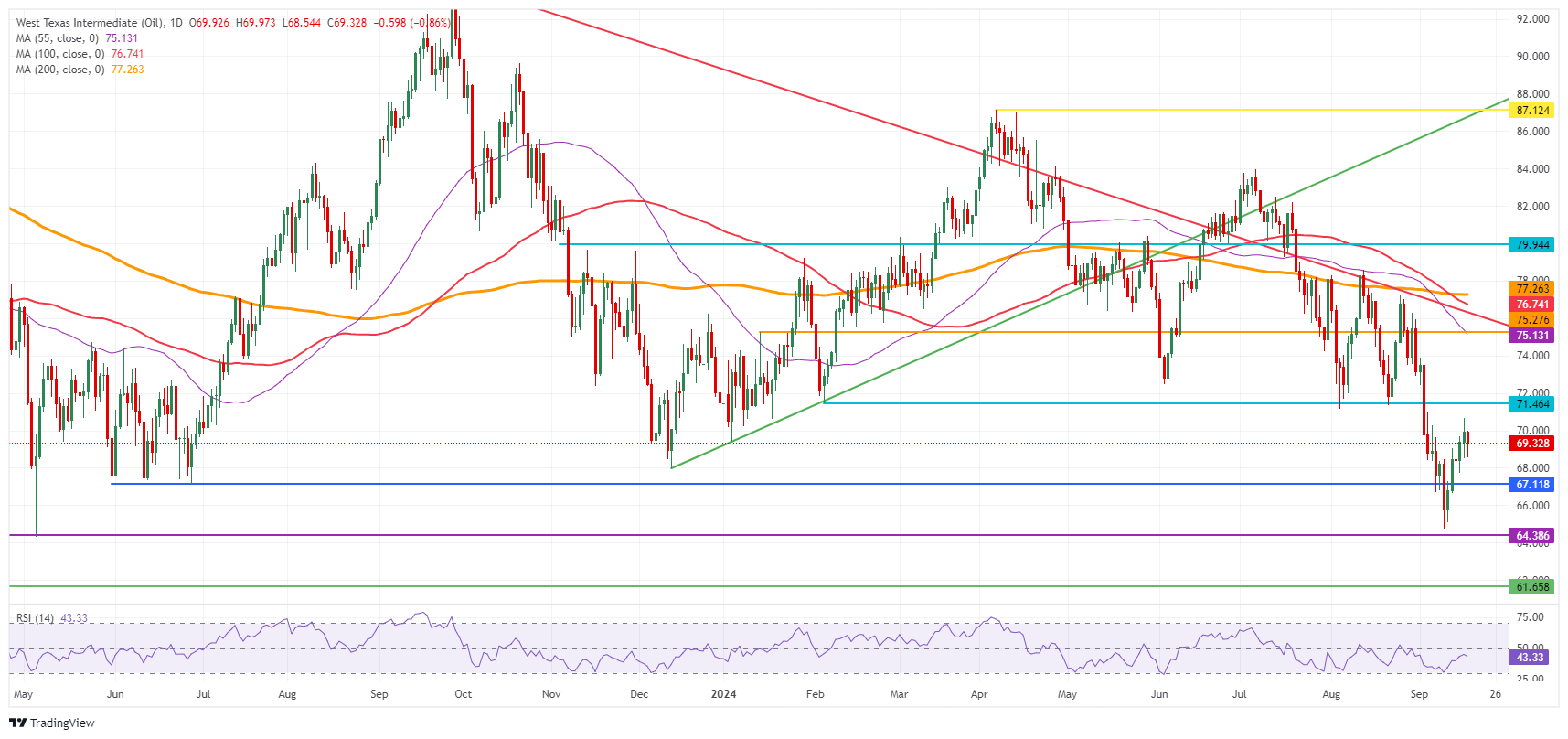
US WTI Crude Oil: Daily Chart
WTI Oil FAQs
WTI Oil is a type of Crude Oil sold on international markets. The WTI stands for West Texas Intermediate, one of three major types including Brent and Dubai Crude. WTI is also referred to as “light” and “sweet” because of its relatively low gravity and sulfur content respectively. It is considered a high quality Oil that is easily refined. It is sourced in the United States and distributed via the Cushing hub, which is considered “The Pipeline Crossroads of the World”. It is a benchmark for the Oil market and WTI price is frequently quoted in the media.
Like all assets, supply and demand are the key drivers of WTI Oil price. As such, global growth can be a driver of increased demand and vice versa for weak global growth. Political instability, wars, and sanctions can disrupt supply and impact prices. The decisions of OPEC, a group of major Oil-producing countries, is another key driver of price. The value of the US Dollar influences the price of WTI Crude Oil, since Oil is predominantly traded in US Dollars, thus a weaker US Dollar can make Oil more affordable and vice versa.
The weekly Oil inventory reports published by the American Petroleum Institute (API) and the Energy Information Agency (EIA) impact the price of WTI Oil. Changes in inventories reflect fluctuating supply and demand. If the data shows a drop in inventories it can indicate increased demand, pushing up Oil price. Higher inventories can reflect increased supply, pushing down prices. API’s report is published every Tuesday and EIA’s the day after. Their results are usually similar, falling within 1% of each other 75% of the time. The EIA data is considered more reliable, since it is a government agency.
OPEC (Organization of the Petroleum Exporting Countries) is a group of 13 Oil-producing nations who collectively decide production quotas for member countries at twice-yearly meetings. Their decisions often impact WTI Oil prices. When OPEC decides to lower quotas, it can tighten supply, pushing up Oil prices. When OPEC increases production, it has the opposite effect. OPEC+ refers to an expanded group that includes ten extra non-OPEC members, the most notable of which is Russia.
Author

Filip Lagaart
FXStreet
Filip Lagaart is a former sales/trader with over 15 years of financial markets expertise under its belt.