Chinese new year pivot: Is a reversal around the corner for HSI?


The Hang Seng Index (HSI) has been rallying hard since mid-2025, and perhaps now it’s time for the rally to reach its crescendo.
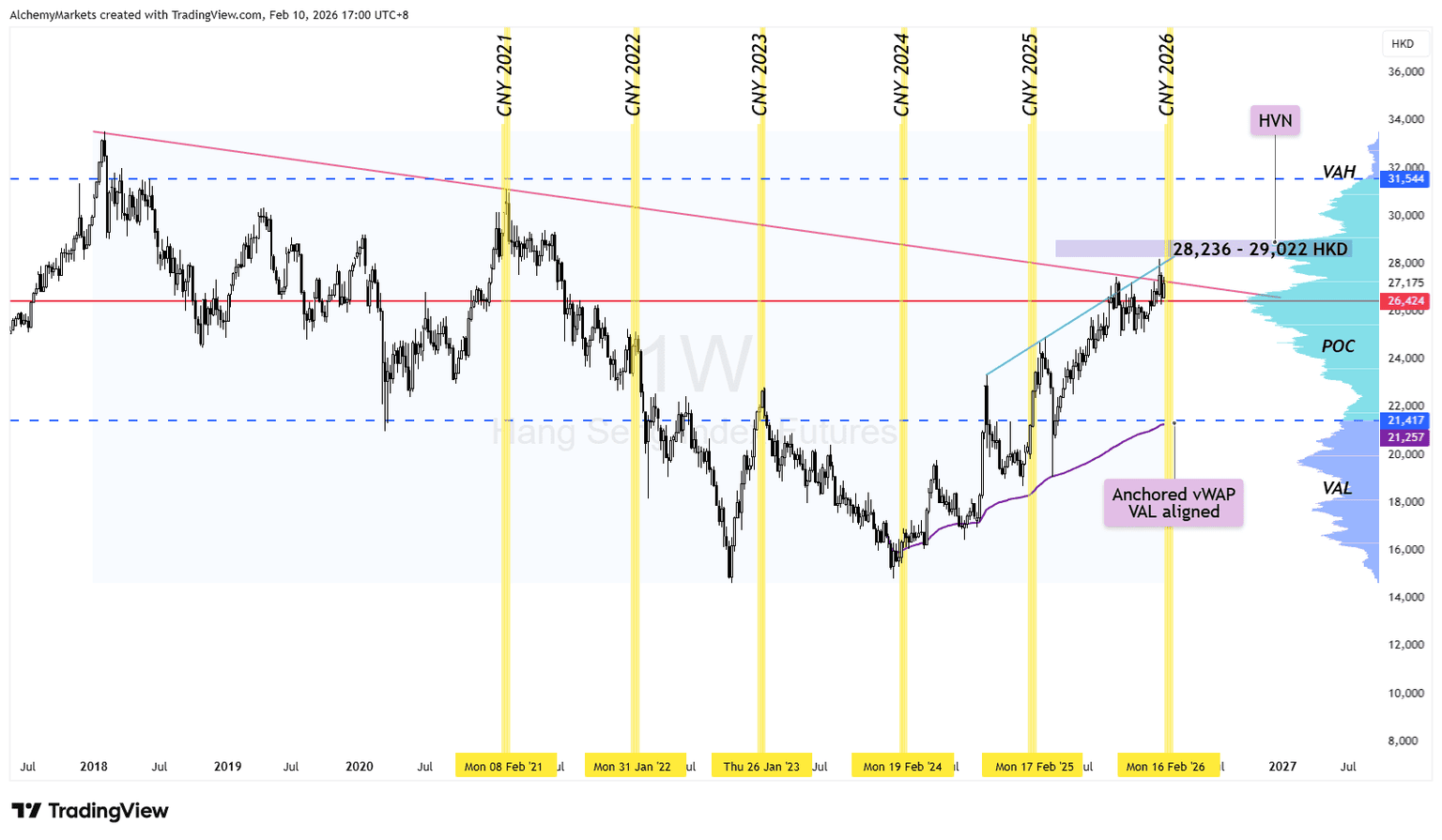
Looking back over the last five years, Chinese New Year has always preceded a significant pivot on the Hang Seng Index.
That alone does not mean Chinese New Year causes reversals… but it is worth mentioning that 4 out of the 5 last CNY celebrations marked the beginning of a significant pivot.
The market has repeatedly reached moments of reassessment around this period.
So now the core question is simple: Is the Hang Seng approaching another pivot as Chinese New Year approaches?
What this means heading into CNY 2026
The setup heading into Chinese New Year 2026 feels familiar. The Hang Seng has rallied strongly. Momentum remains positive, but the pace has slowed, and we are heading into clear overhead resistance (in a multiyear trendline).
This is the kind of environment where past pivots have tended to emerge. While an immediate reversal isn’t guaranteed, it does suggest that trend continuation becomes less forgiving.
We recommend watching how the CNY weekly candles develop; if the candlestick for CNY 2026 is bearish on the final week, or the week after. The likelihood for a bearish reversal increases.
Due to the historically large reversal nature of CNY, a target to watch would be $21,417 HKD. This is where the Value Area Low of the volume profile since 2018, and the anchored vWAP support from Feb 2024 aligns.
And what about the S&P 500?
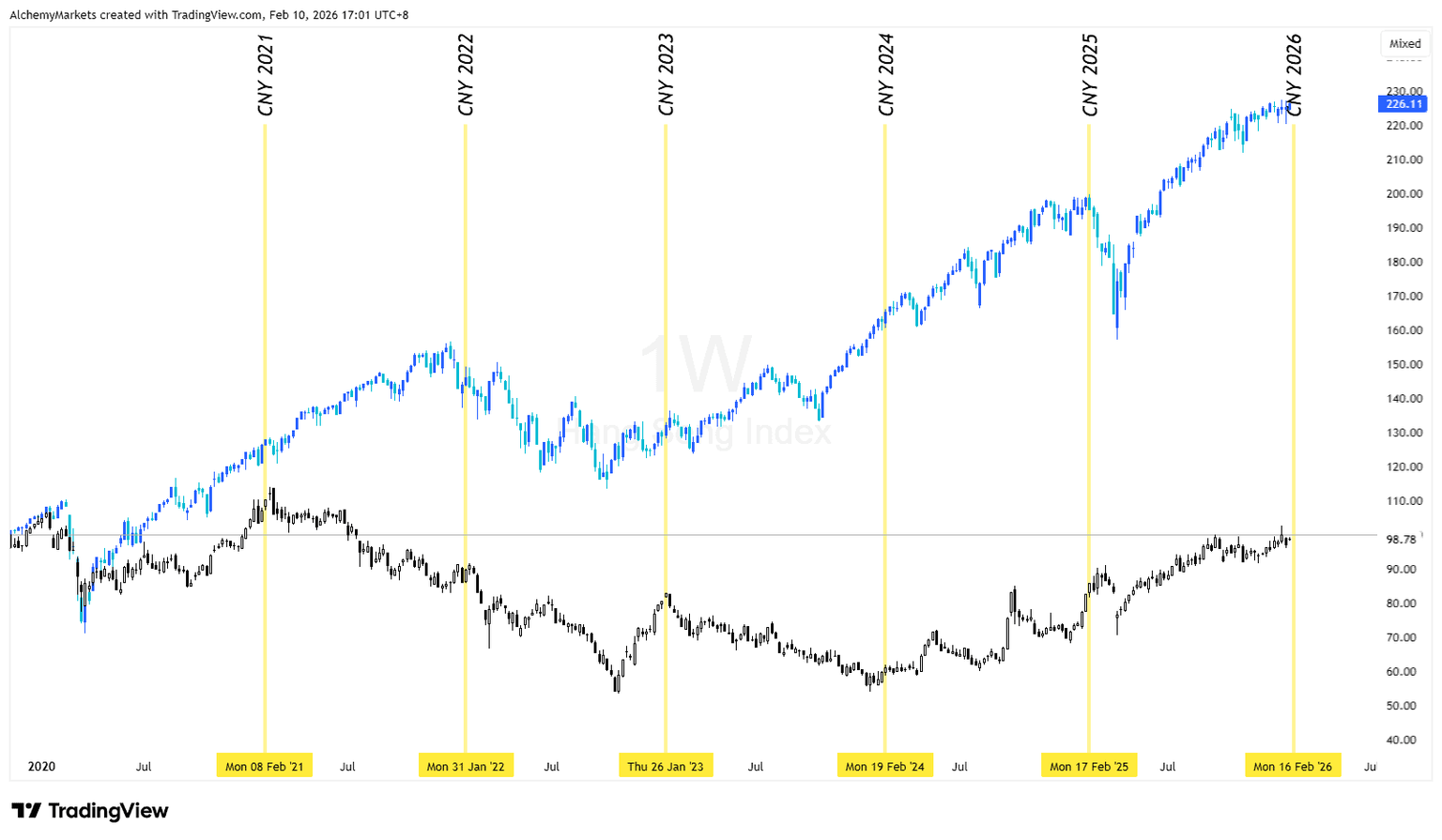
Looking at the chart, the relationship between the Hang Seng and the S&P 500 becomes clearer once we separate local pivots from global stress.
The black and white price action (HSI) shows pronounced pivots around each Chinese New Year. The blue line (SPX), however, behaves very differently depending on the underlying conditions.
When China risk was local, SPX barely reacted
In 2021, the Hang Seng rolled over sharply after Chinese New Year as regulatory pressure hit domestic technology firms. The SPX, shown in blue, continued higher with little interruption. The divergence is obvious on the chart.
This was a period where China risk was policy-driven and contained. It mattered deeply for Hong Kong equities, but it did not force US investors to reprice growth, earnings, or financial conditions.
A similar dynamic played out in 2024. The Hang Seng pivoted higher after Chinese New Year following policy support and liquidity measures. The SPX continued its own trend, largely unaffected. Again, China’s risk remained local.
When China risk became global, spillover appeared
The picture changes in 2022 and 2025.
In 2022, both the Hang Seng and the SPX weakened around the Chinese New Year period. This was not because of China alone, but because both markets were responding to shared macro pressure, tighter financial conditions, and rising geopolitical risk. The correlation increased, but only temporarily.
In 2025, the delayed Hang Seng reversal after Chinese New Year coincided with renewed trade and tariff tensions. This time, the SPX did react. The blue line softened as global growth expectations and trade-sensitive sectors came under pressure.
In these cases, the Hang Seng acted as a pressure gauge for China risk, and that pressure was no longer confined to domestic factors. Trade and technology conflict forced a broader repricing.
How the current setup compares
Heading into Chinese New Year 2026, the Hang Seng is extended after a strong rally, while the SPX remains near highs. However, the nature of China’s risk today looks closer to localised pressure than systemic stress.
That does not eliminate spillover risk to American markets, but it lowers the probability.
Author
Zorrays Junaid
Alchemy Markets
Zorrays Junaid has extensive combined experience in the financial markets as a portfolio manager and trading coach. More recently, he is an Analyst with Alchemy Markets, and has contributed to DailyFX and Elliott Wave Forecast in the past.