CAVA Group sits at all-time high ahead of Q1 earnings
- CAVA Group is a Mediterranean food chain that is growing its location base at breakneck speed.
- CAVA Group will release Q1 results after Tuesday's close.
- Wall Street expects $0.05 in adjusted EPS and $245.5 million in revenue.
- This compares with $0.03 in adjusted EPS in Q4 on revenue of $177.2 million.

CAVA Group (CAVA) is trading at an all-time high leading up to its earnings release, which is slated for the post-market on Tuesday, May 28.
Excitement surrounds the first-quarter results of the Mediterranean chain as it rapidly opens new locations throughout the US market. The company opened 90 net new establishments in the fourth quarter and is on pace to open approximately 50 more in 2024.
CAVA stock news
Wall Street is expecting CAVA Group to report $0.05 in adjusted earnings per share on revenue of $245.5 million. This amounts to a 66% quarterly rise for EPS and a 39% quarterly rise on revenue.
The number of net new restaurants will be high on the list of interests for those listening closely to the earnings call led by CEO Brett Schulman. Additionally, traders will focus on restaurant-level profit margin, which rose by 240 basis points to 22.4% of sales in the fourth quarter.
The quarter has received heightened interest as analysts heaped praise on the company since the last earnings call in February. Over the last three months, profit estimates have been revised upward five times, and no downward revisions were seen. Revenue estimates have seen nine upward revisions and one downward.
Argus got the ball rolling back in April when analyst Christine Dooley gave it a Buy rating and slapped a then impressive $70 price target on the recent IPO. Shares closed last Friday before the Memorial Day holiday just below $83 and advanced to $84 afterhours.
The company has a profitable business model, a clean balance sheet and an experienced management team," wrote Dooley at the time.
The main sticking point for buyers is its valuation however. CAVA stock trades at 356 times forward earnings. Dooley insists that these valuations are less significant near the beginning of a young chain’s growth spurt when earnings can shoot up overnight.
Interestingly, when UBS analysts covered the restaurant sector earlier this month, CAVA stock was rated as neutral in terms of momentum.
S&P 500 FAQs
The S&P 500 is a widely followed stock price index which measures the performance of 500 publicly owned companies, and is seen as a broad measure of the US stock market. Each company’s influence on the computation of the index is weighted based on market capitalization. This is calculated by multiplying the number of publicly traded shares of the company by the share price. The S&P 500 index has achieved impressive returns – $1.00 invested in 1970 would have yielded a return of almost $192.00 in 2022. The average annual return since its inception in 1957 has been 11.9%.
Companies are selected by committee, unlike some other indexes where they are included based on set rules. Still, they must meet certain eligibility criteria, the most important of which is market capitalization, which must be greater than or equal to $12.7 billion. Other criteria include liquidity, domicile, public float, sector, financial viability, length of time publicly traded, and representation of the industries in the economy of the United States. The nine largest companies in the index account for 27.8% of the market capitalization of the index.
There are a number of ways to trade the S&P 500. Most retail brokers and spread betting platforms allow traders to use Contracts for Difference (CFD) to place bets on the direction of the price. In addition, that can buy into Index, Mutual and Exchange Traded Funds (ETF) that track the price of the S&P 500. The most liquid of the ETFs is State Street Corporation’s SPY. The Chicago Mercantile Exchange (CME) offers futures contracts in the index and the Chicago Board of Options (CMOE) offers options as well as ETFs, inverse ETFs and leveraged ETFs.
Many different factors drive the S&P 500 but mainly it is the aggregate performance of the component companies revealed in their quarterly and annual company earnings reports. US and global macroeconomic data also contributes as it impacts on investor sentiment, which if positive drives gains. The level of interest rates, set by the Federal Reserve (Fed), also influences the S&P 500 as it affects the cost of credit, on which many corporations are heavily reliant. Therefore, inflation can be a major driver as well as other metrics which impact the Fed decisions.
CAVA stock forecast
Despite a nearly continuous rally since last October, CAVA stock sits just beneath the overbought condition on the Relative Strength Index (RSI) at 68. The Moving Average Convergence Divergence (MACD) indicator tells us that a bearish turnover is at hand, although an earnings spike would take that possibility off the table.
CAVA stock has been riding the 12-day Exponential Moving Average (EMA) for much of its recent run, but the 60-day EMA rode to the rescue during April's pullback.
If earnings turn out lacklustre, expect CAVA to find its footing near the 60-day EMA near $67. If earnings arrive better than expected, then CAVA could easily meet the low $90s for the first time.
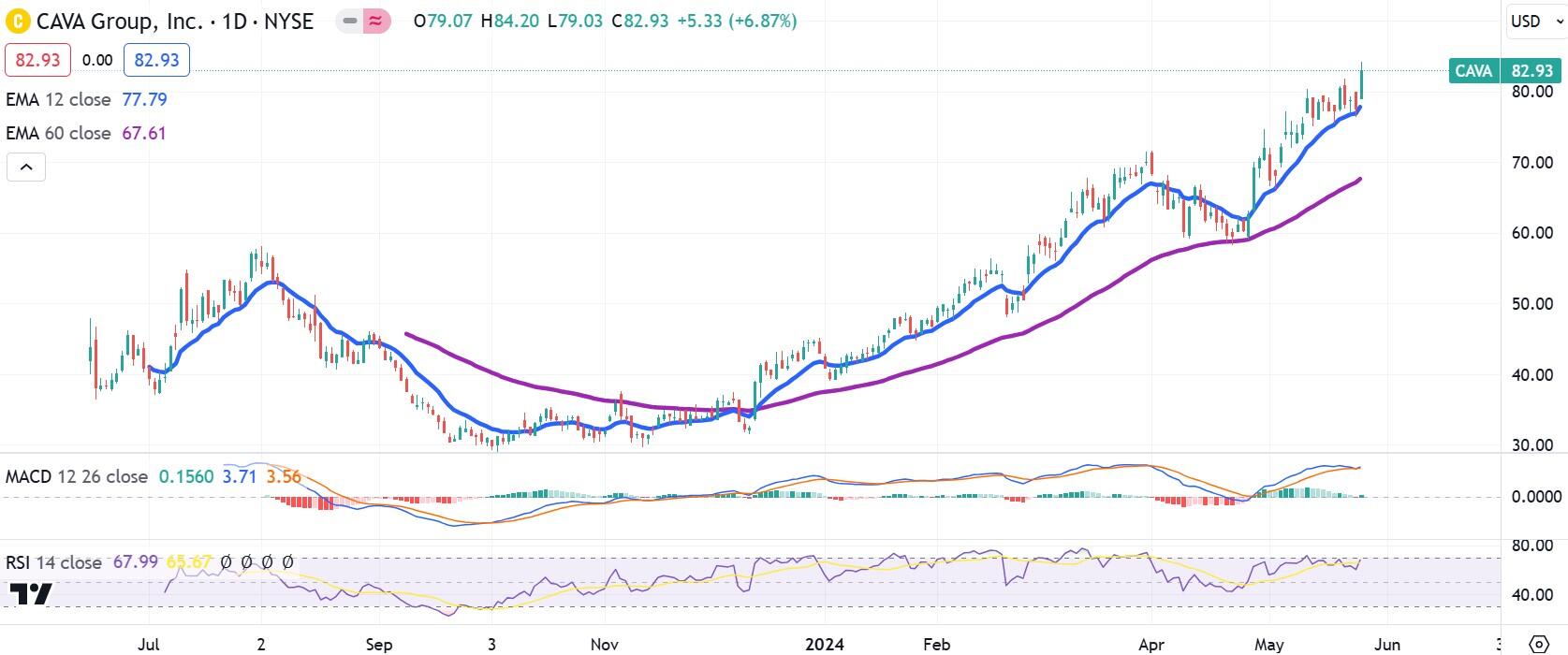
CAVA daily stock chart
Premium
You have reached your limit of 3 free articles for this month.
Start your subscription and get access to all our original articles.
Author
Clay Webster
FXStreet
Clay Webster grew up in the US outside Buffalo, New York and Lancaster, Pennsylvania. He began investing after college following the 2008 financial crisis.