Canadian Dollar retreats sharply on Thursday as trade deal hopes rule the markets
- The Canadian Dollar fell 0.66% against the Greenback on Thursday.
- Market sentiment has broadly bolstered the US Dollar as investors hope for trade deal progress.
- Tariffs still remain the front-and-center concern for traders, latching onto US-UK trade deal announcement.


The Canadian Dollar (CAD) hit a soft patch on Thursday, extending into a second straight day of losses as the US Dollar (USD) catches a broad bid on hopes that the Trump administration will pick up the pace of inking trade deals to subvert its own self-imposed trade tariffs. Details remain thin, and nothing has been formalized, but the announcement of a pending trade deal between the United States (US) and the United Kingdom (UK) has bolstered markets sentiment, boosting the Greenback across the board.
Trade tensions remain high between Canada and the US, and it appears unlikely that a quick pivot on tariffs between the two countries will happen quickly. The US is incredibly dependent on key imports from Canada, including assembled automobiles, automotive vehicle parts, light sweet Crude Oil from the Alberta oilsands, and critical crop fertilizers. 90% of the US’s potash supplies are imported, as the country is unable to produce enough to meet its internal demand.
Daily digest market movers: Canadian Dollar falls back on widespread market hopes for trade deals
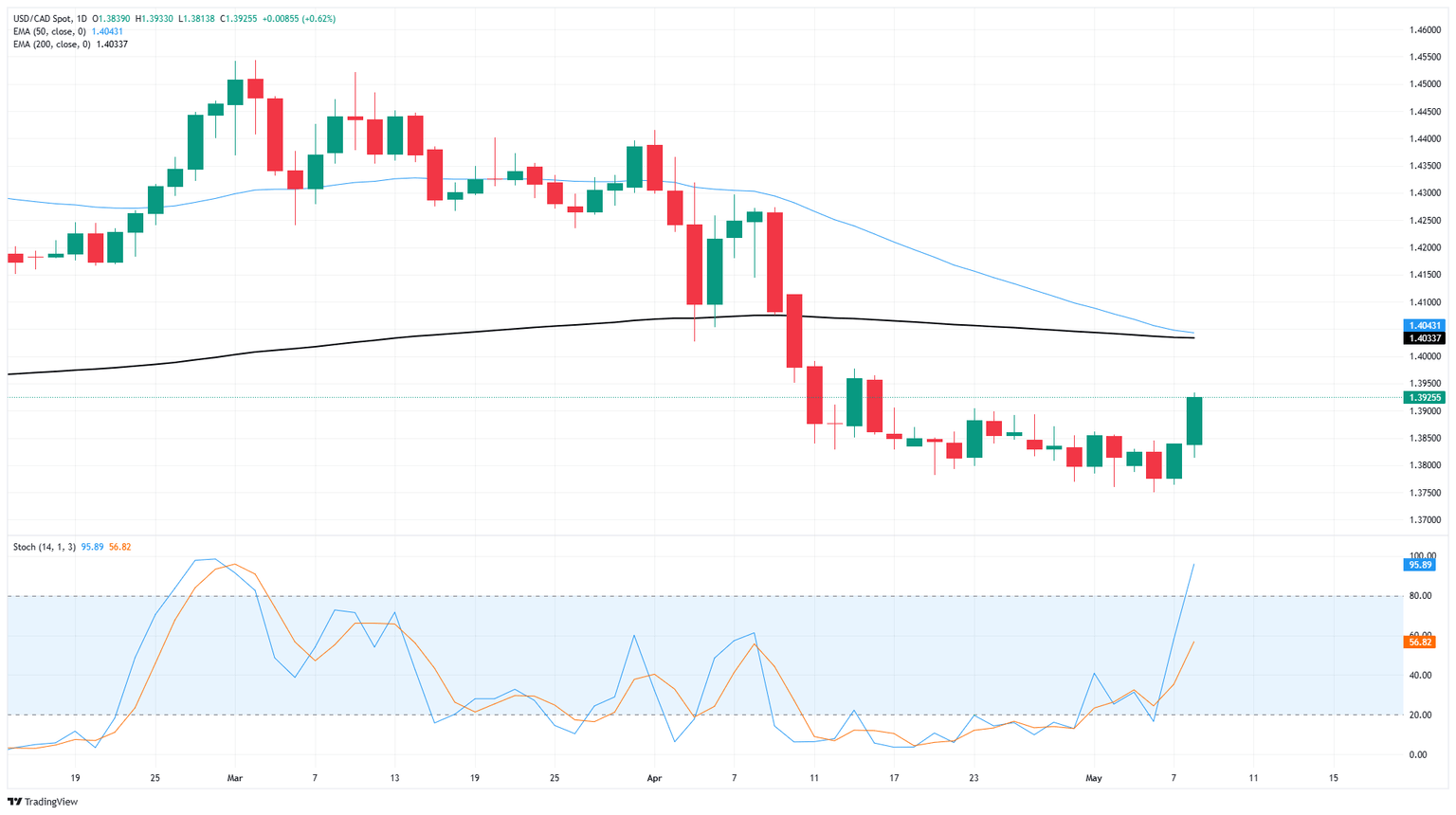
- The Loonie tumbled two-thirds of a percent against the US Dollar on Thursday, sending USD/CAD to a multi-week high near 1.3930.
- USD/CAD has gained 1.23% bottom-to-top over two days as market sentiment re-bids the Greenback.
- Nothing has been signed or formalized, and key details remain light, but the Trump administration scrambled over itself to announce a pending trade deal with the United Kingdom (UK) on Thursday, playing into market hopes that President Trump will find a way to avert his own self-imposed tariffs.
- The grace period on “reciprocal tariffs” runs out on June 9.
- Despite an impending trade deal, nearly all goods imported into the US from the UK will still be subject to 10% tariffs, and President Trump was quick to warn that other countries are unlikely to get as good a “deal” in future trade talks. This gives other countries little reason to continue approaching the negotiation table.
- Tariffs are being fully exempted on key UK goods, such as refined ethanol, which the US hasn’t imported from the UK in over 15 years.
Canadian Dollar price forecast
A two-day decline for the Canadian Dollar, driven largely by a broadbase recovery in Greenback bidding, has pushed USD/CAD back above the 1.3900 handle for the first time since early April. The US Dollar was badly beaten across the board after the Trump administration announced lopsided “reciprocal” tariffs across all of its trading partners, but USD/CAD has chalked in a rough technical floor near the 1.3800 region.
A continued technical recovery in USD/CAD still faces significant headwinds: the 200-day Exponential Moving Average (EMA) floats above near 1.4030. The 50-day EMA is poised to form a bearish cross, which could signal further long-term downside.
USD/CAD daily chart
Canadian Dollar FAQs
The key factors driving the Canadian Dollar (CAD) are the level of interest rates set by the Bank of Canada (BoC), the price of Oil, Canada’s largest export, the health of its economy, inflation and the Trade Balance, which is the difference between the value of Canada’s exports versus its imports. Other factors include market sentiment – whether investors are taking on more risky assets (risk-on) or seeking safe-havens (risk-off) – with risk-on being CAD-positive. As its largest trading partner, the health of the US economy is also a key factor influencing the Canadian Dollar.
The Bank of Canada (BoC) has a significant influence on the Canadian Dollar by setting the level of interest rates that banks can lend to one another. This influences the level of interest rates for everyone. The main goal of the BoC is to maintain inflation at 1-3% by adjusting interest rates up or down. Relatively higher interest rates tend to be positive for the CAD. The Bank of Canada can also use quantitative easing and tightening to influence credit conditions, with the former CAD-negative and the latter CAD-positive.
The price of Oil is a key factor impacting the value of the Canadian Dollar. Petroleum is Canada’s biggest export, so Oil price tends to have an immediate impact on the CAD value. Generally, if Oil price rises CAD also goes up, as aggregate demand for the currency increases. The opposite is the case if the price of Oil falls. Higher Oil prices also tend to result in a greater likelihood of a positive Trade Balance, which is also supportive of the CAD.
While inflation had always traditionally been thought of as a negative factor for a currency since it lowers the value of money, the opposite has actually been the case in modern times with the relaxation of cross-border capital controls. Higher inflation tends to lead central banks to put up interest rates which attracts more capital inflows from global investors seeking a lucrative place to keep their money. This increases demand for the local currency, which in Canada’s case is the Canadian Dollar.
Macroeconomic data releases gauge the health of the economy and can have an impact on the Canadian Dollar. Indicators such as GDP, Manufacturing and Services PMIs, employment, and consumer sentiment surveys can all influence the direction of the CAD. A strong economy is good for the Canadian Dollar. Not only does it attract more foreign investment but it may encourage the Bank of Canada to put up interest rates, leading to a stronger currency. If economic data is weak, however, the CAD is likely to fall.
Author
Joshua Gibson
FXStreet
Joshua joins the FXStreet team as an Economics and Finance double major from Vancouver Island University with twelve years' experience as an independent trader focusing on technical analysis.