Canadian Dollar remains struggles on the low end as rate cuts loom
- The Canadian Dollar went nowhere quickly on Monday.
- Looming Bank of Canada rate call keeps CAD markets tepid.
- Investor sentiment finds a fresh patch of concern about US CPI inflation update.
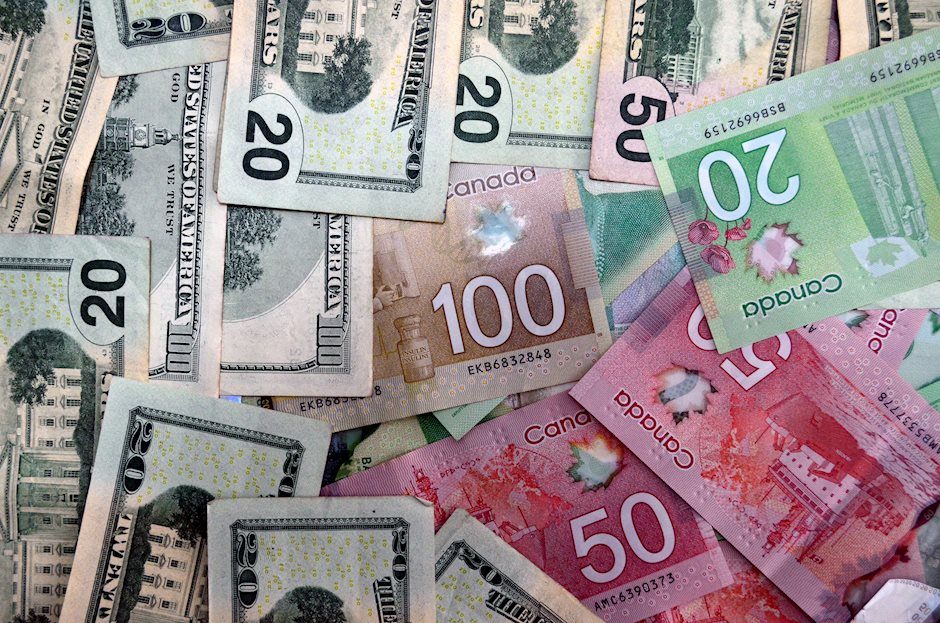

The Canadian Dollar (CAD) struggled to find direction on Monday, kicking off a new trading week digging in near familiar lows. Broad-market sentiment has fizzled as investors are bracing for an expected uptick in US Consumer Price Index (CPI) inflation figures due during the midweek market session, and an overall lack of Canadian representation on this week’s economic calendar leaves Loonie traders in the lurch.
The Bank of Canada (BoC) is slated to deliver its latest rate call on Wednesday, around the time that the US will be releasing its latest CPI inflation figures, which are expected to accelerate slightly. With knock-kneed economic figures coming out of Canada, the BoC is expected to accelerate its pace of rate cuts once again, despite growing potential for another uptick in inflation figures that have hampered the domestic economy.
Daily digest market movers: A quiet start to the week has traders looking ahead
- Markets are coiling ahead of a blustery midweek showing on the data docket.
- Data releases remain thin in the early week.
- The BoC is widely expected to deliver another double rate cut on Wednesday, forecast to trim its main reference rate to 3.25% from 3.75%.
- The US’ upcoming CPI print is expected to show headline consumer-level inflation rise back to 2.7% from 2.6% YoY.
- Core US CPI inflation is expected to hold steady at a heady 3.3% annually.
Canadian Dollar price forecast
The USD/CAD daily chart illustrates a strong uptrend that has been intact since mid-September, with the pair climbing steadily above its 200-day EMA at 1.3726 and the 50-day EMA at 1.3912. The bullish momentum gained traction as USD/CAD broke above the 1.4000 psychological level in late October, consolidating gains in November. The pair recently approached the critical resistance zone near 1.4170, where multiple highs were recorded, signaling an area of strong selling pressure. This level aligns closely with the July peak and remains a significant barrier for bulls.
The most recent candle reflects indecision, closing near 1.4157, with a slight bearish tilt after failing to sustain a breakout above the 1.4170 resistance. Despite reaching an intraday high of 1.4175, the inability to close above this critical level could indicate weakening bullish momentum in the near term. However, the fact that the pair remains well above its 50-day EMA suggests the uptrend is still intact, with support likely to emerge around the 1.4000 handle on any pullbacks. A daily close above 1.4170 would open the door for further upside, potentially targeting the 1.4250 region.
The MACD indicator reflects mild bullish momentum, with the MACD line hovering slightly above the signal line and the histogram showing minimal positive growth. This setup suggests that while buyers remain in control, momentum is not overwhelmingly strong. Traders should watch for a breakout confirmation above 1.4170 for renewed bullish confidence or a move below 1.4050 to signal the start of a corrective phase. The broader trend remains constructive as long as the pair stays above the 200-day EMA, but short-term consolidation cannot be ruled out.
USD/CAD daily chart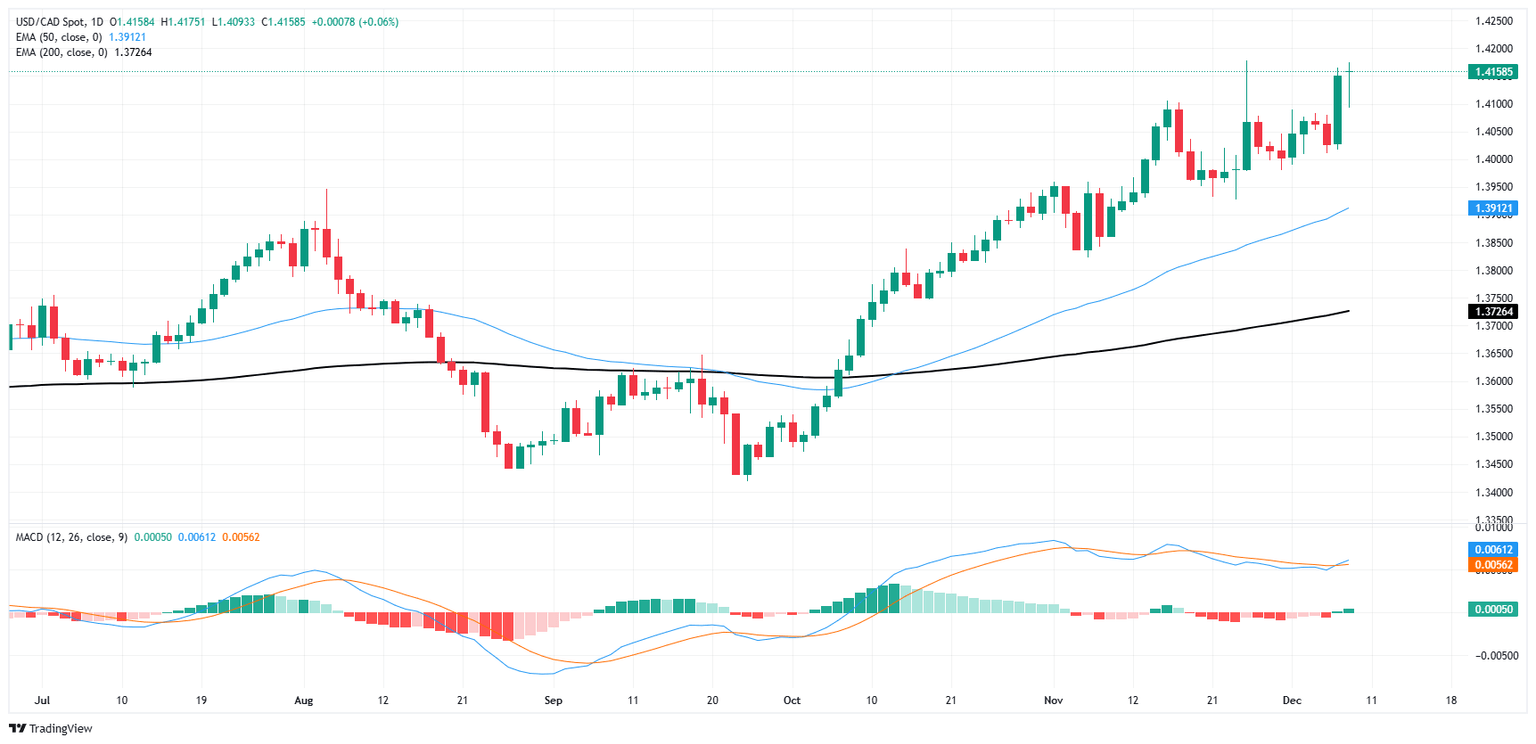
Canadian Dollar FAQs
The key factors driving the Canadian Dollar (CAD) are the level of interest rates set by the Bank of Canada (BoC), the price of Oil, Canada’s largest export, the health of its economy, inflation and the Trade Balance, which is the difference between the value of Canada’s exports versus its imports. Other factors include market sentiment – whether investors are taking on more risky assets (risk-on) or seeking safe-havens (risk-off) – with risk-on being CAD-positive. As its largest trading partner, the health of the US economy is also a key factor influencing the Canadian Dollar.
The Bank of Canada (BoC) has a significant influence on the Canadian Dollar by setting the level of interest rates that banks can lend to one another. This influences the level of interest rates for everyone. The main goal of the BoC is to maintain inflation at 1-3% by adjusting interest rates up or down. Relatively higher interest rates tend to be positive for the CAD. The Bank of Canada can also use quantitative easing and tightening to influence credit conditions, with the former CAD-negative and the latter CAD-positive.
The price of Oil is a key factor impacting the value of the Canadian Dollar. Petroleum is Canada’s biggest export, so Oil price tends to have an immediate impact on the CAD value. Generally, if Oil price rises CAD also goes up, as aggregate demand for the currency increases. The opposite is the case if the price of Oil falls. Higher Oil prices also tend to result in a greater likelihood of a positive Trade Balance, which is also supportive of the CAD.
While inflation had always traditionally been thought of as a negative factor for a currency since it lowers the value of money, the opposite has actually been the case in modern times with the relaxation of cross-border capital controls. Higher inflation tends to lead central banks to put up interest rates which attracts more capital inflows from global investors seeking a lucrative place to keep their money. This increases demand for the local currency, which in Canada’s case is the Canadian Dollar.
Macroeconomic data releases gauge the health of the economy and can have an impact on the Canadian Dollar. Indicators such as GDP, Manufacturing and Services PMIs, employment, and consumer sentiment surveys can all influence the direction of the CAD. A strong economy is good for the Canadian Dollar. Not only does it attract more foreign investment but it may encourage the Bank of Canada to put up interest rates, leading to a stronger currency. If economic data is weak, however, the CAD is likely to fall.
Economic Indicator
BoC Interest Rate Decision
The Bank of Canada (BoC) announces its interest rate decision at the end of its eight scheduled meetings per year. If the BoC believes inflation will be above target (hawkish), it will raise interest rates in order to bring it down. This is bullish for the CAD since higher interest rates attract greater inflows of foreign capital. Likewise, if the BoC sees inflation falling below target (dovish) it will lower interest rates in order to give the Canadian economy a boost in the hope inflation will rise back up. This is bearish for CAD since it detracts from foreign capital flowing into the country.
Read more.Next release: Wed Dec 11, 2024 14:45
Frequency: Irregular
Consensus: 3.25%
Previous: 3.75%
Source: Bank of Canada
Author
Joshua Gibson
FXStreet
Joshua joins the FXStreet team as an Economics and Finance double major from Vancouver Island University with twelve years' experience as an independent trader focusing on technical analysis.