Silver Price Forecast: XAG/USD recovers above $74.50 on safe-haven demand, FOMC Minutes loom
- Silver recovers to around $74.75 in Wednesday’s early European session, bolstered by safe-haven flows.
- Cooling US inflation in January fails to revive near-term rate-cut bets from the Federal Reserve.
- Investors await the FOMC Minutes and monitor US-Iran talks, both seen as potential sources of volatility.
Silver price (XAG/USD) rises to near $74.75 on Wednesday at the time of writing, up 1.90% on the day. The white metal rebounds amid persistent tensions between the United States (US) and Iran, which boost safe-haven demand. Iranian Foreign Minister Abbas Araqchi said on Tuesday that the US and Iran reached an understanding on main “guiding principles” in talks aimed at resolving their longstanding nuclear dispute, but that does not mean a deal is imminent.
US President Donald Trump has signaled that Iran will make a deal, while warning that the nation will face consequences if they don’t resolve issues.

However, the dovish Federal Reserve (Fed) expectations might cap the upside for the precious metal despite cooling US inflation in January. Theoretically, immaterial dovish Fed prospects in the near term weigh on non-yielding assets, such as Silver.
The data released on Friday showed that the US headline inflation dropped to 2.4% YoY from 2.7% in December. In the same period, the core Consumer Price Index (CPI) – which excludes volatile food and energy items – grew moderately by 2.5%, as expected, against the previous reading of 2.6%.
Meanwhile, investors brace for high volatility in the North American session as US markets will open after an extended weekend.
This week, the major trigger for the Silver price will be the release of Federal Open Market Committee (FOMC) minutes of the January policy meeting on Wednesday. In the meeting, the Federal Reserve left interest rates unchanged in the range of 3.50%-3.75%.
Silver technical analysis
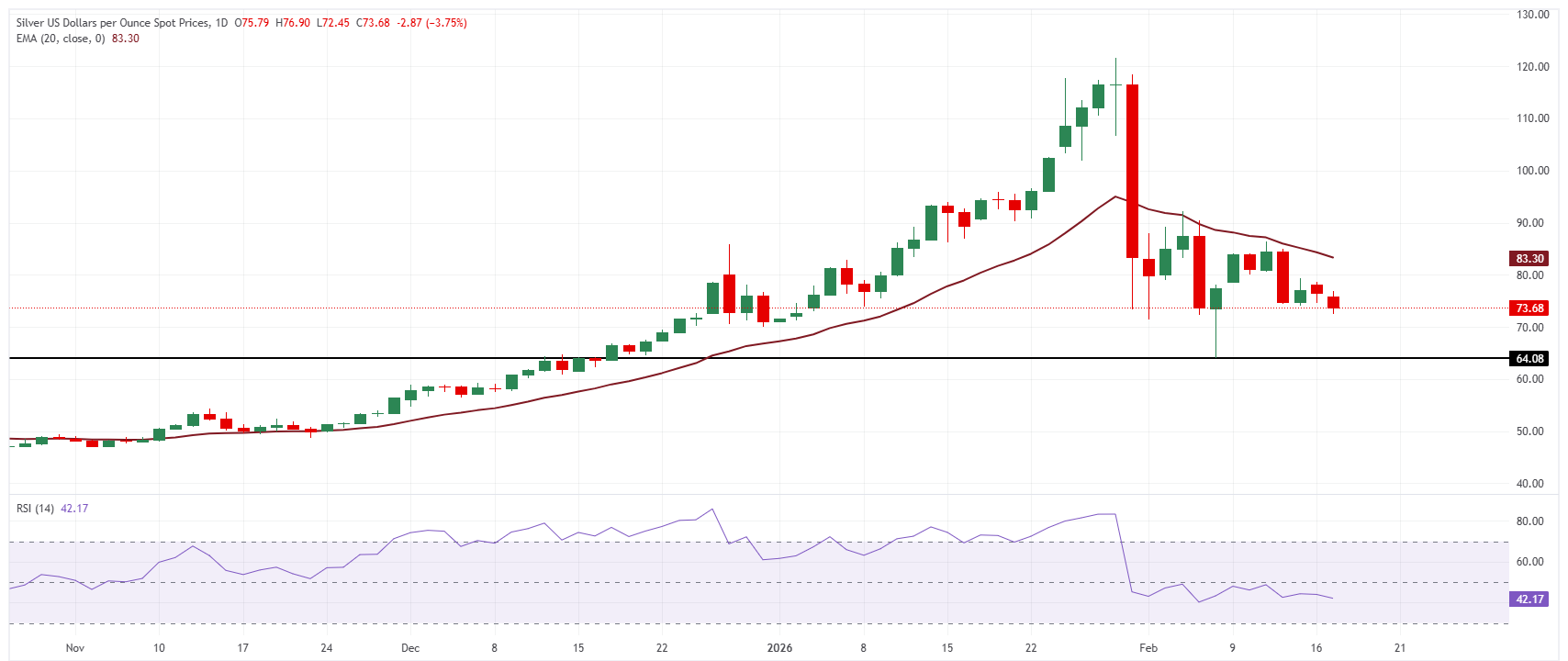
In the daily chart, XAG/USD trades at $73.68. The 20-day exponential moving average descends to $83.30, signaling a weakening short-term structure. Price holds below this gauge, keeping rebounds capped and leaving sellers in control. RSI (14) at 42.17 (neutral) stays under the midline, indicating momentum favors the downside without oversold conditions.
A daily close back above the falling 20-day EMA would ease immediate pressure and improve the near-term tone. Absent that, the path of least resistance remains lower, with failed bounces prone to being faded as the average continues to cap recovery attempts.
(The technical analysis of this story was written with the help of an AI tool.)
Risk sentiment FAQs
In the world of financial jargon the two widely used terms “risk-on” and “risk off'' refer to the level of risk that investors are willing to stomach during the period referenced. In a “risk-on” market, investors are optimistic about the future and more willing to buy risky assets. In a “risk-off” market investors start to ‘play it safe’ because they are worried about the future, and therefore buy less risky assets that are more certain of bringing a return, even if it is relatively modest.
Typically, during periods of “risk-on”, stock markets will rise, most commodities – except Gold – will also gain in value, since they benefit from a positive growth outlook. The currencies of nations that are heavy commodity exporters strengthen because of increased demand, and Cryptocurrencies rise. In a “risk-off” market, Bonds go up – especially major government Bonds – Gold shines, and safe-haven currencies such as the Japanese Yen, Swiss Franc and US Dollar all benefit.
The Australian Dollar (AUD), the Canadian Dollar (CAD), the New Zealand Dollar (NZD) and minor FX like the Ruble (RUB) and the South African Rand (ZAR), all tend to rise in markets that are “risk-on”. This is because the economies of these currencies are heavily reliant on commodity exports for growth, and commodities tend to rise in price during risk-on periods. This is because investors foresee greater demand for raw materials in the future due to heightened economic activity.
The major currencies that tend to rise during periods of “risk-off” are the US Dollar (USD), the Japanese Yen (JPY) and the Swiss Franc (CHF). The US Dollar, because it is the world’s reserve currency, and because in times of crisis investors buy US government debt, which is seen as safe because the largest economy in the world is unlikely to default. The Yen, from increased demand for Japanese government bonds, because a high proportion are held by domestic investors who are unlikely to dump them – even in a crisis. The Swiss Franc, because strict Swiss banking laws offer investors enhanced capital protection.
Author

Ghiles Guezout
FXStreet
Ghiles Guezout is a Market Analyst with a strong background in stock market investments, trading, and cryptocurrencies. He combines fundamental and technical analysis skills to identify market opportunities.