Canadian Dollar grinds out Monday gains amidst quiet start to the week
- Canadian Dollar found room up top, bolstered by floundering Greenback.
- Canada to deliver update on CPI inflation on Tuesday.
- Risk appetite remains subdued as markets await signs of rate cuts.

The Canadian Dollar (CAD) found some room on the high side on Monday, easing higher as the US Dollar softly receded across the board. Investors have little meaningful information to chew on to kick off the new trading week, leaving market sentiment adrift.
Canada will deliver an update on Canadian Consumer Price Index (CPI) inflation on Tuesday. Outside of Friday’s upcoming Canadian Gross Domestic Product (GDP) print, this week's agenda includes little else, save for a Monday appearance from Bank of Canada (BoC) Governor Tiff Macklem. USD traders will also have a long wait for US Durable Goods Orders and US Personal Consumption Expenditures (PCE) Price Index, both of which are due on Friday.
Daily digest market movers: Thin Monday leaves Canadian Dollar to drift higher
- Canadian Dollar is broadly higher on Monday, but gains remain thin. The CAD is up a third of a percent against the US Dollar, while shedding one-tenth of one percent against the Euro.
- Canada’s Tuesday CPI print will be the key release for CAD traders this week, with Canadian GDP far off in the distance.
- Canada’s CPI inflation is expected to tick lower to 2.6% from 2.7% for the year ended in May.
- BoC’s own CPI core inflation metric is forecast to hold flat at 0.2% MoM.
- Broad-market focus will be looking ahead to Friday’s US PCE Price Index inflation print as investors continue to cling to hopes for a September rate cut from the Federal Reserve (Fed).
- BoC's Macklem: Signs of financial stress are particularly evident, but inflation heading lower
Canadian Dollar PRICE Today
The table below shows the percentage change of Canadian Dollar (CAD) against listed major currencies today. Canadian Dollar was the strongest against the US Dollar.
| USD | EUR | GBP | JPY | CAD | AUD | NZD | CHF | |
|---|---|---|---|---|---|---|---|---|
| USD | -0.39% | -0.35% | -0.11% | -0.29% | -0.28% | -0.18% | -0.05% | |
| EUR | 0.39% | 0.06% | 0.34% | 0.15% | 0.13% | 0.27% | 0.42% | |
| GBP | 0.35% | -0.06% | 0.24% | 0.08% | 0.06% | 0.20% | 0.34% | |
| JPY | 0.11% | -0.34% | -0.24% | -0.17% | -0.14% | -0.03% | 0.04% | |
| CAD | 0.29% | -0.15% | -0.08% | 0.17% | 0.02% | 0.11% | 0.25% | |
| AUD | 0.28% | -0.13% | -0.06% | 0.14% | -0.02% | 0.13% | 0.27% | |
| NZD | 0.18% | -0.27% | -0.20% | 0.03% | -0.11% | -0.13% | 0.13% | |
| CHF | 0.05% | -0.42% | -0.34% | -0.04% | -0.25% | -0.27% | -0.13% |
The heat map shows percentage changes of major currencies against each other. The base currency is picked from the left column, while the quote currency is picked from the top row. For example, if you pick the Canadian Dollar from the left column and move along the horizontal line to the US Dollar, the percentage change displayed in the box will represent CAD (base)/USD (quote).
Technical analysis: Canadian Dollar finds fresh highs against Greenback on thin Monday
The Canadian Dollar (CAD) found a bid on Monday as the US Dollar eased into the low end. The CAD is extending a recent bout of strength against the Greenback, clipping into a fresh three-week high against the USD and dragging the USD/CAD pair toward 1.3650.
USD/CAD has closed in the red for all but two of the last ten consecutive trading days and is on pace to extend into another bearish candle as bids fall below the 50-day Exponential Moving Average (EMA) at 1.3675. Long-term technical support sits at the 200-day EMA, which is rising into the 1.3600 handle.
USD/CAD hourly chart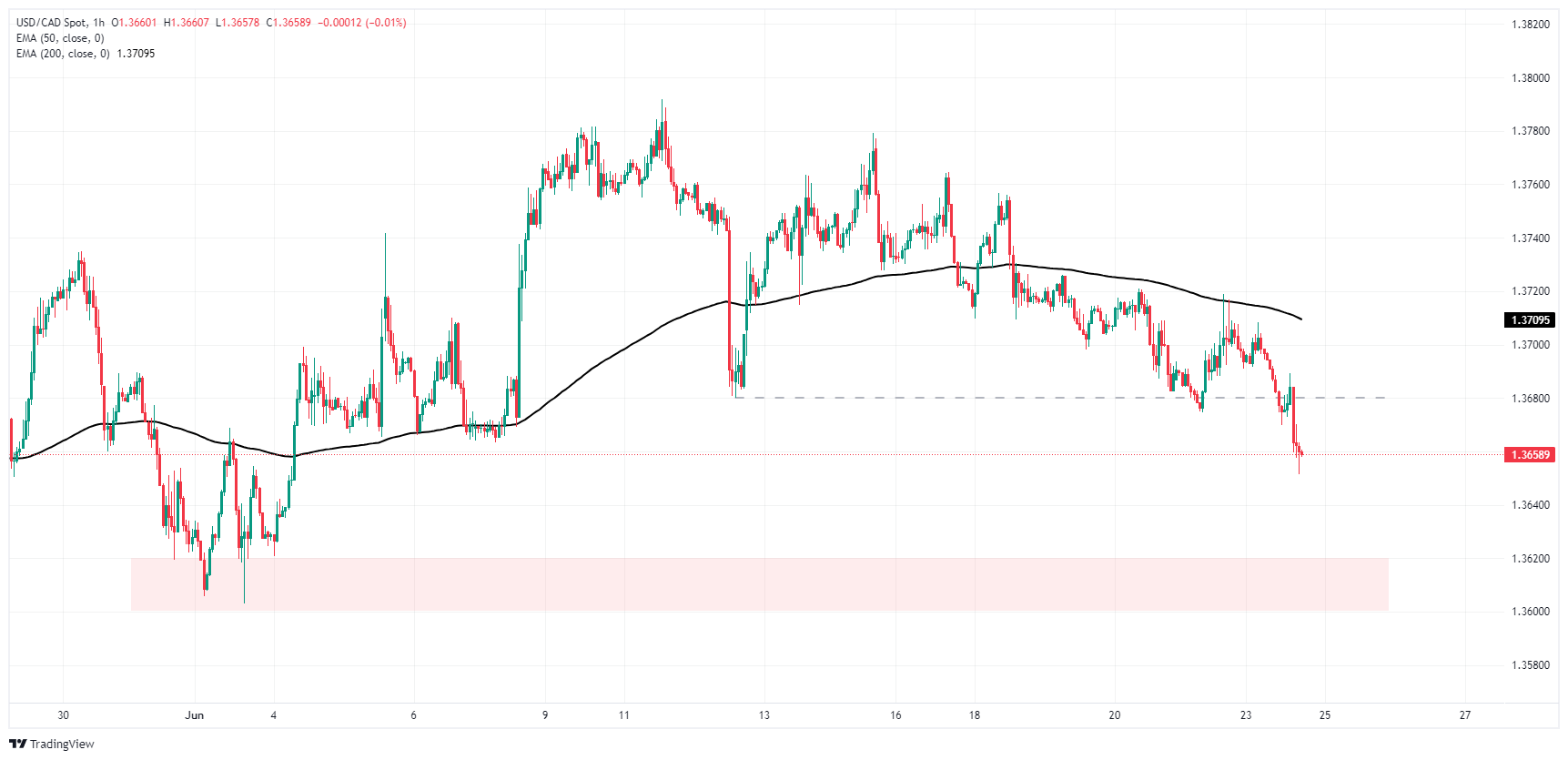
USD/CAD daily chart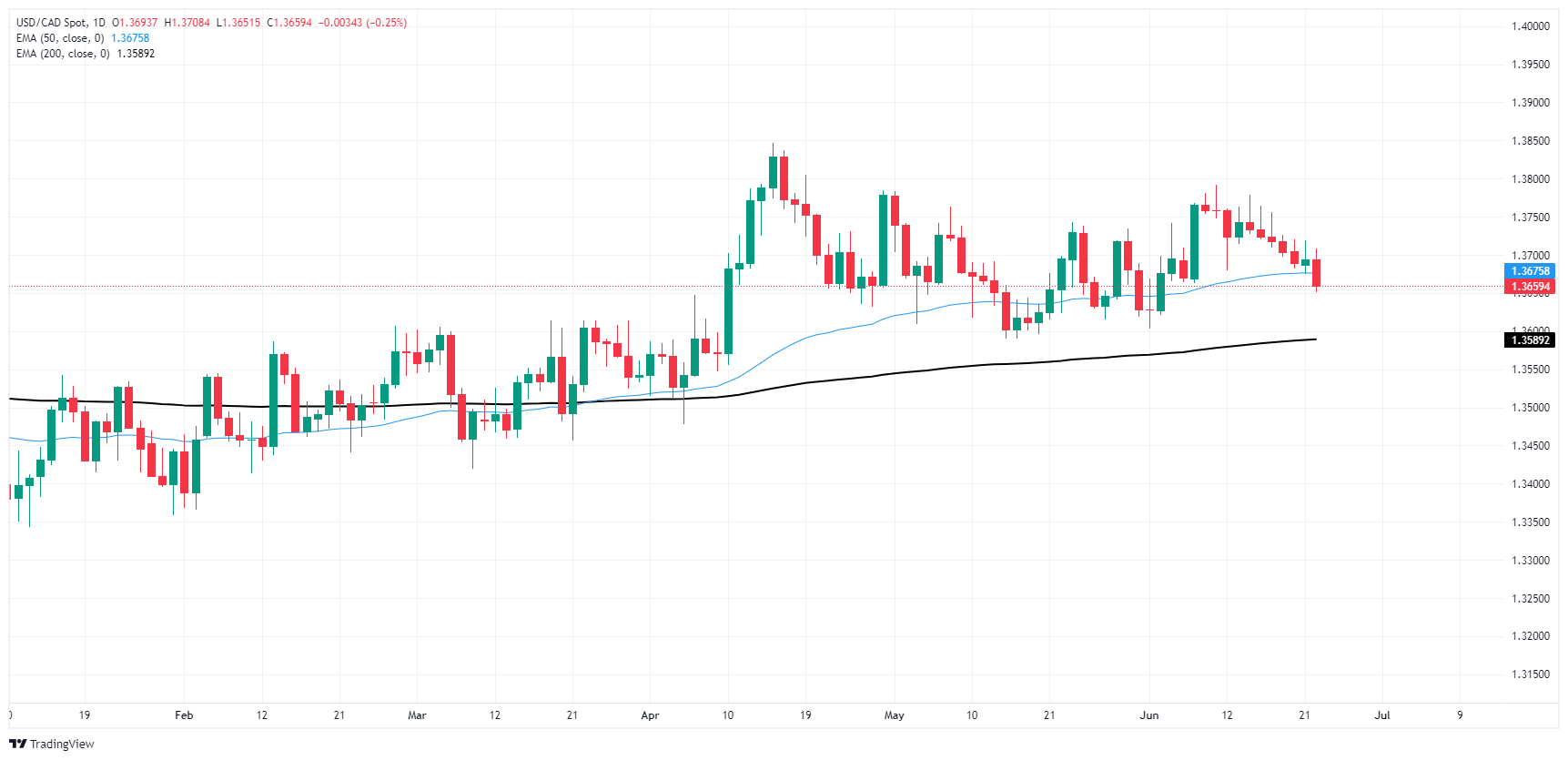
Bank of Canada FAQs
The Bank of Canada (BoC), based in Ottawa, is the institution that sets interest rates and manages monetary policy for Canada. It does so at eight scheduled meetings a year and ad hoc emergency meetings that are held as required. The BoC primary mandate is to maintain price stability, which means keeping inflation at between 1-3%. Its main tool for achieving this is by raising or lowering interest rates. Relatively high interest rates will usually result in a stronger Canadian Dollar (CAD) and vice versa. Other tools used include quantitative easing and tightening.
In extreme situations, the Bank of Canada can enact a policy tool called Quantitative Easing. QE is the process by which the BoC prints Canadian Dollars for the purpose of buying assets – usually government or corporate bonds – from financial institutions. QE usually results in a weaker CAD. QE is a last resort when simply lowering interest rates is unlikely to achieve the objective of price stability. The Bank of Canada used the measure during the Great Financial Crisis of 2009-11 when credit froze after banks lost faith in each other’s ability to repay debts.
Quantitative tightening (QT) is the reverse of QE. It is undertaken after QE when an economic recovery is underway and inflation starts rising. Whilst in QE the Bank of Canada purchases government and corporate bonds from financial institutions to provide them with liquidity, in QT the BoC stops buying more assets, and stops reinvesting the principal maturing on the bonds it already holds. It is usually positive (or bullish) for the Canadian Dollar.
Author

Joshua Gibson
FXStreet
Joshua joins the FXStreet team as an Economics and Finance double major from Vancouver Island University with twelve years' experience as an independent trader focusing on technical analysis.