|

Breaking: EUR/USD jumps above 1.08 as German Manufacturing PMI beats with 47.8

Markit's German Manufacturing PMI for February beat estimates with a score of 47.8 points, far above 44.8 expected and 45.3 recorded in January. The score remains below 50 – reflecting ongoing albeit slower contraction in the eurozone's largest economy's industrial sector. Nevertheless, the rise from the lows – despite growing fears of the coronavirus disease – is boosting the euro.

The services PMI dropped to 53.3 points, below 53.8 estimated by economists. These forward-looking surveys have been showing a significant gap between the sectors for a considerable time. Markit has noted that the outbreak is having a faily limited impact on the manufacturing sector. 

EUR/USD has jumped to 1.0818, advancing from a daily low of 1.0783. 
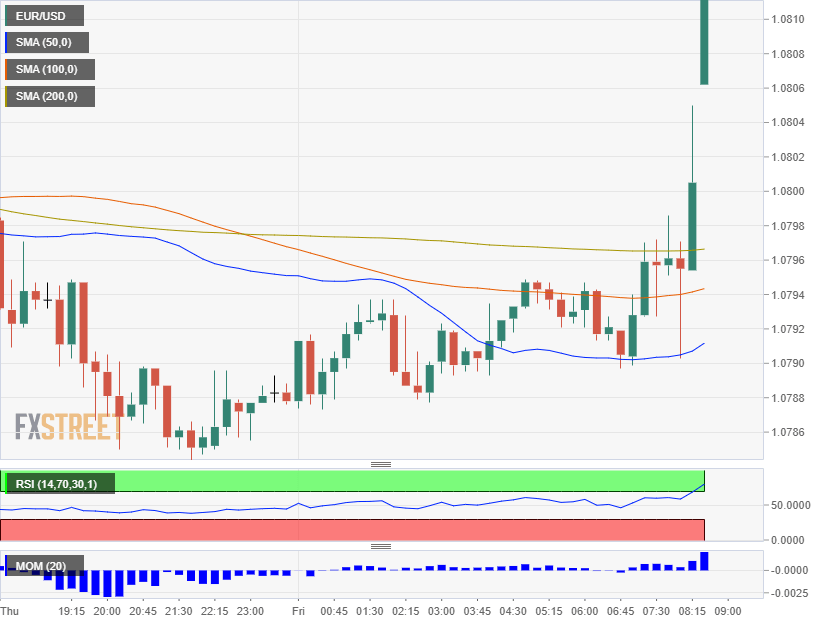
EURUSD February 21 2020 German manufacturing PMI

-- more to come

Markit's preliminary Manufacturing Purchasing Managers' for February was expected to drop from 45.3 to 44.8 points – below the 50-point threshold separating expansion and contraction. The Services PMI was projected to slide from 54.2 to 53.8 points.

Earlier, the French Manufacturing PMI dropped to 49.7, worse than 50.7 expected. The Services PMI in the euro area's largest economy jumped to 52.6 against 51.3 expected. 

EUR/USD has been consolidating its losses around 1.08 ahead of the publication. The US dollar has been storming the board amid coronavirus fears, upbeat American economic performance, and the Federal Reserve's reluctance to cut rates.

Figures for the whole eurozone are due out next. 

Author

Yohay Elam

Yohay Elam

FXStreet

Yohay is in Forex since 2008 when he founded Forex Crunch, a blog crafted in his free time that turned into a fully-fledged currency website later sold to Finixio.


More from Yohay Elam
Share:

Editor's Picks

USD/JPY stays below 160.50 as markets assess BoJ decision

USD/JPY fluctuates in a relatively narrow range above 160.00 on Tuesday as markets assess the Bank of Japan's (BoJ) decision to raise the policy rate by 25 at the June meeting. Meanwhile, investors keep a close eye on news coming out of the Middle East, while preparing for the critical Fed meeting.

AUD/USD trades in tight channel near 0.7050 despite hawkish RBA message

AUD/USD trades modestly lower on the day at around 0.7050 on Tuesday as markets adopt a cautious stance amid a lack of details surrounding the US-Iran peace agreement. The Reserve Bank of Australia (RBA) left the door open for possible policy tightening after leaving the interest rate unchanged, as expected, at the June meeting but failed to boost the Australian Dollar.

Gold: Recovery remains capped by $4,400 for now

Gold continues to trade with a constructive tone and flirts with the $4,350 zone per troy ounce on Tuesday. The early enthusiasm sparked by the US-Iran peace deal has faded somewhat, prompting investors to adopt a more prudent stance as they await further details of the agreement and key guidance from the Fed.

Solana's rebound gains momentum as ETF inflows return

Solana (SOL) steadies at $73 after posting three consecutive green candlesticks since the weekend. The recent recovery is supported by institutional demand, with spot Exchange Traded Funds recording net inflows of $2.81 million on Monday.

BoJ just hiked and US-Iran deal is on the table: Why Japanese Yen is still around 160.00

The Bank of Japan lifted interest rates from 0.75% to 1.00%, its highest level in more than three decades. The landmark move aims to stabilize a sharply weakening Japanese Yen, but by looking at the immediate market reaction, it doesn’t look like it’s going to work.

4.2% headline, 0.2% core: Why the Fed's next hike may be targeting the wrong problem

May's CPI put headline inflation at 4.2% on the year, up from 3.8% in April and the hottest reading since April 2023, while core prices rose just 0.2% on the month, undershooting the 0.3% consensus and halving April's pace.