Brazil FX Today: Brazilian Real stable before the Central Bank of Brazil decision

The Brazilian Real (BRL) seesaws between mild gains and losses against the US Dollar (USD) on Tuesday, as markets await the Central Bank of Brazil meeting scheduled for Wednesday at 21:00 GMT.
The BRL remains supported by a still very restrictive monetary policy, but nervousness is palpable ahead of the decision by the Central Bank of Brazil (BCB), which is expected by a consensus of economists to keep the interest rate unchanged at 15%.
Structural inflationary pressures persist, particularly in services, and justify a prolonged status quo strategy, according to many analysts.
However, the currency market remains attentive to the tone adopted by the monetary authorities, who could give new indications as to the timing of the first interest rate cut, now expected for 2026 by a majority of observers.
Brazilian monetary policy: Caution remains the order of the day
Brazil's central bank, through its Monetary Policy Committee (Copom), is expected to confirm its cautious stance on Wednesday. After raising its key rate by 450 basis points (bps) since September 2024, the institution paused in July, and seems determined to prolong this wait-and-see phase in a context still marked by above-target inflation.
According to Jose Alfaix, economist at Rio Bravo Investimentos, "while the central bank has made progress in bringing inflation back towards its target, it is still faced with a tight labor market and an uncertain international environment".
Indeed, despite a one-off fall in the Consumer Price Index (CPI) in August, annual inflation still stands at 5.13%, well above the official target of the central bank at 3%.
The 0.39% rise in services prices in August, driven by historically low unemployment, is fuelling concerns about persistent core inflation, which gives way for the central bank to maintain a restrictive interest rate level for an extended period.
Another decisive factor in Copom's thinking is the exchange rate. The Brazilian Real appreciated in 2025, helping to ease the pressure on imported product prices. But this trend could be short-lived.
As Julio Cesar de Mello Barros, economist at Banco Daycoval, points out, "the appreciation of the exchange rate has been beneficial, but there is no guarantee that it will continue".
Uncertainty linked to US trade policy, in particular the new tariffs imposed by the US on certain Brazilian imports, further complicates the outlook. These external tensions could prompt the central bank to extend its cautious stance in order to limit excessive volatility on financial markets.
When the Central Bank of Brazil could cut rates?
While the Brazilian central bank is expected to take a break in September, markets remain divided over the timing of the next rate adjustment.
According to the Reuters survey conducted between September 8 and 12, of the 36 economists questioned on this subject, 10 anticipate a cut in December, 13 in January, 9 in March, and the remainder later in 2026.
The median forecasts suggest that the interest rate will remain at 15% until the end of 2025, before easing slowly to 14.25% in the first quarter of 2026.
Technical analysis of USD/BRL: Bearish breakout signals further pressure
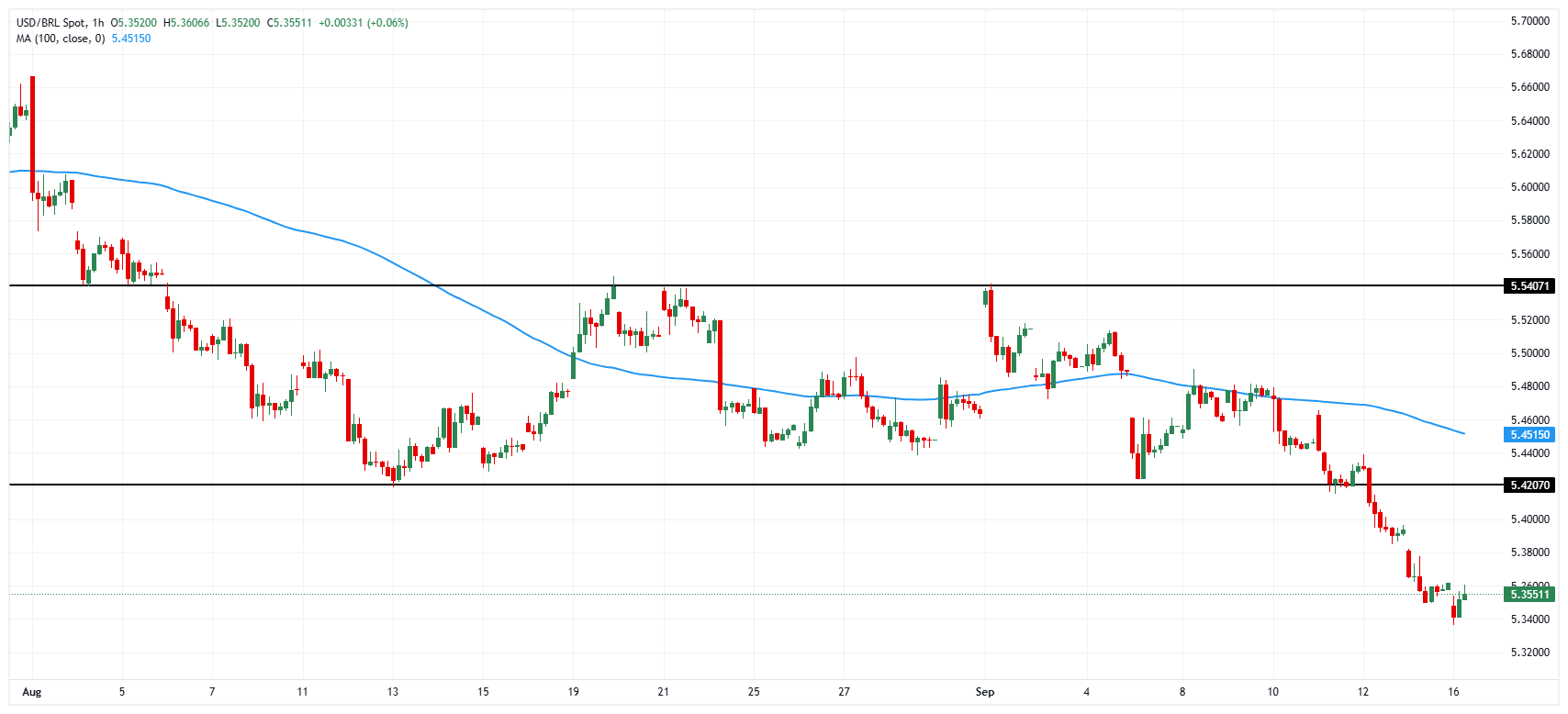
USD/BRL 4-hour chart. Source: FXStreet
After just over a month of trendless consolidation in a wide channel between 5.42 and 5.54, USD/BRL broke lower last Friday, a move followed by a rapid fall to Tuesday's low at 5.34.
A drop below this level could rekindle short-term downward pressure. Conversely, any rebound is likely to encounter resistance at 5.42, which will have to be recovered before a more solid upward movement can be envisaged.
The BRL thus continues to strengthen against the US Dollar, and the Brazilian Central Bank meeting could accentuate or reverse this trend.
The table below shows the percentage change of Brazilian Real (BRL) against listed major currencies today. Brazilian Real was the strongest against the New Zealand Dollar.
| BRL | EUR | GBP | JPY | CAD | AUD | NZD | USD | |
|---|---|---|---|---|---|---|---|---|
| BRL | -0.63% | -0.36% | -0.53% | -0.08% | -0.07% | -0.02% | -0.23% | |
| EUR | 0.63% | 0.34% | 0.12% | 0.55% | 0.67% | 0.64% | 0.77% | |
| GBP | 0.36% | -0.34% | -0.16% | 0.21% | 0.34% | 0.30% | 0.43% | |
| JPY | 0.53% | -0.12% | 0.16% | 0.37% | 0.43% | 0.22% | 0.56% | |
| CAD | 0.08% | -0.55% | -0.21% | -0.37% | 0.06% | 0.05% | 0.20% | |
| AUD | 0.07% | -0.67% | -0.34% | -0.43% | -0.06% | 0.06% | 0.10% | |
| NZD | 0.02% | -0.64% | -0.30% | -0.22% | -0.05% | -0.06% | 0.11% | |
| USD | 0.23% | -0.77% | -0.43% | -0.56% | -0.20% | -0.10% | -0.11% |
The heat map shows percentage changes of major currencies against each other. The base currency is picked from the left column, while the quote currency is picked from the top row. For example, if you pick the Brazilian Real from the left column and move along the horizontal line to the US Dollar, the percentage change displayed in the box will represent BRL (base)/USD (quote).
Author

Ghiles Guezout
FXStreet
Ghiles Guezout is a Market Analyst with a strong background in stock market investments, trading, and cryptocurrencies. He combines fundamental and technical analysis skills to identify market opportunities.