|

BoJ Kuroda: We won’t know until later whether recent stock rises are excessive

The Bank of Japan's governor Haruhiko Kuroda is crossing the wires and has said ''we won’t know until later whether recent stock rises are excessive.''

Key comments

BoJ won't end, seek exit from its ETF buying for time being.

There is still very high uncertainty over economic outlook.

Can't ignore downside risks to Japan, global economies even as vaccine rollouts proceed at rapid pace in western economies.

We won't know until later whether recent stock rises are excessive.

BoJ is buying ETFs in flexible way, have been buying 'very small' amount since last autumn as markets stablised.

Recent stock rally reflects the market's optimism toward economic outlook, vaccine rollout.

Premature to debate exit from massive stimulus programme including BoJ's ETF buying.

When the achievement of our price target approaches, we will debate the exit strategy at our policy meeting, communicate our stance accordingly.

Don't have a preset idea on what to do with BoJ's ETF holdings, which will be debated at BoJs policy meeting when exit from easy policy nears.

BoJ will continue powerful easing, but will also be vigilant to potential financial risks associated with its ultra-loose policy.

Market implications

There is a current focus on the strength of the yen and continued jawboning can be expected at times of dollar weakness and higher US yeilds. 

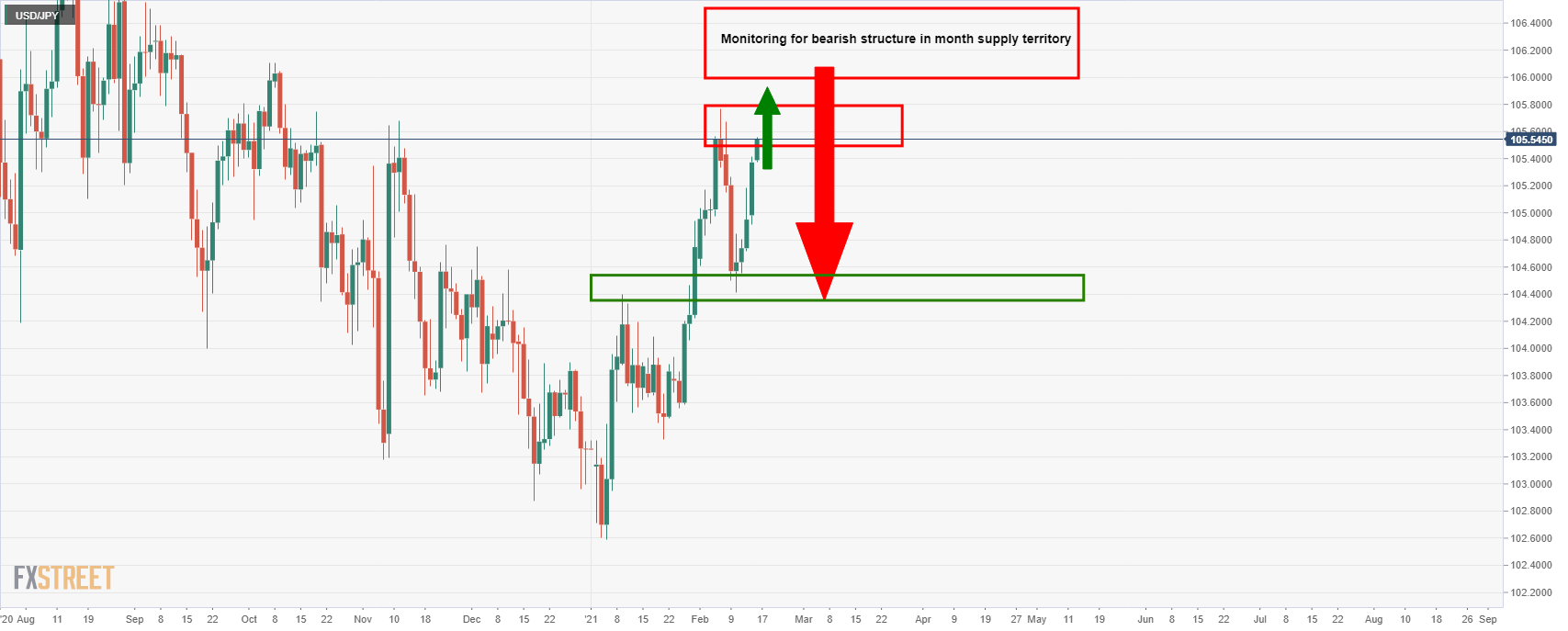
The yen is on the backfoot as risk appetite has started off the week on a strong footing. However, there may only be so far the bulls can go before supply emerges in the media term.

USD/JPY Price Analysis: Bulls climbing a wall of resistance
Author

Ross J Burland

Ross J Burland, born in England, UK, is a sportsman at heart. He played Rugby and Judo for his county, Kent and the South East of England Rugby team.


More from Ross J Burland
Share:

Editor's Picks

EUR/USD remains weak near 1.1800

EUR/USD remains on the back foot on Thursday, trading close to the 1.1800 support ahead of the opening bell in Asia. The pair’s pullback comes amid further gains in the Greenback, while investors keep assessing the ECB’s decision to leave its policy rates unchanged

GBP/USD falls to new lows near 1.3530

GBP/USD extends Wednesday’s pullback on Thursday, easing lower towards two week lows around the 1.3530 area. Ongoing strength in the Greenback and the dovish hold from the BoE at its earlier meeting are keeping demand for the British Pound on the defensive for now.

Gold fails to sustain gains above $5,000 for third consecutive day

Gold is back under pressure on Thursday, slipping back towards the $4,800 region per troy ounce. A firmer US Dollar is weighing on the yellow metal, even as the broader mood remains risk off. That said, falling US Treasury yields across the curve are helping to cushion the downside and, for now at least, are limiting the depth of the pullback.

Ethereum plunges below $2,000 as funding rates return to negative territory

Ethereum has broken below $2,000 on Thursday, extending its decline to about 30% over the past week. The move follows a crash in Ethereum's funding rates, which have returned to negative territory after briefly flipping positive.

The AI mirror just turned on tech and nobody likes the reflection

Tech just got hit with a different kind of selloff. Not the usual rates tantrum, not a recession whisper, not even an earnings miss in the classic sense. This was the market staring into an AI mirror and recoiling at its reflection.

Breaking: Bitcoin slips below $70,000 as falling knife scenario in play

Bitcoin (BTC) price dips below $70,000 on Thursday, having corrected nearly 20% for this year. Market momentum turned extremely bearish, with technical indicators pointing to further downside toward the next key support at $65,000.














