|

BoJ January policy meeting Summary of Opinions: Price rises accelerating

The Bank of Japan's Summary of Opinions is coming out in stages.

Key points

It will take time for Japan to achieve sustained wage growth, must support the economy with macro policy.
    
Focusing on service prices as demand-pull inflation must be achieved for Bank of Jaopan's price target to be met.
    
Price rises accelerating not just for goods but for services.
    
Public's norm on prices may be changing due to big, external shock.

Appropriate to maintain current monetary easing, including YCC.
    
Crucial to generate positive economic, price cycle in order to achieve BoJ's price target
    
BoJ must keep yields from rising across curve while being mindful of bond market function.
    
Must spend more time to gauge impact of December decision on bond market function.
    
Must communicate to markets achievement of price target will take some time.
    
Expansion of BoJ's market operation tool will help create stable shape of yield curve.
    
When time for exiting ultra-loose policy comes, boj must check whether market players are prepared for the move.
    
BoJ must conduct a review of its policy at some point, but appropriate to maintain easy monetary policy for now.
    
Japan's consumer inflation is likely to slow pace of increase toward latter half of next fiscal year.
    
Cost-push pressure on prices are starting to ease.
    
Still see some distance in achieving the BoJs price target.

USD/JPY update

There has been no effect on the Yen but the price action was volatile on Wednesday with the bulls now back under pressure again towards 129.00:
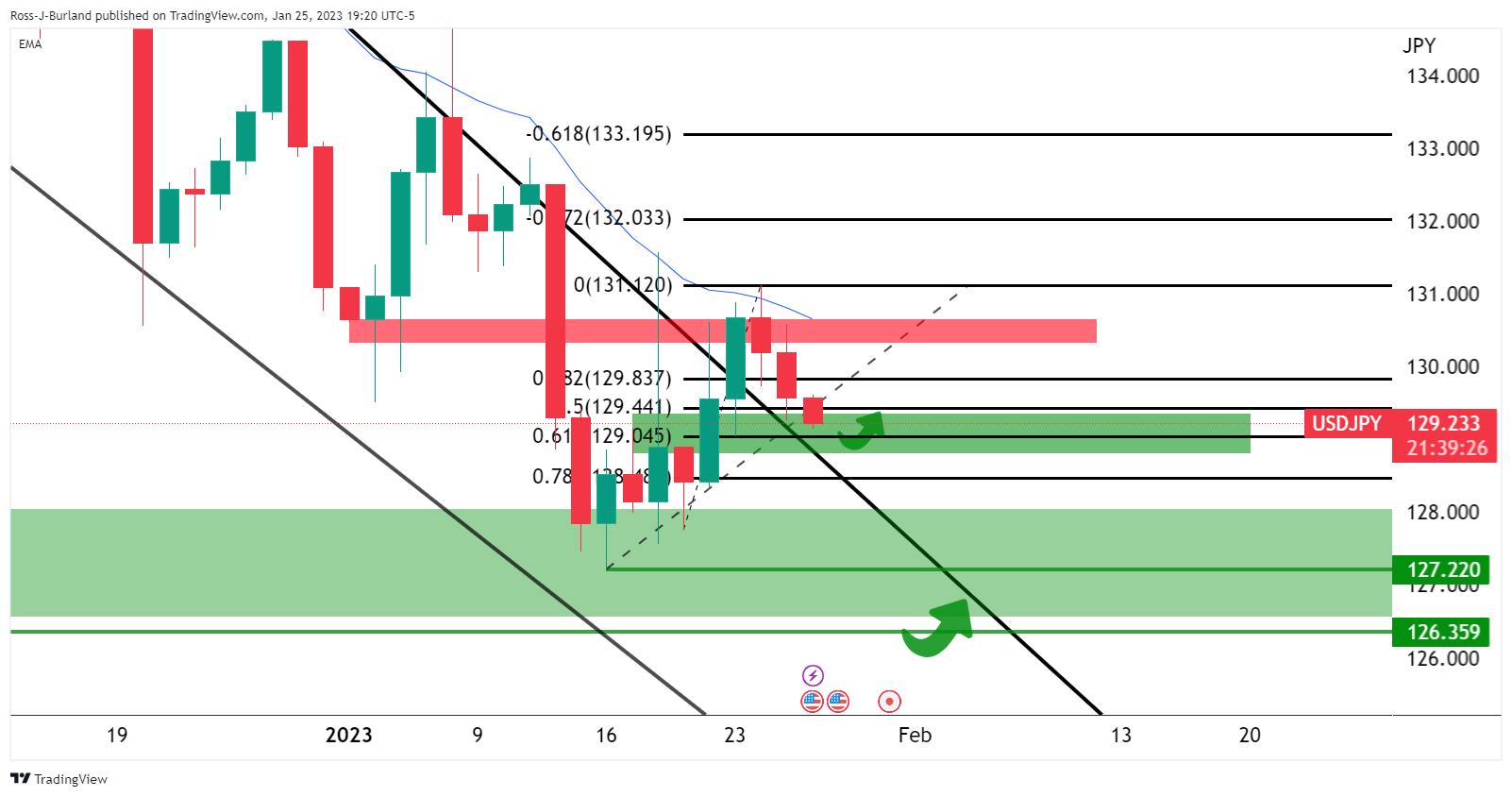
If the bulls commit near 129.00, the has a confluence with the 129.00 figure, then there could be prosp3ects of a move back to test 130.00 before the week is out. 

About the Bank of Japan's Summary of Opinions

This report includes the BOJ's projection for inflation and economic growth. It is scheduled 8 times per year, about 10 days after the Monetary Policy Statement is released.

Author

Ross J Burland

Ross J Burland, born in England, UK, is a sportsman at heart. He played Rugby and Judo for his county, Kent and the South East of England Rugby team.


More from Ross J Burland
Share:

Editor's Picks

AUD/USD bounces back toward 0.6950 on fresh USD supply

AUD/USD bounces back toward 0.6950 in the Asian session on Friday. The US Dollar retreats from 17-month highs as traders take profits off the table ahead of the all-important US Nonfarm Payrolls report. Meanwhile, the Australian Dollar draws support from reviving expectations of a November interest rate hike amid elevated global yields and inflation risks.


USD/JPY struggles near 158.00 as USD retreats ahead of NFP

USD/JPY is struggling for fresh impetus near 158.00, moving away from the top end of its weekly range in the Asian session on Friday, after hotter-than-expected Tokyo CPI and amid a broad US Dollar retreat. Traders reposition themselves ahead of US Nonfarm Payrolls.

Gold fades the earlier optimism; back below $4,200

Gold could not sustain the post-NFP bull run past the $4,200 mark per troy ounce, receding toward the $4,180 region at the end of the week. The precious metal’s inconclusive price action comes amid fresh selling pressure hurting the US Dollar as investors assess the latest NFP data.

Crypto Today: Bitcoin, Ethereum and XRP gains reinforce bullish outlook

Cryptocurrency prices are broadly recovering on Friday, led by Bitcoin moving above $86,000. Ethereum has reaffirmed its bullish outlook, rising above $2,700 while the immediate area at $2,800 caps upside. Meanwhile, Ripple hovers near $1.54.

Week ahead – Fed minutes in the spotlight amid bond market rout

Energy crisis and soaring bond yields to stay in driver’s seat in quiet week. Fed minutes eyed after drop in October rate hike bets. ISM services PMI and Treasury auctions to be watched too. Canadian employment, Japanese wages and ECB minutes also on tap.

The Euro is near a one-year low: Inflation could trigger its rebound, not its fall

EUR/USD has fallen to its lowest level since May 2025. The pair hit 1.1312 on Wednesday and trades well below the January peak of 1.2082. The decline reflects a powerful combination of US Dollar strength, geopolitical uncertainty and renewed concerns about Europe's exposure to higher energy prices.















