|

BoC’s Macklem: Canadian economy in excess demand, inflation too high

The Canadian economy is in excess demand while inflation is too high although wage growth 'now looks to be plateauing', the Bank of Canada's Tiff Macklem explained. 

Key notes

There is scope to cool labor market without causing the kind of unemployment surge we have typically experienced a recession.

Suggest unemployment rate will rise somewhat if the job vacancy returns to more normal levels, but it would not be high unemployment by historical standards.

Slightly negative growth is possible over the next few quarters.

That's not a severe recession, but it is a significantly slowing of the economy.

Right now we need the economy to slow down.

To reach 2% inflation target we need to rebalance labor market and that will be a difficult adjustment.

In recent months we are seeing additional signs that exceptionally tight labor market conditions have started to ease, wage growth looks to be plateauing.

Much of the inflation Canada is experiencing reflects domestic factors, namely excess demand in economy.

Will be watching broad set of indicators to gauge health of labor market.

We will be looking beyond headline unemployment numbers to gauge how different groups and labor market are adjusting.

It will be hard to know when we have reached maximum sustainable employment since it is not directly measurable.

USDCAD update

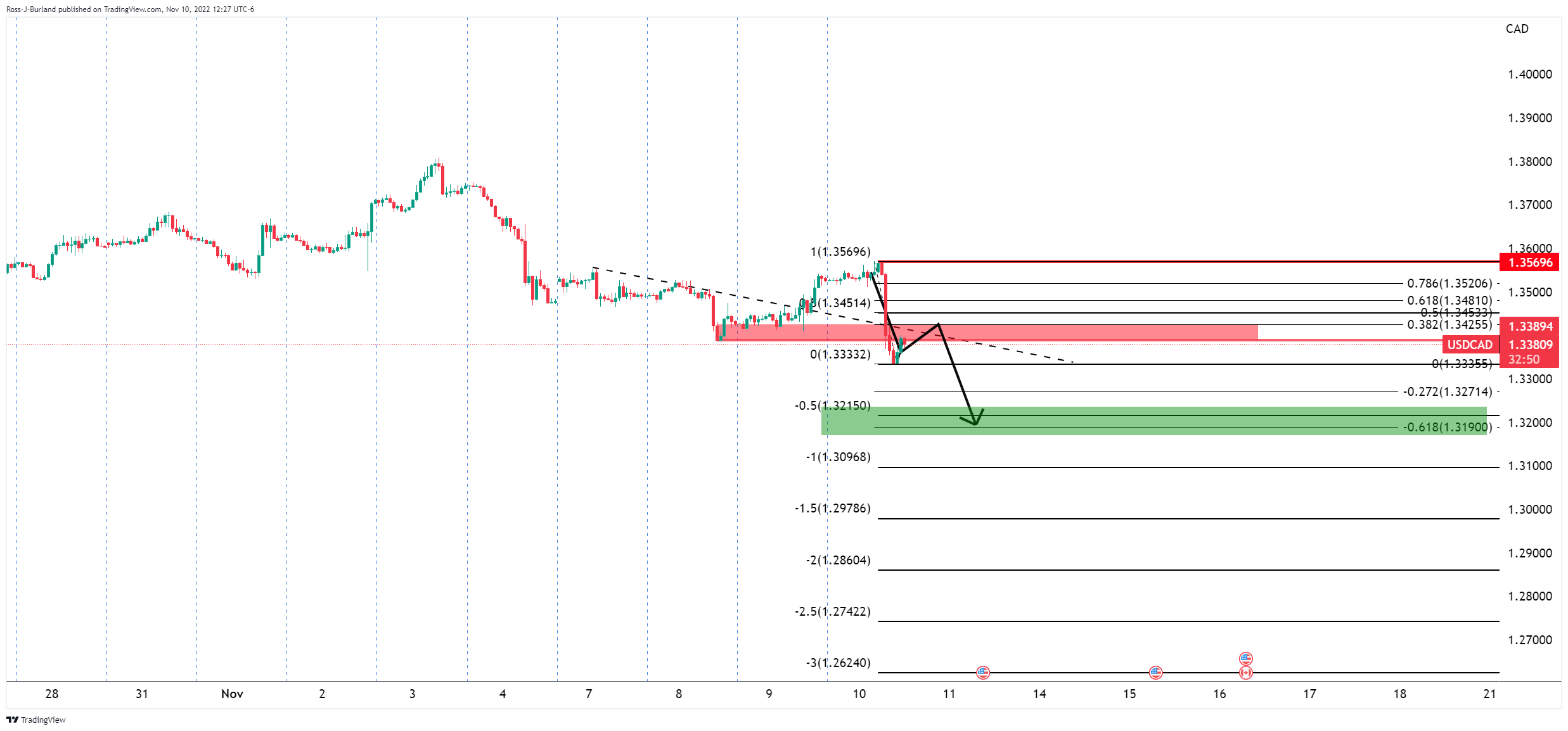
Meanwhile, the Canadian Dollar is under water following the US inflation report, losing some 1% and below 1.34 the figure. The price fell from a high of 1.3571 to a low of 1.3333.

On a 1-hour basis, there are prospects of a full 50% expansion of the recent range to test 1.32 the figure for the days ahead. 
Author

Ross J Burland

Ross J Burland, born in England, UK, is a sportsman at heart. He played Rugby and Judo for his county, Kent and the South East of England Rugby team.


More from Ross J Burland
Share:

Editor's Picks

EUR/USD slumps below 1.1750 as USD benefits from risk-aversion

EUR/USD comes under renewed bearish pressure in the European session and trades below 1.1750 following a recovery attempt earlier in the day. The US Dollar gathers strength and weighs on the pair as investors seek refuge in the wake of Israel and the United States' joint attack on Iran.

GBP/USD targets 1.3500 barrier near moving averages

GBP/USD rebounds from the daily losses, trading around 1.3450 during the Asian hours on Monday. The technical analysis of the daily chart indicates an ongoing bearish bias, as the pair trades within a descending channel pattern.

Gold surges on safe-haven demand, tests $5,400

Gold benefits from intense risk-aversion on Monday and climbs to the $5,400 region, setting a fresh monthly-high in the process. Tensions in the Middle East remain high as Israel and Hezbollah continue to exchange strikes following the US-Israel joint attack on Iran over the weekend.

Bitcoin on brink of breakdown amid US-Iran war

Bitcoin (BTC) remains under pressure near the key support level of $65,700. Trading at $66,400 at the time of writing on Monday, a breakdown below this critical level would suggest a deeper correction ahead.

The week ahead: Conflict in the Middle East jolts markets

Events in the Middle East are obviously dominating financial markets this morning. The Brent crude oil price is extending gains and is higher by more than 8%, stock futures are pointing lower and the gold price is higher by more than 2%. 

Pi Network Price Forecast: Core team offloads supply, weighing on PI recovery

Pi Network  hovers below $0.1700, broadly steady at press time on Monday, attempting a recovery after a 2% loss the previous day. Sunday’s decline aligned with nearly 49 million PI tokens offloaded by the Pi Foundation, implying a spike in supply pressure that capped the prevailing four-day recovery.