Australian Dollar continues scaling higher as hawkish RBA offsets softer Q3 GDP
- The Australian Dollar shrugs off a disappointing Q3 GDP print amid the RBA’s hawkish tilt.
- Rising December Fed rate cut bets continue to undermine the USD and support AUD/USD.
- Traders now look forward to the US ADP report and ISM Services PMI for a fresh impetus.

The Australian Dollar (AUD) builds on its intraday ascent against a broadly weaker US Dollar (USD), pushing the AUD/USD pair to a fresh high since late October and closer to the 0.6600 mark heading into the European session on Wednesday. The initial market reaction to the disappointing Australian economic growth figures turns out to be short-lived amid diminishing odds for more policy easing by the Reserve Bank of Australia (RBA). This, in turn, is seen as a key factor that continues to underpin the AUD.
Apart from this, a generally positive tone around the equity markets helps offset China's unimpressive Services PMI and further contributes to the Aussie's relative outperformance. The USD, on the other hand, hangs near its lowest level in over two weeks amid bets that the Federal Reserve (Fed) will cut interest rates next week. This offers additional support to the AUD/USD pair and backs the case for an extension of a nearly two-week-old uptrend. Traders now look to the US economic releases for a fresh impetus.
Australian Dollar remains on the front foot vs USD amid RBA-Fed policy divergence
- The Australian Bureau of Statistics reported this Wednesday that the economy grew by 0.4% during the July-September period, down from the 0.6% rise seen in the second quarter. The annual Gross Domestic Product growth rate stood at 2.1% compared to 1.8% in the previous quarter. Both the quarterly and the yearly print missed expectations, prompting some intraday selling around the Australian Dollar during the Asian session.
- Speaking before a parliamentary committee earlier today, Reserve Bank of Australia Governor Michele Bullock said that the central bank is looking very hard at recent inflation numbers to see if some of the price pressures are temporary. Bullock added that if inflation proves to be persistent, it would have implications for future monetary policy. This dampens hopes for more policy easing and lends support to the Aussie.
- In fact, Australia's headline Consumer Price Index (CPI) accelerated from a 3.5% increase reported in the previous month to 3.8% YoY in October. Moreover, the RBA Trimmed Mean CPI rose 3.3% during the reported month from 3.2% in September. This indicated that inflation remains above the RBA’s 2% to 3% annual target and raises questions about just how much headroom the central bank has to cut rates further.
- The latest data published by RatingDog showed that China's Services Purchasing Managers' Index (PMI) dropped to 52.1 in November from 52.6 in October. This, however, was better than consensus estimates for a reading of 52 and does little to dent the underlying bullish sentiment surrounding the China-proxy AUD.
- The US Dollar hangs near its lowest level since November 14, touched on Monday, amid dovish Federal Reserve expectations, and contributes to limiting the downside for the AUD/USD pair. According to the CME Group's FedWatch Tool, traders are pricing in a nearly 90% chance of a 25-basis-point rate cut on December 10. Moreover, speculations of a dovish pick for the next Fed Chair undermine the Greenback.
- Meanwhile, the prospects for lower US interest rates, along with hopes for a peace deal between Russia and Ukraine, remain supportive of a generally positive tone around the equity markets. This further dents the safe-haven buck and benefits the risk-sensitive Aussie. Traders now look to the release of the US ADP report on private-sector employment and the US ISM Services PMI for a fresh impetus.
- The market attention, however, will remain glued to the US Personal Consumption Expenditure (PCE) Price Index, due on Friday, which will be scrutinized for cues about the Fed's future rate-cut path. This, in turn, will play a key role in influencing the USD and determining the next leg of a directional move for the AUD/USD pair. The fundamental backdrop, meanwhile, remains tilted in favor of bullish traders.
AUD/USD bulls might now await move beyond 0.6600 before placing fresh bets
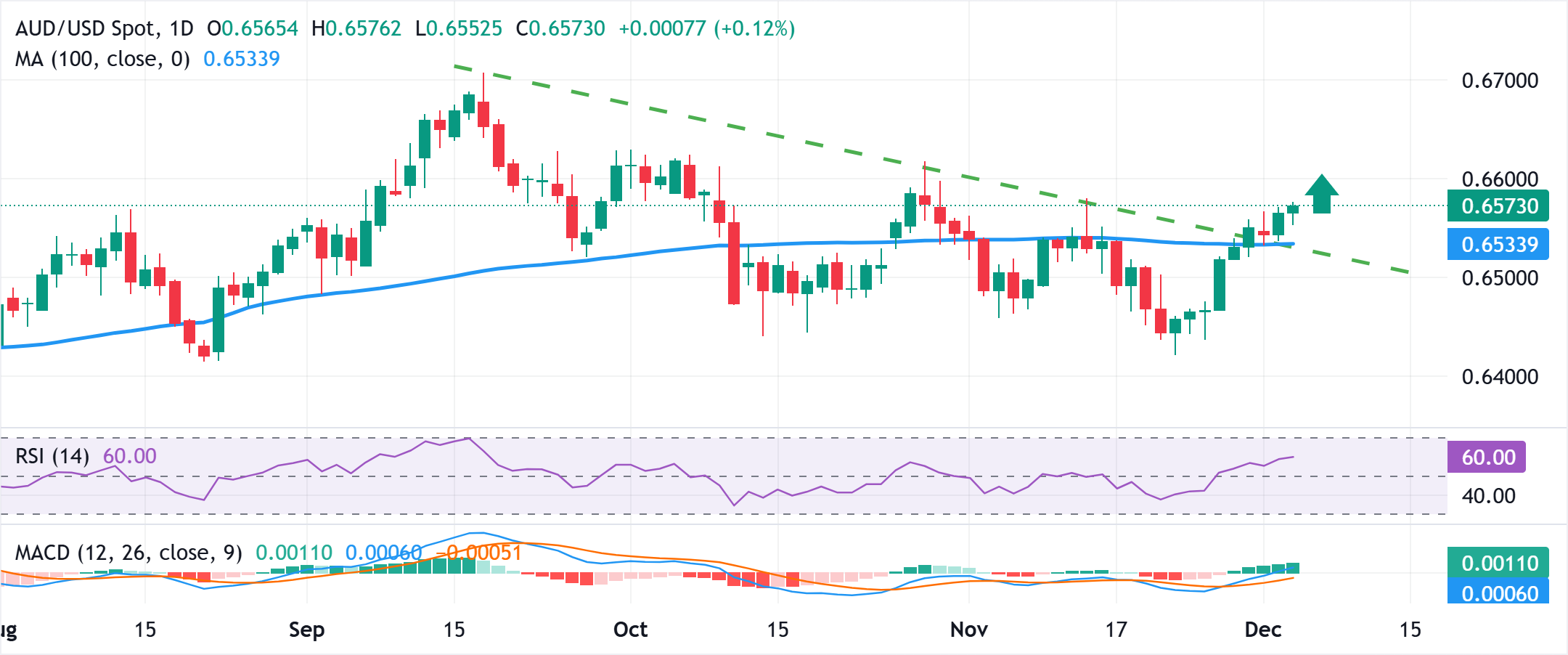
The recent breakout through a descending trend-line hurdle extending from the September swing high and acceptance above the 100-day Simple Moving Average (SMA) favors the AUD/USD bulls. Moreover, oscillators on the daily chart have been gaining positive traction and are still away from being in the overbought territory. This, in turn, validates the near-term positive outlook, suggesting that any corrective pullback could be seen as a buying opportunity near the aforementioned confluence resistance breakpoint, currently around the 0.6535-0.6530 region.
This is closely followed by the 0.6500 psychological mark. A convincing break below the latter could make the AUD/USD pair vulnerable to weaken further below the 200-day SMA, currently pegged near the 0.6465 zone, toward challenging a multi-month low, around the 0.6420 region, touched in November. Some follow-through selling, leading to a subsequent fall below the 0.6400 mark, will be seen as a fresh trigger for bearish traders and pave the way for deeper losses.
Nevertheless, the AUD/USD pair seems poised to prolong a two-week-old uptrend and aim to reclaim the 0.6600 mark, above which the momentum could extend further towards the next relevant hurdle near the 0.6660-0.6665 region. Spot prices could eventually climb to test the year-to-date high, levels just above the 0.6700 mark, touched in September.
Risk sentiment FAQs
In the world of financial jargon the two widely used terms “risk-on” and “risk off'' refer to the level of risk that investors are willing to stomach during the period referenced. In a “risk-on” market, investors are optimistic about the future and more willing to buy risky assets. In a “risk-off” market investors start to ‘play it safe’ because they are worried about the future, and therefore buy less risky assets that are more certain of bringing a return, even if it is relatively modest.
Typically, during periods of “risk-on”, stock markets will rise, most commodities – except Gold – will also gain in value, since they benefit from a positive growth outlook. The currencies of nations that are heavy commodity exporters strengthen because of increased demand, and Cryptocurrencies rise. In a “risk-off” market, Bonds go up – especially major government Bonds – Gold shines, and safe-haven currencies such as the Japanese Yen, Swiss Franc and US Dollar all benefit.
The Australian Dollar (AUD), the Canadian Dollar (CAD), the New Zealand Dollar (NZD) and minor FX like the Ruble (RUB) and the South African Rand (ZAR), all tend to rise in markets that are “risk-on”. This is because the economies of these currencies are heavily reliant on commodity exports for growth, and commodities tend to rise in price during risk-on periods. This is because investors foresee greater demand for raw materials in the future due to heightened economic activity.
The major currencies that tend to rise during periods of “risk-off” are the US Dollar (USD), the Japanese Yen (JPY) and the Swiss Franc (CHF). The US Dollar, because it is the world’s reserve currency, and because in times of crisis investors buy US government debt, which is seen as safe because the largest economy in the world is unlikely to default. The Yen, from increased demand for Japanese government bonds, because a high proportion are held by domestic investors who are unlikely to dump them – even in a crisis. The Swiss Franc, because strict Swiss banking laws offer investors enhanced capital protection.
Author

Haresh Menghani
FXStreet
Haresh Menghani is a detail-oriented professional with 10+ years of extensive experience in analysing the global financial markets.