Australian Dollar remains stronger as US Dollar holds losses ahead of CPI inflation data
- The Australian Dollar gains ground ahead of the US April Consumer Price Index (CPI) report.
- Australia’s Westpac Consumer Confidence Index rose 2.2% MoM, recovering from a 6.0% drop in the previous month.
- US Trade Representative Jamieson Greer said that if things don’t work out, China tariffs can go back up.

The Australian Dollar (AUD) has recovered its recent losses against the US Dollar (USD) for a second consecutive session on Tuesday. However, the AUD/USD pair faced challenges despite a rebound in Australia’s Westpac Consumer Confidence Index, which rose 2.2% month-on-month to 92.1 in May, recovering from a 6.0% drop in the previous month and marking its third increase this year.
The AUD/USD pair weakened as the US Dollar strengthened following news that the United States and China reached a preliminary agreement to significantly reduce tariffs after productive trade talks over the weekend in Switzerland. Under the deal, US tariffs on Chinese goods will be reduced from 145% to 30%, while China will lower its tariffs on US imports from 125% to 10%—a move broadly viewed as a major step toward de-escalating trade tensions.
Australia, which has deep trade ties with China, is particularly sensitive to shifts in US-China relations. The easing of global trade tensions has also led investors to scale back expectations for aggressive domestic interest rate cuts. Markets now expect the Reserve Bank of Australia (RBA) to lower the cash rate to around 3.1% by the end of the year, up from earlier forecasts of 2.85%. However, the RBA is still widely anticipated to implement a 25 basis point rate cut at its upcoming policy meeting.
Australian Dollar advances as US Dollar corrects downward
- The US Dollar Index (DXY), which measures the US Dollar against a basket of six major currencies, is trading lower at around 101.60 at the time of writing. Looking ahead, market participants are awaiting the release of the US Consumer Price Index (CPI) report for April, scheduled later on Tuesday. Analysts expect headline inflation to rebound to 0.3% month-over-month from a previous -0.1%, while core CPI is also projected to rise to 0.3% from 0.1%. Year-over-year figures for both are forecast to remain unchanged.
- After two days of negotiations aimed at easing trade tensions, both the US and China reported “substantial progress.” China’s Vice Premier He Lifeng described the talks as “an important first step” toward stabilizing bilateral relations.
- Meanwhile, US Treasury Secretary Bessent and Trade Representative Greer called the discussions a constructive move toward narrowing the $400 billion trade imbalance. However, Greer warned later that if the agreement falls through, tariffs on Chinese goods could be reinstated.
- Last week, the Federal Reserve (Fed) left interest rates unchanged at 4.25%–4.50%, but its accompanying statement highlighted rising concerns about inflation and unemployment, adding a layer of uncertainty to the market outlook.
- Fed Chair Jerome Powell, in a post-meeting press conference, warned that ongoing trade tariffs could hinder the central bank’s efforts to manage inflation and employment in 2025. He also suggested that persistent policy instability may prompt the Fed to take a more cautious, wait-and-see approach to future rate moves.
- China's Consumer Price Index (CPI) declined for the third consecutive month in April, falling 0.1% year-on-year, matching both the market forecast and the drop recorded in March, according to data released Saturday by the National Bureau of Statistics. Meanwhile, the Producer Price Index (PPI) contracted 2.7% YoY in April, steeper than the 2.5% drop in March and below the market expectation of a 2.6% decline.
- On the trade front, China posted a trade surplus of $96.18 billion in April, exceeding the forecast of $89 billion but down from March’s $102.63 billion. Exports rose 8.1% YoY, outperforming the expected 1.9% but slowing from the 12.4% gain seen previously. Imports dipped 0.2% YoY, a milder decline than both the forecasted -5.9% and March’s -4.3%. China’s trade surplus with the US narrowed to $20.46 billion from $27.6 billion in March.
- Australia’s Ai Group Industry Index showed improvement in April, although it marked the 33rd straight month of contraction—particularly driven by weakness in export-reliant manufacturing. These signs of persistent softness have strengthened market expectations that the Reserve Bank of Australia (RBA) may cut its cash rate by 25 basis points to 3.85% later this month.
Australian Dollar rises to near 0.6400 barrier, nine-day EMA
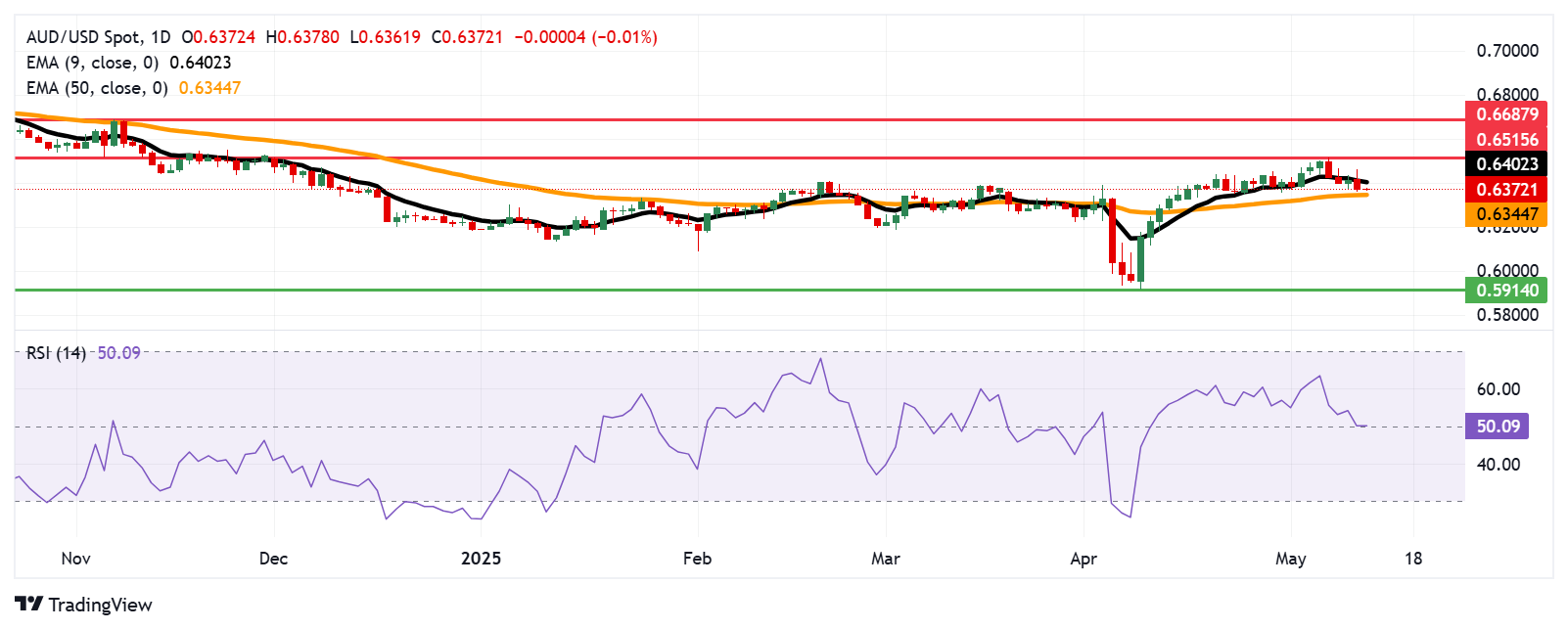
The AUD/USD pair rises to near 0.6400 on Tuesday. Technical analysis of the daily chart indicates a bearish outlook, with the pair trading below the nine-day Exponential Moving Average (EMA). Furthermore, the 14-day Relative Strength Index (RSI) has dipped below the 50 mark, reinforcing the bearish sentiment.
The AUD/USD pair is likely to test initial support at the 50-day EMA around 0.6344. A decisive break below this level could strengthen the bearish bias and open the door for a decline toward 0.5914 — a level not seen since March 2020.
On the upside, the AUD/USD pair could retest the nine-day EMA at 0.6402 and potentially revisit the six-month high of 0.6515, recorded on December 2, 2024. A sustained break above this level may pave the way for a move toward the seven-month high of 0.6687 from November 2024.
AUD/USD: Daily Chart
Australian Dollar PRICE Today
The table below shows the percentage change of Australian Dollar (AUD) against listed major currencies today. Australian Dollar was the strongest against the Canadian Dollar.
| USD | EUR | GBP | JPY | CAD | AUD | NZD | CHF | |
|---|---|---|---|---|---|---|---|---|
| USD | -0.16% | -0.13% | -0.36% | -0.05% | -0.56% | -0.59% | -0.27% | |
| EUR | 0.16% | 0.03% | -0.20% | 0.10% | -0.40% | -0.42% | -0.07% | |
| GBP | 0.13% | -0.03% | -0.23% | 0.07% | -0.43% | -0.47% | -0.10% | |
| JPY | 0.36% | 0.20% | 0.23% | 0.31% | -0.21% | -0.26% | 0.14% | |
| CAD | 0.05% | -0.10% | -0.07% | -0.31% | -0.60% | -0.54% | -0.19% | |
| AUD | 0.56% | 0.40% | 0.43% | 0.21% | 0.60% | -0.02% | 0.33% | |
| NZD | 0.59% | 0.42% | 0.47% | 0.26% | 0.54% | 0.02% | 0.35% | |
| CHF | 0.27% | 0.07% | 0.10% | -0.14% | 0.19% | -0.33% | -0.35% |
The heat map shows percentage changes of major currencies against each other. The base currency is picked from the left column, while the quote currency is picked from the top row. For example, if you pick the Australian Dollar from the left column and move along the horizontal line to the US Dollar, the percentage change displayed in the box will represent AUD (base)/USD (quote).
Economic Indicator
Consumer Price Index (MoM)
Inflationary or deflationary tendencies are measured by periodically summing the prices of a basket of representative goods and services and presenting the data as The Consumer Price Index (CPI). CPI data is compiled on a monthly basis and released by the US Department of Labor Statistics. The MoM figure compares the prices of goods in the reference month to the previous month.The CPI is a key indicator to measure inflation and changes in purchasing trends. Generally, a high reading is seen as bullish for the US Dollar (USD), while a low reading is seen as bearish.
Read more.Next release: Tue May 13, 2025 12:30
Frequency: Monthly
Consensus: 0.3%
Previous: -0.1%
Source: US Bureau of Labor Statistics
The US Federal Reserve (Fed) has a dual mandate of maintaining price stability and maximum employment. According to such mandate, inflation should be at around 2% YoY and has become the weakest pillar of the central bank’s directive ever since the world suffered a pandemic, which extends to these days. Price pressures keep rising amid supply-chain issues and bottlenecks, with the Consumer Price Index (CPI) hanging at multi-decade highs. The Fed has already taken measures to tame inflation and is expected to maintain an aggressive stance in the foreseeable future.
Author

Akhtar Faruqui
FXStreet
Akhtar Faruqui is a Forex Analyst based in New Delhi, India. With a keen eye for market trends and a passion for dissecting complex financial dynamics, he is dedicated to delivering accurate and insightful Forex news and analysis.