Australian Dollar consolidates near 11-month lows after RBA policy decision
- Australian Dollar extends losses due to a stronger US Dollar.
- RBA maintains its current interest rate at 4.10%
- Australian Bureau of Statistics showed the number of permits for new construction projects improved in August.
- Higher US Treasury yields bolster the Greenback, coupled with mixed US data.

The Australian Dollar (AUD) continues its losses on Tuesday due to another surge in US Dollar (USD) and US Treasury yields. Additionally, the AUD/USD pair is receiving downward pressure on soft policy decisions by the Reserve Bank of Australia (RBA).
Australia’s central bank maintains the status quo and keeps the current interest rate unchanged at 4.10% in the policy meeting on Tuesday, which could contribute to pressure on the Aussie pair. However, there is a likelihood of hiking rates to a peak of 4.35% by the end of this year as inflation remains above target, according to a Reuters poll.
Australian Bureau of Statistics showed the number of permits for new construction projects improved in August. The ANZ Job Advertisements data showed a slump in September from the previous reading.
The US Dollar Index (DXY) extends gains as the 10-year U.S. Treasury yield rose above its highest level since 2007 and the dollar climbed to an 11-month high after mixed data from the United States (US) on Monday.
US ISM Manufacturing PMI improved in September from August’s reading. The Manufacturing Employment Index (Sep) also showed improvement but Manufacturing Prices Paid declined in said month.
Daily Digest Market Movers: Australian Dollar falls on RBA policy decision, stronger US Dollar
- AUD/USD extends losses, trading lower around 0.6320 at the time of writing on Tuesday.
- The Aussie Dollar is under pressure ahead of the RBA interest rate decision.
- RBA decided to keep the current interest rate at 4.1%, yet, there is a possibility of hiking rates to a peak of 4.35% through the end of this year.
- Australia’s Building Permits (MoM) rose to 7% compared to the 2.5% expected in August, swinging from the previous 8.1% decline.
- ANZ Job Advertisements data showed a 0.1% decline in September from the previous increase of 1.9%.
- China’s Manufacturing PMI data rose into positive territory. China’s NBS Manufacturing PMI for August grew to 50.2 from the previous 49.7 figures, exceeding the 50.0 expected.
- The 10-year US Treasury yield rose to 4.70% on Monday, the highest level since 2007.
- US ISM Manufacturing PMI improved to 49.0 in September from 47.6 in the previous reading, above the market consensus of 47.7.
- Manufacturing Prices Paid fell significantly from 48.4 to 43.8. The Employment Index rose from 48.4 to 51.2.
- On Friday, bills were successfully passed in the US to avert a government shutdown, securing funding until November 17. This development has prompted a resumption of the US Dollar Index (DXY) upward trajectory.
- Federal Reserve (Fed) Governor Michelle Bowman expressed on Monday that it is likely appropriate to raise the policy rate further and maintain it at restrictive levels for an extended period.
- Fed Vice Chair for Supervision Michael Barr emphasized a cautious approach to monetary policy. Barr stated that the central bank should be mindful not just of how much interest rates will increase, but also of the duration they will be held at a sufficiently restrictive level. Despite this, Barr believes that the Fed can manage inflation without causing significant harm to the job market.
- Traders await the US employment data, with the release of the ADP report on Wednesday and the Nonfarm Payrolls on Friday.
Technical Analysis: Australian Dollar moves downward toward 0.6300 psychological level
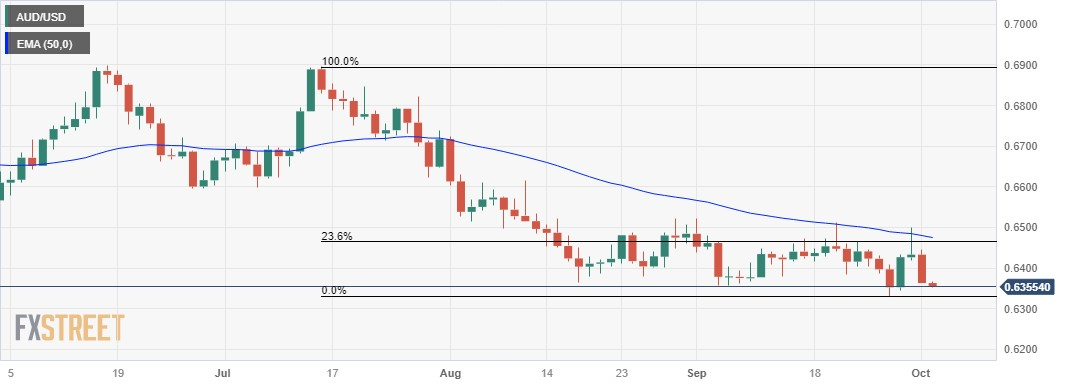
Australian Dollar trades around 0.6320 after the RBA's interest rate decision on Tuesday. The major level at 0.6300 emerges as the immediate support, followed by November's low at 0.6272. On the upside, the 23.6% Fibonacci retracement at 0.6464 level appears to be a key barrier, followed by the 50-day Exponential Moving Average (EMA) at 0.6475.
AUD/USD: Daily Chart
RBA FAQs
What is the Reserve Bank of Australia and how does it influence the Australian Dollar?
The Reserve Bank of Australia (RBA) sets interest rates and manages monetary policy for Australia. Decisions are made by a board of governors at 11 meetings a year and ad hoc emergency meetings as required. The RBA’s primary mandate is to maintain price stability, which means an inflation rate of 2-3%, but also “..to contribute to the stability of the currency, full employment, and the economic prosperity and welfare of the Australian people.” Its main tool for achieving this is by raising or lowering interest rates. Relatively high interest rates will strengthen the Australian Dollar (AUD) and vice versa. Other RBA tools include quantitative easing and tightening.
How does inflation data impact the value of the Australian Dollar?
While inflation had always traditionally been thought of as a negative factor for currencies since it lowers the value of money in general, the opposite has actually been the case in modern times with the relaxation of cross-border capital controls. Moderately higher inflation now tends to lead central banks to put up their interest rates, which in turn has the effect of attracting more capital inflows from global investors seeking a lucrative place to keep their money. This increases demand for the local currency, which in the case of Australia is the Aussie Dollar.
How does economic data influence the value of the Australian Dollar?
Macroeconomic data gauges the health of an economy and can have an impact on the value of its currency. Investors prefer to invest their capital in economies that are safe and growing rather than precarious and shrinking. Greater capital inflows increase the aggregate demand and value of the domestic currency. Classic indicators, such as GDP, Manufacturing and Services PMIs, employment, and consumer sentiment surveys can influence AUD. A strong economy may encourage the Reserve Bank of Australia to put up interest rates, also supporting AUD.
What is Quantitative Easing (QE) and how does it affect the Australian Dollar?
Quantitative Easing (QE) is a tool used in extreme situations when lowering interest rates is not enough to restore the flow of credit in the economy. QE is the process by which the Reserve Bank of Australia (RBA) prints Australian Dollars (AUD) for the purpose of buying assets – usually government or corporate bonds – from financial institutions, thereby providing them with much-needed liquidity. QE usually results in a weaker AUD.
What is Quantitative tightening (QT) and how does it affect the Australian Dollar?
Quantitative tightening (QT) is the reverse of QE. It is undertaken after QE when an economic recovery is underway and inflation starts rising. Whilst in QE the Reserve Bank of Australia (RBA) purchases government and corporate bonds from financial institutions to provide them with liquidity, in QT the RBA stops buying more assets, and stops reinvesting the principal maturing on the bonds it already holds. It would be positive (or bullish) for the Australian Dollar.
Author

Akhtar Faruqui
FXStreet
Akhtar Faruqui is a Forex Analyst based in New Delhi, India. With a keen eye for market trends and a passion for dissecting complex financial dynamics, he is dedicated to delivering accurate and insightful Forex news and analysis.
















