Australian Dollar gains as CPI beats forecasts, Fed rate cut bets grow
- The Australian Dollar gains as monthly inflation boosts RBA caution.
- Australia’s CPI rose 3.8% YoY in October, beating the market forecast of 3.6% and accelerating from the previous 3.5% increase.
- The US Dollar faces challenges as softer data reinforce the likelihood of a Fed rate cut in December.

The Australian Dollar (AUD) advances against the US Dollar (USD) on Wednesday, extending its gains for the fourth successive session. The AUD/USD pair holds ground after the Australian Bureau of Statistics (ABS) released the first “complete” monthly Consumer Price Index (CPI), which climbed by 3.8% year-over-year (YoY) in October. The reading surpassed the market consensus of a 3.6% rise and a 3.5% increase prior.
The AUD could gain ground as the first monthly CPI increased the cautious sentiment surrounding the Reserve Bank of Australia (RBA) policy outlook. The RBA is expected to maintain the Official Cash Rate (OCR) at 3.6% in December as inflation remains above the RBA’s 2–3% target range. RBA officials noted that the unemployment rate has risen slightly, but the job market remains healthy and is expected to continue doing so.
Minutes from the RBA’s November meeting indicated the central bank may keep rates unchanged for an extended period. The ASX 30-Day Interbank Cash Rate Futures indicate that, as of November 25, the December 2025 contract was trading at 96.41, implying a 6% probability of a rate cut to 3.35% from 3.60% at the upcoming RBA Board meeting.
US Dollar struggles as recent data increase Fed rate cut bets
- The US Dollar Index (DXY), which measures the value of the US Dollar against six major currencies, is holding ground after registering modest losses in the previous session and trading around 99.80 at the time of writing. The Greenback faced challenges amid rising expectations of a Fed rate cut in December, driven by soft US data.
- The CME FedWatch Tool suggests that markets are now pricing in a more than 84% chance that the Fed will cut its benchmark overnight borrowing rate by 25 basis points (bps) at its December meeting, up from the 50% probability that markets priced a week ago.
- The US Producer Price Index (PPI) remained steady at 2.7% year-over-year in September, matching expectations and August’s reading and suggesting that inflationary pressures have stabilized. Core PPI eased to 2.6% from 2.9%, undershooting forecasts of 2.7%.
- The US Retail Sales rose by 0.2% month-over-month (MoM) in September, slowing from the 0.6% increase seen in August, indicating more cautious consumer spending. Separately, the Conference Board reported a sharp deterioration in household sentiment, with Consumer Confidence sliding 6.8 points to 88.7 in November from 95.5 in October.
- Fed Governor Christopher Waller told Fox Business on Monday that his main concern is the weakening labour market, adding that inflation is “not a big problem” given the recent softness in employment. He also said the September payrolls figure will likely be revised lower and warned that concentrated hiring is “not a good sign,” indicating his support for a near-term rate cut.
- New York Fed President John Williams said on Friday that policymakers could still cut rates in the “near-term,” a remark that lifted market odds for a December move. Moreover, Fed Governor Stephen Miran said that Nonfarm Payrolls data support a December rate cut, adding that if his vote were decisive, he “would vote for a 25-bps cut.”
- The preliminary reading of Australia's S&P Global Manufacturing Purchasing Managers Index (PMI) came in at 51.6 in November, versus 49.7 prior. Meanwhile, Services PMI rose to 52.7 in November from the previous reading of 52.5, while the Composite PMI increased to 52.6 in November versus 52.1 prior.
- The Reserve Bank of Australia published the Minutes of its November monetary policy meeting last week, indicating that board members signalled a more balanced policy stance, adding that it could keep the cash rate unchanged for longer if incoming data proves stronger than expected.
- RBA Assistant Governor Sarah Hunter noted last week that “sustained above-trend growth could fuel inflationary pressures.” Hunter noted that monthly inflation data can be volatile and that the central bank won’t react to a single month of figures. She added that the RBA is closely assessing labour-market conditions to gauge supply capacity and is examining how the effects of monetary policy may be changing over time.
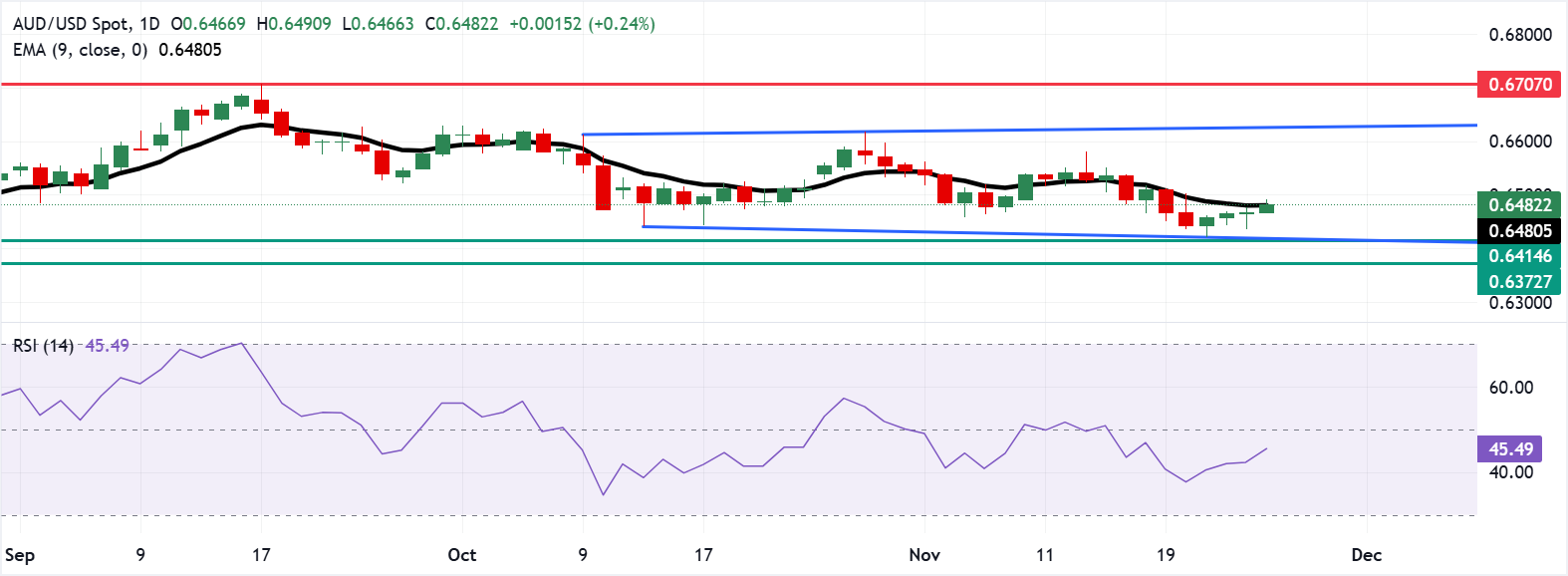
Australian Dollar could target 0.6500 after decisively breaking above nine-day EMA
The AUD/USD pair is trading around 0.6480 on Wednesday. The daily chart analysis shows the pair holding within a rectangular consolidation zone, signaling a neutral bias. The pair continues to trade below the nine-day Exponential Moving Average (EMA), highlighting subdued short-term upward momentum.
The AUD/USD pair finds immediate support at the lower boundary of the rectangle around 0.6420, followed by the five-month low of 0.6414, set on August 21.
On the upside, the pair hovers around the nine-day EMA at 0.6479. A successful break above this moving average would support the AUD/USD pair to test the psychological level of 0.6500. Further advances would lead the pair to reach the rectangle’s upper boundary near 0.6630.
Australian Dollar Price Today
The table below shows the percentage change of Australian Dollar (AUD) against listed major currencies today. Australian Dollar was the strongest against the Japanese Yen.
| USD | EUR | GBP | JPY | CAD | AUD | NZD | CHF | |
|---|---|---|---|---|---|---|---|---|
| USD | -0.20% | -0.21% | 0.00% | -0.18% | -0.58% | -1.25% | -0.34% | |
| EUR | 0.20% | -0.01% | 0.20% | 0.02% | -0.39% | -1.05% | -0.14% | |
| GBP | 0.21% | 0.01% | 0.23% | 0.03% | -0.37% | -1.04% | -0.12% | |
| JPY | 0.00% | -0.20% | -0.23% | -0.19% | -0.58% | -1.26% | -0.34% | |
| CAD | 0.18% | -0.02% | -0.03% | 0.19% | -0.42% | -1.08% | -0.16% | |
| AUD | 0.58% | 0.39% | 0.37% | 0.58% | 0.42% | -0.67% | 0.25% | |
| NZD | 1.25% | 1.05% | 1.04% | 1.26% | 1.08% | 0.67% | 0.93% | |
| CHF | 0.34% | 0.14% | 0.12% | 0.34% | 0.16% | -0.25% | -0.93% |
The heat map shows percentage changes of major currencies against each other. The base currency is picked from the left column, while the quote currency is picked from the top row. For example, if you pick the Australian Dollar from the left column and move along the horizontal line to the US Dollar, the percentage change displayed in the box will represent AUD (base)/USD (quote).
Australian Dollar FAQs
One of the most significant factors for the Australian Dollar (AUD) is the level of interest rates set by the Reserve Bank of Australia (RBA). Because Australia is a resource-rich country another key driver is the price of its biggest export, Iron Ore. The health of the Chinese economy, its largest trading partner, is a factor, as well as inflation in Australia, its growth rate and Trade Balance. Market sentiment – whether investors are taking on more risky assets (risk-on) or seeking safe-havens (risk-off) – is also a factor, with risk-on positive for AUD.
The Reserve Bank of Australia (RBA) influences the Australian Dollar (AUD) by setting the level of interest rates that Australian banks can lend to each other. This influences the level of interest rates in the economy as a whole. The main goal of the RBA is to maintain a stable inflation rate of 2-3% by adjusting interest rates up or down. Relatively high interest rates compared to other major central banks support the AUD, and the opposite for relatively low. The RBA can also use quantitative easing and tightening to influence credit conditions, with the former AUD-negative and the latter AUD-positive.
China is Australia’s largest trading partner so the health of the Chinese economy is a major influence on the value of the Australian Dollar (AUD). When the Chinese economy is doing well it purchases more raw materials, goods and services from Australia, lifting demand for the AUD, and pushing up its value. The opposite is the case when the Chinese economy is not growing as fast as expected. Positive or negative surprises in Chinese growth data, therefore, often have a direct impact on the Australian Dollar and its pairs.
Iron Ore is Australia’s largest export, accounting for $118 billion a year according to data from 2021, with China as its primary destination. The price of Iron Ore, therefore, can be a driver of the Australian Dollar. Generally, if the price of Iron Ore rises, AUD also goes up, as aggregate demand for the currency increases. The opposite is the case if the price of Iron Ore falls. Higher Iron Ore prices also tend to result in a greater likelihood of a positive Trade Balance for Australia, which is also positive of the AUD.
The Trade Balance, which is the difference between what a country earns from its exports versus what it pays for its imports, is another factor that can influence the value of the Australian Dollar. If Australia produces highly sought after exports, then its currency will gain in value purely from the surplus demand created from foreign buyers seeking to purchase its exports versus what it spends to purchase imports. Therefore, a positive net Trade Balance strengthens the AUD, with the opposite effect if the Trade Balance is negative.
Author

Akhtar Faruqui
FXStreet
Akhtar Faruqui is a Forex Analyst based in New Delhi, India. With a keen eye for market trends and a passion for dissecting complex financial dynamics, he is dedicated to delivering accurate and insightful Forex news and analysis.

















