Australian Dollar drops as ASX 200 Index declines, awaits US Consumer Sentiment
- Australian Dollar extends losses after stronger US PPI data.
- Australia's S&P/ASX 200 Index tracks losses on Wall Street overnight.
- People's Bank of China has maintained the 1-year MLF rate at 2.5%.
- US Dollar strengthened as the Fed is expected to prolong its higher interest rates.

The Australian Dollar (AUD) extends its losses for the second successive day on Friday, reaching weekly lows. The AUD/USD pair depreciates as the US Dollar (USD) gains fresh momentum, driven by stronger-than-expected Producer Price Index (PPI) data from the United States (US). This data further complicates the outlook for when the Federal Reserve will begin to cut interest rates.
Australia’s S&P/ASX 200 Index tumbles to its lowest levels in three weeks amidst a widespread market selloff. Australian shares follow losses on Wall Street overnight, with major banking and iron ore mining shares leading the decline. The Reserve Bank of Australia (RBA) maintains its stance of potentially raising rates further, with the RBA’s policy decision scheduled for next week. In the meantime, traders will likely keep an eye on the preliminary US Michigan Consumer Sentiment Index for March, due to be released on Friday.
The US Dollar Index (DXY) benefits from the hawkish sentiment surrounding the Federal Reserve, contemplating maintaining its higher interest rates in response to persistent inflationary pressures. Additionally, US Treasury yields have risen for the past four consecutive sessions, lending further support to the US Dollar (USD), consequently, undermining the AUD/USD pair.
Daily Digest Market Movers: Australian Dollar depreciates after stronger US PPI data
- Australia's NAB Business Confidence Index decreased to 0 in February, from the previous reading of 1. Business Conditions Index improved to 10 from the previous reading of 7 (revised from 6).
- According to a Reuters poll conducted ahead of the RBA meeting, analysts forecast that the central bank could maintain its official cash rate at 4.35% for a third consecutive meeting, with no changes expected until at least the end of September.
- RBA Governor Michele Bullock recently stated that inflation in Australia is primarily "homegrown" and "demand-driven," attributable to the strength of the labor market and increasing wage inflation. The RBA does not anticipate this phenomenon occurring until 2026.
- Former RBA Governor Philip Lowe stated on Wednesday that there is a two-way risk on interest rates, supporting current RBA Governor Michelle Bullock's warning that interest rates might still need to increase.
- The People's Bank of China has maintained the 1-year Medium-term Lending Facility (MLF) rate at 2.5% and continues its trend of injecting cash via MLF for the 16th consecutive month. This time, it has added CNY 387 billion, slightly below the CNY 500 billion maturing.
- US Treasury Secretary Janet Louise Yellen remarked that it appears unlikely for interest rates to revert to levels as low as those before the Covid-19 pandemic. She also noted that the interest rate assumptions outlined in Biden’s budget plan were deemed "reasonable" and aligned with a broad spectrum of forecasts.
- According to the CME FedWatch Tool, the probability of a rate cut in March currently stands at 1.0%, while it has decreased to 7.7% for May. The likelihood of a rate cut in June and July is lower, at 59.0% and 79.4%, respectively.
- The US Core Producer Price Index (PPI) remained consistent with the rise of 2.0% year-over-year in February, maintaining its position above the 1.9% expected. The monthly report showed an increase of 0.3% against 0.5% prior, exceeding the expected 0.2% reading.
- US PPI (YoY) increased by 1.6% in February, surpassing the expected 1.1% and 1.0% prior. PPI (MoM) rose by 0.6% above the market expectation and the previous increase of 0.3%.
- US Retail Sales rose by 0.6% monthly, below the expected 0.8% in February, swinging from the previous decline of 1.1%. While Retail Sales Control Group improved to a flat 0.0%, compared to the previous decline of 0.3%.
Technical Analysis: Australian Dollar drops to near 0.6570 followed by a 50.0% retracement
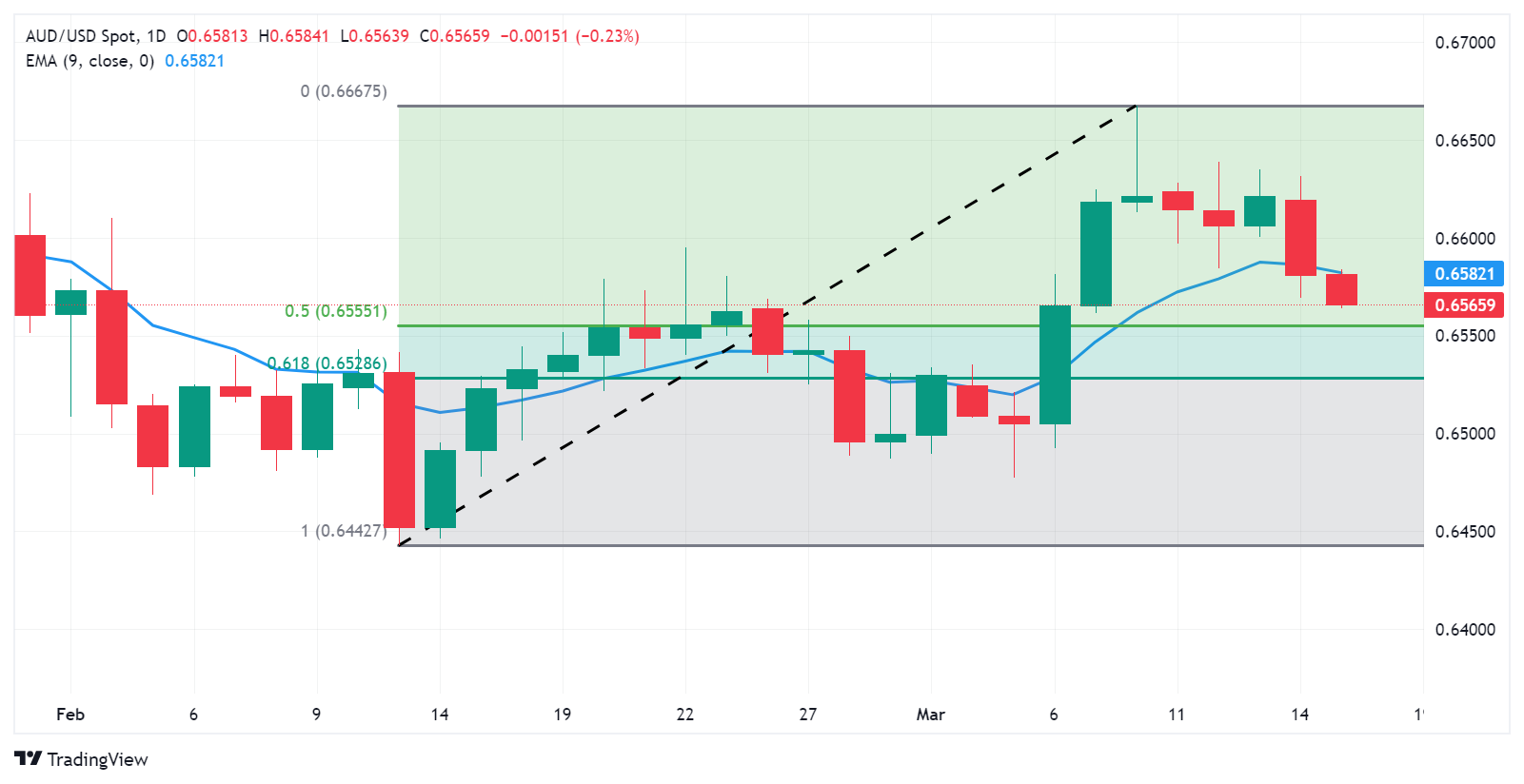
The Australian Dollar traded near 0.6570 on Friday. Immediate support is seen around the 50.0% retracement level of 0.6555, which aligns with the major support at 0.6550. A breach below this level could exert downward pressure on the AUD/USD pair, with potential support at the 61.8% Fibonacci retracement level of 0.6528, followed by the psychological level of 0.6500. On the upside, the AUD/USD pair may encounter a barrier around the nine-day Exponential Moving Average (EMA) at 0.6583, preceding the psychological barrier at 0.6600. A breakthrough above this level could lead the pair to revisit the weekly high of 0.6638, followed by the major level of 0.6650.
AUD/USD: Daily Chart
Australian Dollar price today
The table below shows the percentage change of Australian Dollar (AUD) against listed major currencies today. Australian Dollar was the weakest against the US Dollar.
| USD | EUR | GBP | CAD | AUD | JPY | NZD | CHF | |
| USD | 0.05% | 0.03% | -0.01% | 0.19% | 0.01% | 0.37% | 0.05% | |
| EUR | -0.04% | -0.01% | -0.07% | 0.10% | -0.06% | 0.32% | 0.00% | |
| GBP | -0.06% | 0.01% | -0.07% | 0.11% | -0.04% | 0.32% | 0.01% | |
| CAD | 0.03% | 0.06% | 0.06% | 0.21% | 0.02% | 0.38% | 0.07% | |
| AUD | -0.19% | -0.10% | -0.11% | -0.16% | -0.15% | 0.19% | -0.10% | |
| JPY | 0.00% | 0.07% | 0.04% | -0.02% | 0.18% | 0.35% | 0.05% | |
| NZD | -0.37% | -0.31% | -0.33% | -0.38% | -0.18% | -0.36% | -0.31% | |
| CHF | -0.05% | 0.00% | -0.02% | -0.07% | 0.13% | -0.05% | 0.31% |
The heat map shows percentage changes of major currencies against each other. The base currency is picked from the left column, while the quote currency is picked from the top row. For example, if you pick the Euro from the left column and move along the horizontal line to the Japanese Yen, the percentage change displayed in the box will represent EUR (base)/JPY (quote).
Australian Dollar FAQs
One of the most significant factors for the Australian Dollar (AUD) is the level of interest rates set by the Reserve Bank of Australia (RBA). Because Australia is a resource-rich country another key driver is the price of its biggest export, Iron Ore. The health of the Chinese economy, its largest trading partner, is a factor, as well as inflation in Australia, its growth rate and Trade Balance. Market sentiment – whether investors are taking on more risky assets (risk-on) or seeking safe-havens (risk-off) – is also a factor, with risk-on positive for AUD.
The Reserve Bank of Australia (RBA) influences the Australian Dollar (AUD) by setting the level of interest rates that Australian banks can lend to each other. This influences the level of interest rates in the economy as a whole. The main goal of the RBA is to maintain a stable inflation rate of 2-3% by adjusting interest rates up or down. Relatively high interest rates compared to other major central banks support the AUD, and the opposite for relatively low. The RBA can also use quantitative easing and tightening to influence credit conditions, with the former AUD-negative and the latter AUD-positive.
China is Australia’s largest trading partner so the health of the Chinese economy is a major influence on the value of the Australian Dollar (AUD). When the Chinese economy is doing well it purchases more raw materials, goods and services from Australia, lifting demand for the AUD, and pushing up its value. The opposite is the case when the Chinese economy is not growing as fast as expected. Positive or negative surprises in Chinese growth data, therefore, often have a direct impact on the Australian Dollar and its pairs.
Iron Ore is Australia’s largest export, accounting for $118 billion a year according to data from 2021, with China as its primary destination. The price of Iron Ore, therefore, can be a driver of the Australian Dollar. Generally, if the price of Iron Ore rises, AUD also goes up, as aggregate demand for the currency increases. The opposite is the case if the price of Iron Ore falls. Higher Iron Ore prices also tend to result in a greater likelihood of a positive Trade Balance for Australia, which is also positive of the AUD.
The Trade Balance, which is the difference between what a country earns from its exports versus what it pays for its imports, is another factor that can influence the value of the Australian Dollar. If Australia produces highly sought after exports, then its currency will gain in value purely from the surplus demand created from foreign buyers seeking to purchase its exports versus what it spends to purchase imports. Therefore, a positive net Trade Balance strengthens the AUD, with the opposite effect if the Trade Balance is negative.
Author

Akhtar Faruqui
FXStreet
Akhtar Faruqui is a Forex Analyst based in New Delhi, India. With a keen eye for market trends and a passion for dissecting complex financial dynamics, he is dedicated to delivering accurate and insightful Forex news and analysis.