Australian Dollar extends losses on dovish RBA message despite rate hike
- Australian Dollar extends losses amid a 25 bps interest rate hike by the RBA.
- Australia’s central bank lifted OCR from 4.10% to 4.35% after holding interest rate for four consecutive meetings.
- China's Trade Balance reduced to $56.53B against the market consensus of $81.95B in October.

The Australian Dollar (AUD) continues to decline despite a 25 basis points interest rate hike by the Reserve Bank of Australia (RBA) on Tuesday. The AUD/USD pair also faced losses as a result of the positive performance of US Treasury yields, aiding the US Dollar (USD) in bouncing back from its two-month low.
Australia's central bank has recommenced policy tightening, raising the Official Cash Rate (OCR) from 4.10% to 4.35% after keeping the benchmark interest rate steady for four consecutive meetings. The RBA's decision to take this step could be a reaction to the recent Consumer Price Index (CPI) data, which showed a third-quarter increase surpassing market consensus. Additionally, Australia's seasonally adjusted Retail Sales (MoM) for September exceeded expectations.
The RBA has indicated reduced confidence in the necessity for additional hikes and is now adopting a data-dependent approach, waiting for more significant upside inflation before considering further increases. While there is skepticism that upcoming data will prompt additional RBA rate hikes, the central bank's apprehension about persistent inflation risks might discourage premature rate cuts next year.
China's Trade Balance data for October revealed a decrease in the surplus balance against the market expectations of an improvement. While Exports (YoY) experienced a more significant decline, surpassing the expected decrease and exceeding the previous decline.
US Dollar Index (DXY) recovers from its seven-week low due to improved US Treasury yields. The 10-year US Treasury yield has bounced back from the six-week low noted last Friday. Moreover, Minneapolis Federal Reserve Bank President Neel Kashkari, in a Monday interview with the Wall Street Journal, conveyed a cautious approach to monetary policy.
President Kashkari leans towards being overly cautious, expressing a preference for overtightening rather than risking not doing enough to bring inflation in line with the central bank's 2% target.
Daily Digest Market Movers: Australian Dollar faces challenges despite the interest rate hike by RBA
- RBA has resumed policy tightening, raising the Official Cash Rate (OCR) from 4.10% to 4.35% after maintaining the benchmark interest rate unchanged for four consecutive meetings.
- Australia’s TD Securities Inflation (YoY) reduced to 5.1% in September from 5.7% prior.
- Australia’s Retail Sales improved to 0.2% in the third quarter from the previous reading of -0.6%.
- Aussie Trade Balance (Month-on-Month) decreased to 6,786M in September, falling short of expectations set at 9,400M and down from the previous figure of 10,161M.
- In the twelve months leading up to September 2023, Australia’s monthly Consumer Price Index (CPI) recorded a 5.6% increase. However, the quarterly inflation rate dipped to 5.4% year-on-year in Q3.
- China's Trade Balance data for October revealed a decrease in the surplus balance at $56.53B against the market expectations of an improvement to $81.95B from the previous readings of $77.71B. While Exports (YoY) experienced a more significant decline of 6.4%, more than the expected decline of 3.1%.
- US Bureau of Labor Statistics recently unveiled the Non-Farm Payrolls (NFP) data for October, disclosing a figure of 150K. This missed the expected 180K and marked a substantial drop from September's 297K.
- US Average Hourly Earnings (Month-on-Month) saw a decline to 0.2%, deviating from the anticipated 0.3%. On a year-over-year basis, it came in at 4.1%, surpassing the 4.0% expectations.
- US ISM Services Purchasing Managers' Index (PMI) declined from the previous 53.6 to 51.8. Additionally, on Thursday, the US Department of Labor released the count of initial claims for unemployment benefits for the week ending October 27, showing an increase from 212,000 to 217,000.
Technical Analysis: Australian Dollar breaks below the major support at 0.6450 level
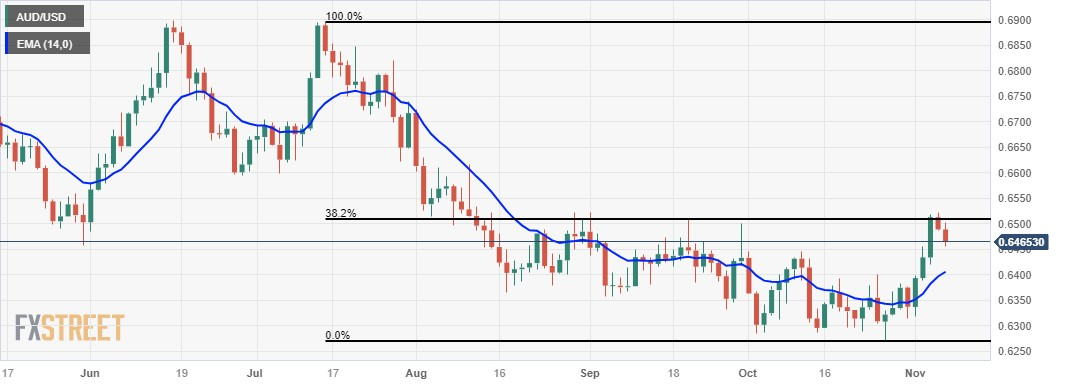
The Australian Dollar trades lower around the major support at the 0.6450 level followed by the 14-day Exponential Moving Average (EMA) at 0.6406 lined up with the psychological level at 0.6400. On the upside, the 38.2% Fibonacci retracement level at 0.6508 could act as the immediate resistance followed by September’s high at 0.6521.
AUD/USD: Daily Chart
Australian Dollar price today
The table below shows the percentage change of Australian Dollar (AUD) against listed major currencies today. Australian Dollar was the weakest against the US Dollar.
| USD | EUR | GBP | CAD | AUD | JPY | NZD | CHF | |
| USD | 0.23% | 0.24% | 0.32% | 0.99% | 0.24% | 0.72% | 0.01% | |
| EUR | -0.24% | 0.00% | 0.08% | 0.73% | 0.02% | 0.52% | -0.21% | |
| GBP | -0.24% | -0.03% | 0.06% | 0.75% | 0.01% | 0.50% | -0.23% | |
| CAD | -0.32% | -0.08% | -0.09% | 0.69% | -0.06% | 0.44% | -0.28% | |
| AUD | -1.01% | -0.80% | -0.77% | -0.69% | -0.77% | -0.26% | -0.99% | |
| JPY | -0.27% | -0.04% | -0.02% | 0.03% | 0.70% | 0.50% | -0.25% | |
| NZD | -0.76% | -0.55% | -0.52% | -0.44% | 0.23% | -0.52% | -0.74% | |
| CHF | -0.03% | 0.19% | 0.22% | 0.30% | 0.97% | 0.22% | 0.73% |
The heat map shows percentage changes of major currencies against each other. The base currency is picked from the left column, while the quote currency is picked from the top row. For example, if you pick the Euro from the left column and move along the horizontal line to the Japanese Yen, the percentage change displayed in the box will represent EUR (base)/JPY (quote).
Australian Dollar FAQs
What key factors drive the Australian Dollar?
One of the most significant factors for the Australian Dollar (AUD) is the level of interest rates set by the Reserve Bank of Australia (RBA). Because Australia is a resource-rich country another key driver is the price of its biggest export, Iron Ore. The health of the Chinese economy, its largest trading partner, is a factor, as well as inflation in Australia, its growth rate and Trade Balance. Market sentiment – whether investors are taking on more risky assets (risk-on) or seeking safe-havens (risk-off) – is also a factor, with risk-on positive for AUD.
How do the decisions of the Reserve Bank of Australia impact the Australian Dollar?
The Reserve Bank of Australia (RBA) influences the Australian Dollar (AUD) by setting the level of interest rates that Australian banks can lend to each other. This influences the level of interest rates in the economy as a whole. The main goal of the RBA is to maintain a stable inflation rate of 2-3% by adjusting interest rates up or down. Relatively high interest rates compared to other major central banks support the AUD, and the opposite for relatively low. The RBA can also use quantitative easing and tightening to influence credit conditions, with the former AUD-negative and the latter AUD-positive.
How does the health of the Chinese Economy impact the Australian Dollar?
China is Australia’s largest trading partner so the health of the Chinese economy is a major influence on the value of the Australian Dollar (AUD). When the Chinese economy is doing well it purchases more raw materials, goods and services from Australia, lifting demand for the AUD, and pushing up its value. The opposite is the case when the Chinese economy is not growing as fast as expected. Positive or negative surprises in Chinese growth data, therefore, often have a direct impact on the Australian Dollar and its pairs.
How does the price of Iron Ore impact the Australian Dollar?
Iron Ore is Australia’s largest export, accounting for $118 billion a year according to data from 2021, with China as its primary destination. The price of Iron Ore, therefore, can be a driver of the Australian Dollar. Generally, if the price of Iron Ore rises, AUD also goes up, as aggregate demand for the currency increases. The opposite is the case if the price of Iron Ore falls. Higher Iron Ore prices also tend to result in a greater likelihood of a positive Trade Balance for Australia, which is also positive of the AUD.
How does the Trade Balance impact the Australian Dollar?
The Trade Balance, which is the difference between what a country earns from its exports versus what it pays for its imports, is another factor that can influence the value of the Australian Dollar. If Australia produces highly sought after exports, then its currency will gain in value purely from the surplus demand created from foreign buyers seeking to purchase its exports versus what it spends to purchase imports. Therefore, a positive net Trade Balance strengthens the AUD, with the opposite effect if the Trade Balance is negative.
Author

Akhtar Faruqui
FXStreet
Akhtar Faruqui is a Forex Analyst based in New Delhi, India. With a keen eye for market trends and a passion for dissecting complex financial dynamics, he is dedicated to delivering accurate and insightful Forex news and analysis.

















