Despite NASDAQ sell-off, software stocks recoup losses on Thursday
- Software stock continue rebounding for third straight session.
- Accenture, Atlassian lead the pack as both rise north of 6%.
- NASDAQ loses as much as 2% on Thursday due to Nvidia's post-earnings slide.
- IGV, XSW software ETFs both require new range highs in order to confirm a bottom.

Thursday's NASDAQ index sell-off is the major story of the session, but underneath it lies a recovering software market. Despite Nvidia (NVDA) hitting every consensus figure on Wall Street with its Q4 result posted late Wednesday, shares of the world's largest company have sunk nearly 5% by noon in New York. That caused the tech-heavy NASDAQ to sink as much as 2% intraday.
However, shares of the most beaten-down software stocks are rebounding at a decent clip. The State Street SPDR S&P Software & Services ETF (XSW) has resisted the index trend to rise 1.3%. The S&P 500 was trimmed by close to 1%, while the more value-conscious Dow Jones Industrial Average (DJIA) is off just a quarter percent.
Software is the place to be on Thursday
Software stocks have been trading lower for months as the narrative that artificial intelligence will destroy many software-as-a-service (SaaS) business models has taken hold. Most software indices or ETFs are down about 30% from the highs seen last autumn.
So, following Monday's major sell-off in a number of high-profile software names, most of which were affected by Citrini Research's THE 2028 GLOBAL INTELLIGENCE CRISIS report that dropped the day before, software has been rebounding for three straight days. Citrini's contention that AI would allow most big businesses to build their own in-house software and thus depress SaaS pricing gave way to other voices this week arguing that most software companies would themselves be advantaged by the upsurge in AI use cases.
Thursday's groundswell in software stock buying, the third straight day of significant gains, could signal the end of the early 2026 software drought.
Accenture (ACN), which has a sizable software consulting business, has regained over 6% on Thursday, while Atlassian (TEAM) has advanced north of 7%. Workday (WDAY) is up more than 3%, as are Datadog (DDOG) and ServiceNow (NOW).
Despite another post-earnings sell-off, Salesforce (CRM) has risen 2%, as has Intuit (INTU), a major victim of the software sell-off.
Cybersecurity names like Palo Alto Networks (PANW) and CrowdStrike (CRWD) also moved higher.
Software ETF technical analysis: IGV, XSW
Does three days of accumulation signal that the drought is over? Not so fast. In both cases, two popular software ETFs tell us that the first necessary ingredient, a new range high, is yet to surface.
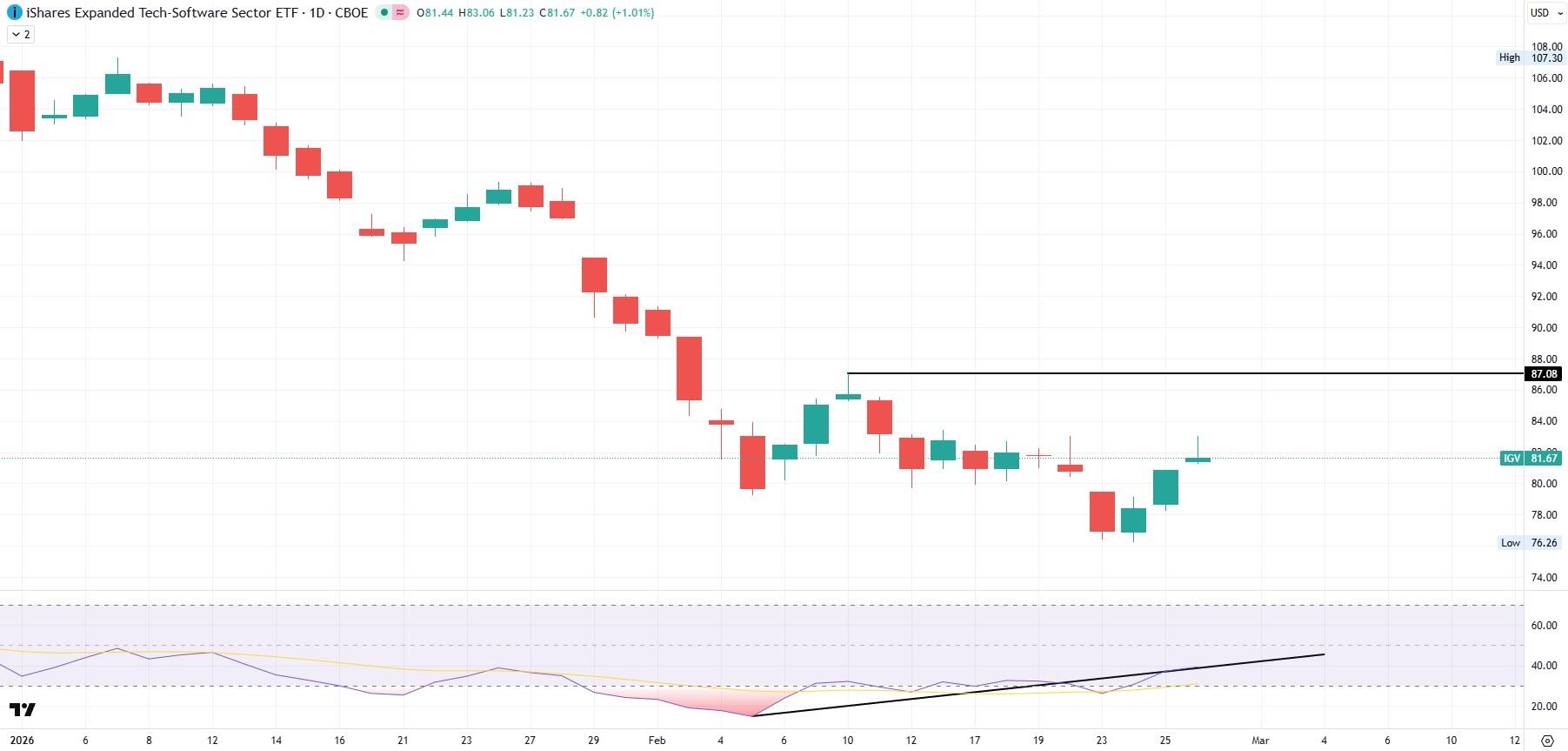
First, we have the daily chart from iShares Expanded Tech-Software Sector ETF (IGV). While the ETF has made notable gains for the last three sessions, the share price needs to close above $87.08, the high from February 10, before we can admit to a bullish signal. However, the Relative Strength Index (RSI) is seeing divergence with the price action over the past three weeks, so that is one point in favor of bulls. Reversals in major trends are often foreshadowed by RSI divergence.
For the XSW ETF, which features a number of software companies with lower market caps, we see a similar dynamic. XSW might have climbed out of the hole created by Monday's sell-off, but the ETF needs to close above $161.09 in order to confirm a range high. Once again, though, the RSI is rising out of the oversold territory despite cascading new lows in the share price. This RSI divergence is sure to interest bulls, but waiting for a breakout above $161.09 remains necessary.
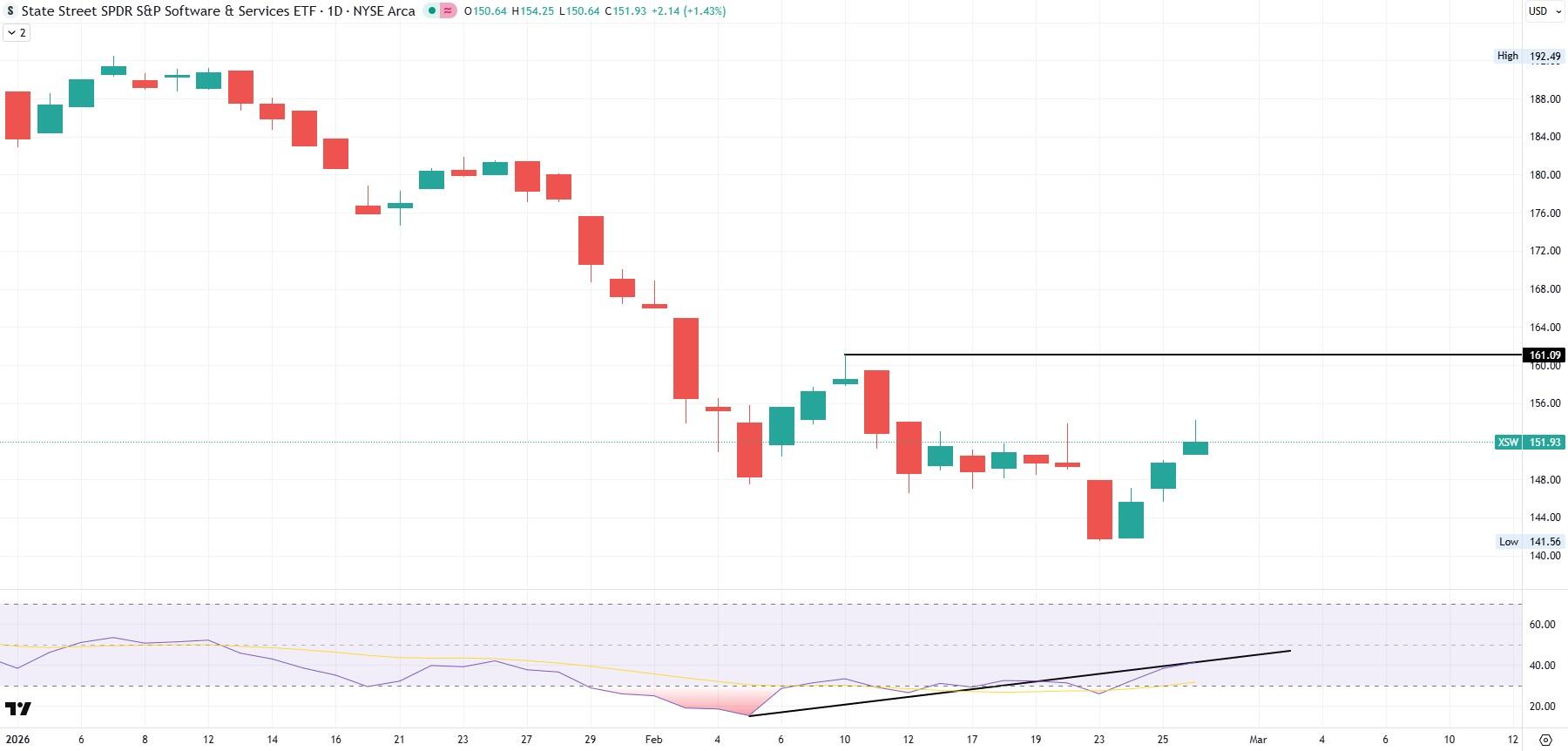
This is because the February 6, 9 and 10 candles for both ETFs mirror a similar optimism with the Tuesday through Thursday candles this week. That earlier phase of rebound saw similar price movements only to be followed by multiple sessions of lower lows.
Author

Clay Webster
FXStreet
Clay Webster grew up in the US outside Buffalo, New York and Lancaster, Pennsylvania. He began investing after college following the 2008 financial crisis.