Australian Dollar advances as US Dollar remains subdued ahead of economic data releases
- The Australian Dollar gains ground as the US Dollar remains subdued amid bond market optimism.
- Australia’s Monthly Consumer Price Index remained consistent at a 2.1% rise YoY in October, against an expected 2.3% increase.
- November’s FOMC Meeting Minutes indicated that policymakers are adopting a cautious stance on rate cuts.

The Australian Dollar (AUD) halts its three-day losing streak on Wednesday as the US Dollar (USD) remains subdued amid bond market optimism. Additionally, the Reserve Bank of Australia's (RBA) hawkish outlook on future interest rate decisions provides support for the AUD. Traders await the US Personal Consumption Expenditure (PCE) Price Index and quarterly Gross Domestic Product Annualized scheduled to be released later in the North American session.
Australia's monthly Consumer Price Index (CPI) rose by 2.1% year-over-year in October, unchanged from the previous month but below market expectations of 2.3%. This marked the lowest inflation rate since July 2021 and remained within the central bank's target range of 2-3% for the third consecutive month.
The upside of the AUD/USD pair could be restrained due to dampened market sentiment following President-elect Donald Trump's announcement of a 10% increase in tariffs on all Chinese goods entering the United States (US). Given that both countries are close trade partners, any change in China's economy would impact Australian markets.
China’s Ambassador to Australia remarked on Tuesday that "US policy on trade with China and other countries will have an impact." The Ambassador highlighted China's expectation for dialogue with the US to address trade policies and explore ways to manage their bilateral relationship effectively.
Australian Dollar receives support from hawkish sentiment surrounding the RBA
- The latest Federal Open Market Committee's (FOMC) Meeting Minutes for the policy meeting held on November 7, indicated that policymakers are adopting a cautious stance on cutting interest rates, citing easing inflation and a robust labor market.
- US President-elect Donald Trump is expected to appoint Jamieson Greer as the US Trade Representative, Bloomberg reported on Tuesday. Greer’s nomination highlights the central role of tariffs in Trump’s economic strategy.
- Chicago Fed President Austan Goolsbee indicated on Tuesday that the Fed is likely to continue lowering interest rates toward a neutral stance that neither stimulates nor restricts economic activity. Meanwhile, Minneapolis Fed President Neel Kashkari highlighted that it remains appropriate to consider another rate cut at the Fed’s December meeting, according to Bloomberg.
- US bond market gains ground as US President-elect Donald Trump selected the fund manager Scott Bessent as the US Treasury secretary, a seasoned Wall Street figure and fiscal conservative.
- The recent preliminary S&P Global US Purchasing Managers’ Index (PMI) data have reinforced expectations that the Federal Reserve (Fed) may slow the pace of rate cuts. Futures traders are now assigning a 57.7% probability to the Federal Reserve cutting rates by a quarter point in December, according to the CME FedWatch Tool.
- Australia's four largest banks are predicting the Reserve Bank of Australia's first rate cut. Westpac has revised its forecast for the first cut to May, up from February. National Australia Bank (NAB) also expects the cut in May. Meanwhile, the Commonwealth Bank of Australia (CBA) and ANZ are cautiously forecasting a rate cut in February.
Technical Analysis: Australian Dollar rises toward nine-day EMA near 0.6500
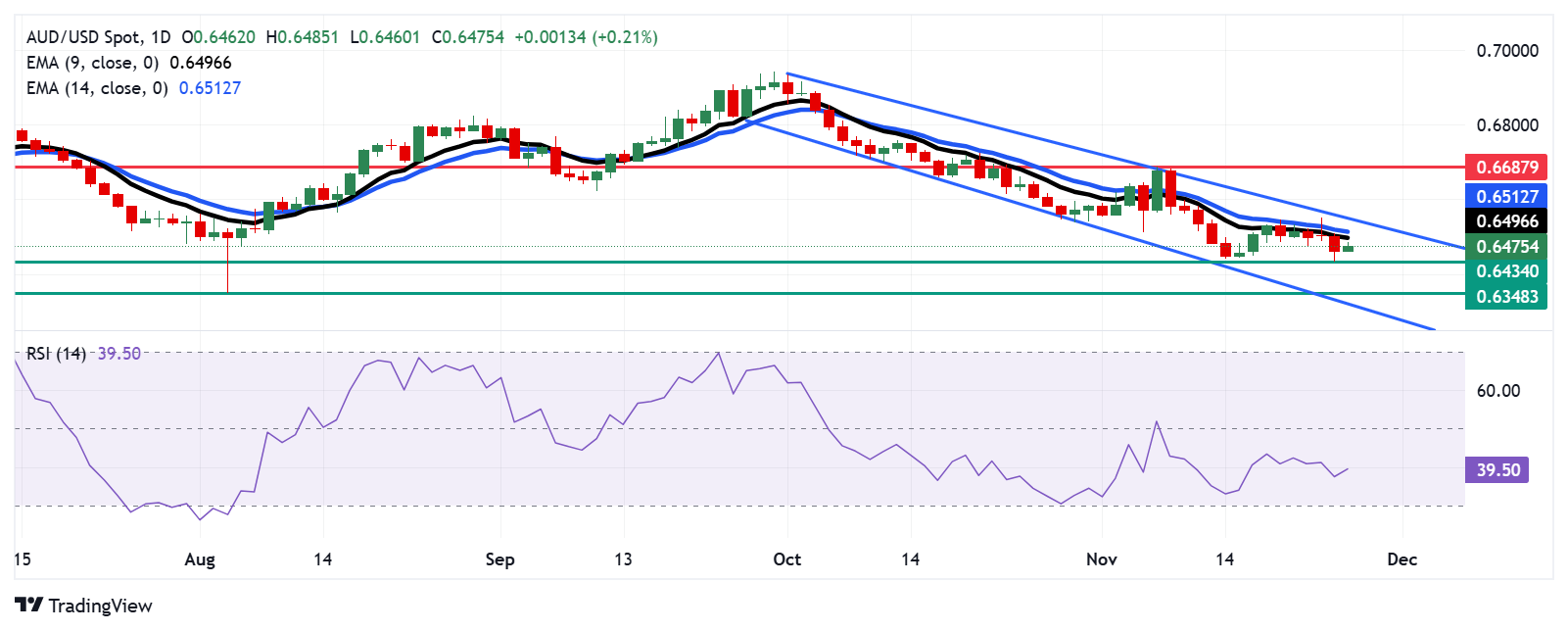
The AUD/USD pair hovers near 0.6470 on Wednesday, with technical analysis of the daily chart suggesting strengthening short-term bearish momentum. The pair remains confined within a descending channel, while the 14-day Relative Strength Index (RSI) stays below 50, signaling persistent negative sentiment.
Regarding its support, the AUD/USD pair could test its four-month low of 0.6434 recorded on November 26. A break below this level could lead the pair to approach the yearly low of 0.6348, last reached on August 5, with additional support found near the descending channel's lower boundary at 0.6320.
On the upside, the resistance lies at the nine-day Exponential Moving Average (EMA) of 0.6495 and the 14-day EMA of 0.6512. Further resistance appears at the upper boundary of the descending channel at the 0.6550 level. A decisive break above these levels could support the pair to explore the region around its four-week high of 0.6687.
AUD/USD: Daily Chart
Australian Dollar PRICE Today
The table below shows the percentage change of Australian Dollar (AUD) against listed major currencies today. Australian Dollar was the strongest against the US Dollar.
| USD | EUR | GBP | JPY | CAD | AUD | NZD | CHF | |
|---|---|---|---|---|---|---|---|---|
| USD | -0.08% | -0.18% | -0.65% | -0.02% | -0.33% | -0.83% | -0.24% | |
| EUR | 0.08% | -0.10% | -0.57% | 0.05% | -0.25% | -0.75% | -0.17% | |
| GBP | 0.18% | 0.10% | -0.48% | 0.16% | -0.14% | -0.65% | -0.06% | |
| JPY | 0.65% | 0.57% | 0.48% | 0.63% | 0.33% | -0.18% | 0.41% | |
| CAD | 0.02% | -0.05% | -0.16% | -0.63% | -0.31% | -0.81% | -0.22% | |
| AUD | 0.33% | 0.25% | 0.14% | -0.33% | 0.31% | -0.50% | 0.08% | |
| NZD | 0.83% | 0.75% | 0.65% | 0.18% | 0.81% | 0.50% | 0.59% | |
| CHF | 0.24% | 0.17% | 0.06% | -0.41% | 0.22% | -0.08% | -0.59% |
The heat map shows percentage changes of major currencies against each other. The base currency is picked from the left column, while the quote currency is picked from the top row. For example, if you pick the Australian Dollar from the left column and move along the horizontal line to the US Dollar, the percentage change displayed in the box will represent AUD (base)/USD (quote).
Economic Indicator
Gross Domestic Product Annualized
The real Gross Domestic Product (GDP) Annualized, released quarterly by the US Bureau of Economic Analysis, measures the value of the final goods and services produced in the United States in a given period of time. Changes in GDP are the most popular indicator of the nation’s overall economic health. The data is expressed at an annualized rate, which means that the rate has been adjusted to reflect the amount GDP would have changed over a year’s time, had it continued to grow at that specific rate. Generally speaking, a high reading is seen as bullish for the US Dollar (USD), while a low reading is seen as bearish.
Read more.Next release: Wed Nov 27, 2024 13:30 (Prel)
Frequency: Quarterly
Consensus: 2.8%
Previous: 2.8%
Source: US Bureau of Economic Analysis
The US Bureau of Economic Analysis (BEA) releases the Gross Domestic Product (GDP) growth on an annualized basis for each quarter. After publishing the first estimate, the BEA revises the data two more times, with the third release representing the final reading. Usually, the first estimate is the main market mover and a positive surprise is seen as a USD-positive development while a disappointing print is likely to weigh on the greenback. Market participants usually dismiss the second and third releases as they are generally not significant enough to meaningfully alter the growth picture.
Author

Akhtar Faruqui
FXStreet
Akhtar Faruqui is a Forex Analyst based in New Delhi, India. With a keen eye for market trends and a passion for dissecting complex financial dynamics, he is dedicated to delivering accurate and insightful Forex news and analysis.















