AUD/USD retreats as geopolitical risks increase, limiting US Dollar weakness
- The AUD/USD falls on rising geopolitical risks and a lack of fresh fundamental drivers in Australia.
- The US Dollar gains after Israel attacks Iran's nuclear facilities, impacting demand for the Australian Dollar.
- The pair continues to be influenced by monetary policy expectations of both the Reserve Bank of Australia and the Federal Reserve.

The Australian Dollar (AUD) is weakening against the US Dollar (USD) on Friday, with price action being guided by a combination of factors.
The two primary drivers of the recent move have been increasing geopolitical risks and interest rate expectations, which are likely to continue influencing near-term price movements.
At the time of writing, AUD/USD is trading below 0.6500, with intraday losses of 0.60%.
Market sentiment remains fragile following the escalation of tensions in the Middle East. Reports overnight say that Israel launched targeted strikes on Iranian nuclear and military sites, killing several senior officials.
This has led to heightened fears of a broader regional conflict. It has also underpinned safe-haven demand for the US Dollar, limiting risk appetite and pressuring high-beta currencies, such as the Australian Dollar.
On the data front, the University of Michigan’s preliminary Consumer Sentiment Index for June showed an improvement in household confidence.
However, both one-year and five-year Consumer Inflation Expectations moved slightly lower, reinforcing this week’s softer-than-expected US CPI and PPI prints.
Looking ahead, focus turns to key Chinese data due Monday, including Industrial Production and Retail Sales for May, which could heavily influence AUD/USD due to Australia’s strong trade ties with China.
AUD/USD technical analysis: Bearish bias below 0.6500
AUD/USD is trading below 0.6500 on Friday, pulling back after stalling at resistance around 0.6535.
Price remains confined within a rising wedge pattern after failing to break through prior wedge resistance, with 0.6535 now acting as a key upside barrier.
The 61.8% Fibonacci retracement level of the September–April decline at 0.6549 adds further resistance just above.
The pattern reflects fading bullish momentum and the risk of a breakdown if support levels fail to hold. Immediate support is located at the 20-day Simple Moving Average (SMA) near 0.6473, while stronger support aligns with the 200-day SMA and the 50% Fibonacci level at 0.6428.
AUD/USD daily chart
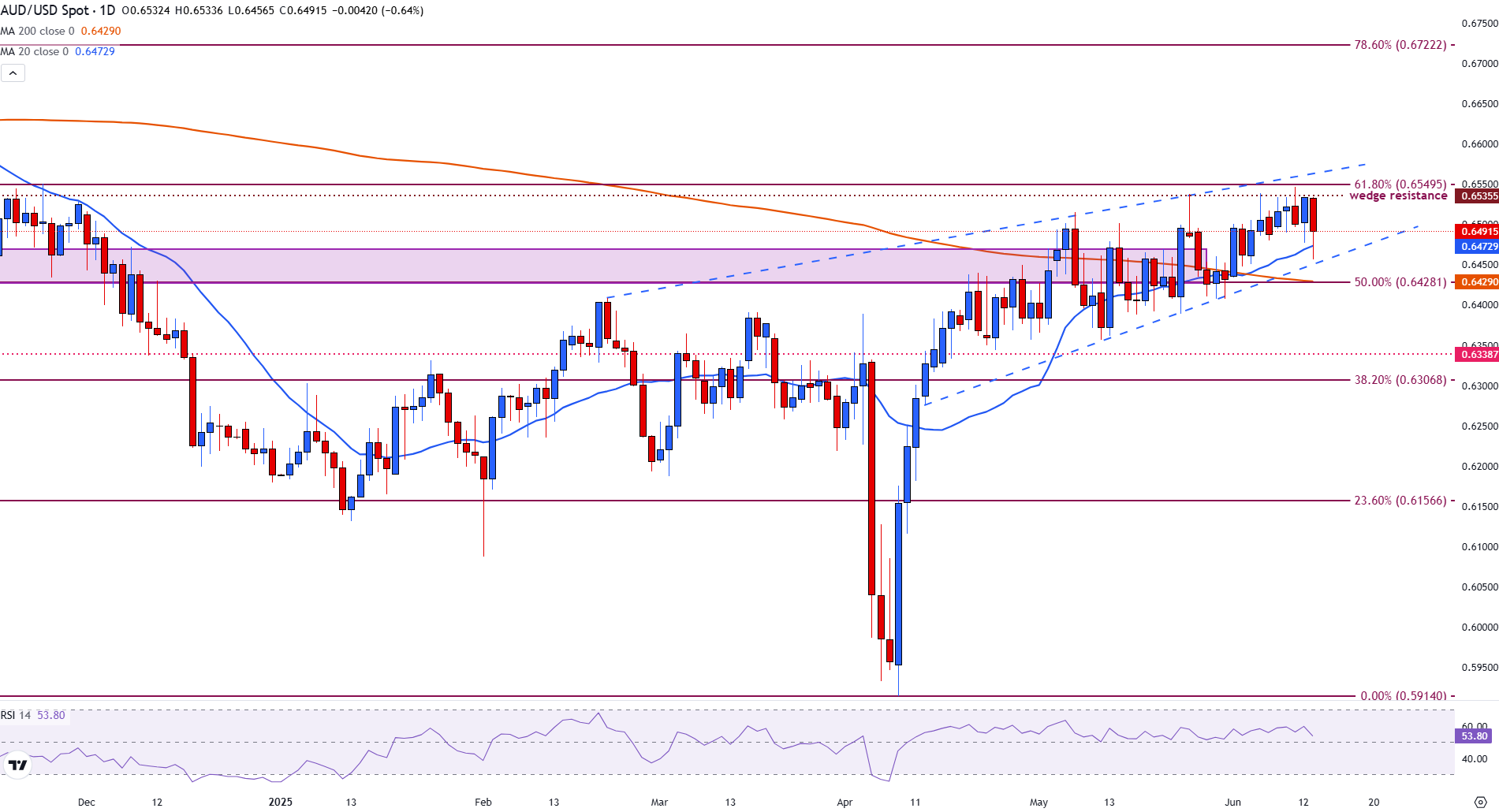
A close below this zone would confirm a break from the wedge and expose downside targets at 0.6338 and 0.6306.
On the upside, a breakout above 0.6535 would shift focus toward 0.6550 and the broader recovery target at 0.6722. The Relative Strength Index (RSI) is near 54, indicating a potential shift in trend as bullish momentum fades.
Australian Dollar FAQs
One of the most significant factors for the Australian Dollar (AUD) is the level of interest rates set by the Reserve Bank of Australia (RBA). Because Australia is a resource-rich country another key driver is the price of its biggest export, Iron Ore. The health of the Chinese economy, its largest trading partner, is a factor, as well as inflation in Australia, its growth rate and Trade Balance. Market sentiment – whether investors are taking on more risky assets (risk-on) or seeking safe-havens (risk-off) – is also a factor, with risk-on positive for AUD.
The Reserve Bank of Australia (RBA) influences the Australian Dollar (AUD) by setting the level of interest rates that Australian banks can lend to each other. This influences the level of interest rates in the economy as a whole. The main goal of the RBA is to maintain a stable inflation rate of 2-3% by adjusting interest rates up or down. Relatively high interest rates compared to other major central banks support the AUD, and the opposite for relatively low. The RBA can also use quantitative easing and tightening to influence credit conditions, with the former AUD-negative and the latter AUD-positive.
China is Australia’s largest trading partner so the health of the Chinese economy is a major influence on the value of the Australian Dollar (AUD). When the Chinese economy is doing well it purchases more raw materials, goods and services from Australia, lifting demand for the AUD, and pushing up its value. The opposite is the case when the Chinese economy is not growing as fast as expected. Positive or negative surprises in Chinese growth data, therefore, often have a direct impact on the Australian Dollar and its pairs.
Iron Ore is Australia’s largest export, accounting for $118 billion a year according to data from 2021, with China as its primary destination. The price of Iron Ore, therefore, can be a driver of the Australian Dollar. Generally, if the price of Iron Ore rises, AUD also goes up, as aggregate demand for the currency increases. The opposite is the case if the price of Iron Ore falls. Higher Iron Ore prices also tend to result in a greater likelihood of a positive Trade Balance for Australia, which is also positive of the AUD.
The Trade Balance, which is the difference between what a country earns from its exports versus what it pays for its imports, is another factor that can influence the value of the Australian Dollar. If Australia produces highly sought after exports, then its currency will gain in value purely from the surplus demand created from foreign buyers seeking to purchase its exports versus what it spends to purchase imports. Therefore, a positive net Trade Balance strengthens the AUD, with the opposite effect if the Trade Balance is negative.
Author

Tammy Da Costa, CFTe®
FXStreet
Tammy is an economist and market analyst with a deep passion for financial markets, particularly commodities and geopolitics.