|

AUD/USD Price Analysis: Moving up within a range

  • AUD/USD has started an up leg within its range. 
  • The move is facing tough resistance from a cluster of Moving Averages but will probably eventually extend higher.
  • A decisive breakout of the range will change the trend, making it more directional. 

AUD/USD bounces off the floor of a range it has formed since the middle of May. The pair is in a sideways trend which, given “the trend is your friend”, is more likely than not to extend. This suggests the up leg which began on Monday will probably continue rising to the range highs at circa 0.6709.

AUD/USD 4-hour Chart
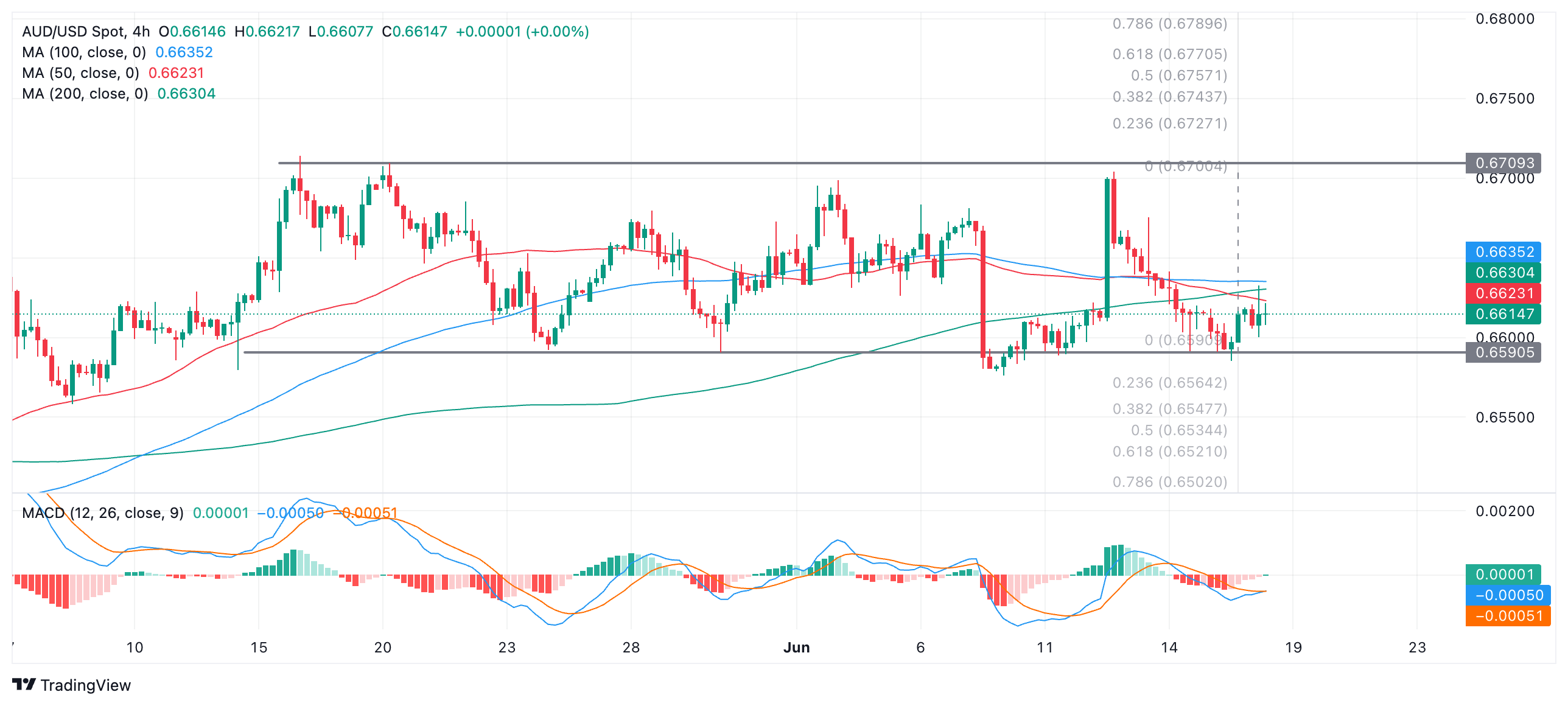
AUD/USD is currently encountering resistance from three major Simple Moving Averages (SMA) on the 4-hour timeframe, the 50, 100 and 200 SMAs. Whilst this is  obstructing further upside price will probably eventually break above the cluster. A close above 0.6640 would provide added confirmation of more upside, and probably lead to move up all the way to the range ceiling.

As long as price remains within the bounds of the range it will likely keep oscillating. A decisive breakout of the range would be required to signal a change to a more directional trend. An upside break is marginally more likely to happen because the trend prior to the formation of the range was bullish. The breakout move is likely to be volatile given the range highs and lows have been touched multiple times. 

A decisive break above the ceiling of the range would see a follow-through to a conservative target at 0.6770; a decisive break below the range floor would indicate a follow-through to an initial target at 0.6521. 

A decisive break would be one in which a longer-than-average candle broke out of the range and closed near its high or low, or three successive candles of the same color broke cleanly through the range top or bottom. 

The targets are generated using the technical-analysis method of extrapolating the height of the range by a Fibonacci 0.618 ratio higher (in the case of an upside break) or lower (in the case of a downside break). A more generous target would come from extrapolating the full height of the range.

Author

Joaquin Monfort

Joaquin Monfort is a financial writer and analyst with over 10 years experience writing about financial markets and alt data. He holds a degree in Anthropology from London University and a Diploma in Technical analysis.


More from Joaquin Monfort
Share:

Editor's Picks

GBP/USD ranges below 1.3450 amid US-Iran uncertainty, ahead of US data

GBP/USD keeps its range below 1.3450 in the European session on Tuesday. Uncertainty surrounding US-Iran talks drives traders toward a safe-haven currency such as the US Dollar, while undermining the risk-sensitive British Pound. All eyes remain on the US JOLTS data and Mideast headlines.

EUR/USD flatlines above 1.1500, awaits US jobs data

EUR/USD holds steady around 1.1505 in European trading hours on Tuesday. Markets remain cautious ahead of a slew of US jobs data, starting with the JOLTS Job Openings Survey later today. However, the downside appears capped by hot Eurozone inflation in July, bolstering the case for a European Central Bank rate hike at the next meeting.

Gold consolidates above $4,050 amid Fed hike bets and Iran uncertainty

Gold seesaws between tepid gains and minor losses during the Asian session as traders seem hesitant and opt to wait for further developments surrounding the Middle East crisis. The US Dollar struggles to build on the previous day's solid bounce from the lowest level since Mid-June and acts as a tailwind for the bullion. However, the uncertainty over US-Iran peace talks helps limit the downside for the buck.

Ripple and Stellar steady as derivatives data points to easing downside pressure

Ripple and Stellar show mixed price action, with XRP holding above the key $1 support zone while XLM faces rejection at $0.173. Meanwhile, improving derivatives metrics alongside fading bearish momentum suggest that the downside pressure may be easing for both altcoins. Derivatives data shows mild bullish sentiment among traders.

US JOLTs report in focus
In the US, the June JOLTs report will be in the spotlight. Job openings have increased modestly this year, which has historically predicted rising wage cost pressures ahead. June trade balance data will also be released in the afternoon and the preliminary reading pointed towards a stable trade deficit from May. The Fed's Schmid (non-voter, hawk) will be on the wires overnight.
9-3: Is the Federal Reserve’s vote tally Warsh's new forward guidance?
The rate did not move. Neither did the statement, and that’s the more interesting fact. Set the July 29 Federal Open Market Committee (FOMC) statement beside the one issued on June 17, and the two documents are identical apart from a single verb and a paragraph at the bottom naming three dissenters.















