|

AUD/USD Price Analysis: Drops towards 0.7300 even as sellers flirt with 20-DMA

  • AUD/USD remains pressured after the heaviest daily fall in a week.
  • MACD conditions, downside break of 50-DMA favor sellers.
  • Bulls need to refresh monthly top for fresh entry.

AUD/USD stays depressed around 0.7315 after declining the most in a week the previous day. Although 20-DMA challenges the pair sellers, a clear downside break of 50-DMA, backed by downbeat MACD signals, keeps bears hopeful.

However, the 20-DMA level of 0.7315 and the 0.7300 round figure challenge the pair’s short-term declines.

Also acting as the key support is 23.6% Fibonacci retracement of AUD/USD south-run from June 25 to August 20, near 0.7225, which holds the key to the pair’s slump towards the yearly low of 0.7105.

Meanwhile, corrective pullback needs to cross the 50-DMA level of 0.7355 before directing the pair buyers to the 61.8% Fibonacci retracement level of 0.7420.

Even so, the quote remains on the bear’s radar until it stays below the monthly high of 0.7478.

Overall, AUD/USD bears are in control but may take a breather around the short-term moving average support.

AUD/USD: Daily chart
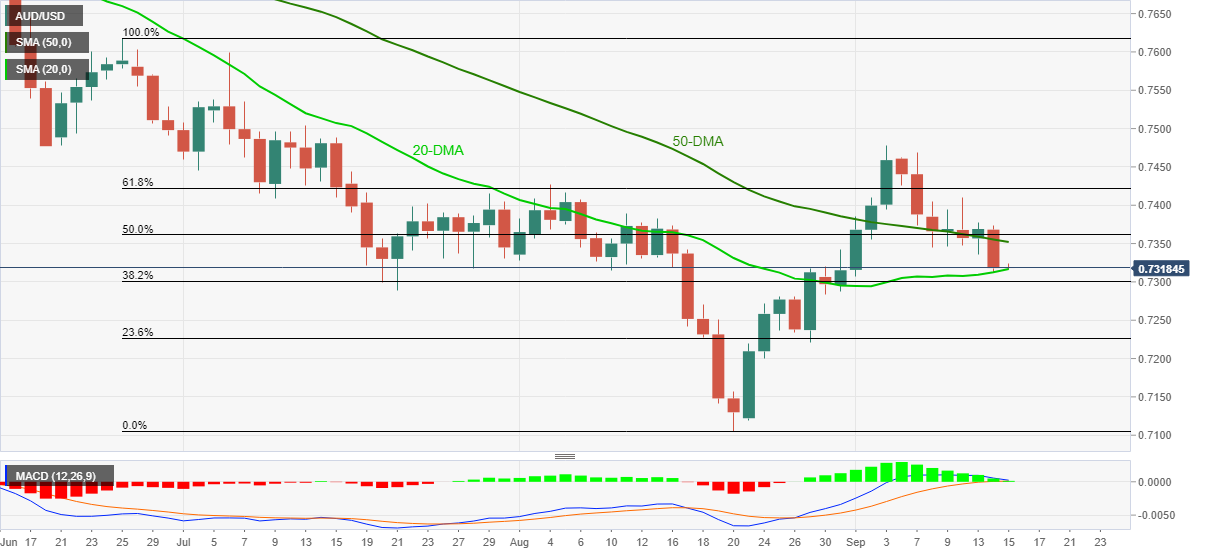
Trend: Further weakness expected

Additional important levels

Overview
Today last price0.7319
Today Daily Change-0.0050
Today Daily Change %-0.68%
Today daily open0.7369
 
Trends
Daily SMA200.7309
Daily SMA500.7359
Daily SMA1000.7525
Daily SMA2000.7609
 
Levels
Previous Daily High0.7377
Previous Daily Low0.7336
Previous Weekly High0.7469
Previous Weekly Low0.7345
Previous Monthly High0.7427
Previous Monthly Low0.7106
Daily Fibonacci 38.2%0.7361
Daily Fibonacci 61.8%0.7351
Daily Pivot Point S10.7344
Daily Pivot Point S20.7319
Daily Pivot Point S30.7302
Daily Pivot Point R10.7385
Daily Pivot Point R20.7402
Daily Pivot Point R30.7427

Author

Anil Panchal

Anil Panchal

FXStreet

Anil Panchal has nearly 15 years of experience in tracking financial markets. With a keen interest in macroeconomics, Anil aptly tracks global news/updates and stays well-informed about the global financial moves and their implications.


More from Anil Panchal
Share:

Editor's Picks

AUD/USD flatlines as US yield ripples meet RBA hawks

The Australian Dollar is virtually unchanged against the US Dollar on Wednesday amid a light economic calendar, with the US Treasury's announcement of a buyback for the September 10 auction boosting the Greenback. The AUD/USD trades at 0.7219, flat.


USD/JPY rises above 153.50 on renewed USD strength

USD/JPY shakes off the bearish pressure and trades above 153.50 in the American session on Wednesday. The US Dollar (USD) stages a rebound following the US Treasury buyback announcement and helps the pair gain traction. Nevertheless, solid Japanese data reinforce expectations that the BoJ will continue normalising monetary policy, lending further support to the Yen and capping the pair's upside for now.

Gold regains balance above $4,400

Gold rebounds on Wednesday, snapping a three-day losing streak and reclaiming the are beyond the key $4,400 mark per troy ounce. The precious metal’s bounce comes amid further selling pressure on the US Dollar and steady uncertainty on the geopolitical front.

Bitcoin and Gold Outlook: BTC and XAU kick-start recovery ahead of key economic events
Bitcoin (BTC) holds above $79,000, maintaining resilience on Wednesday as the broader cryptocurrency market consolidates gains. Gold (XAU) is steady above $4,400, underpinned by a measured shift toward risk-on sentiment among investors.
Venezuela’s 65-billion-barrel Oil deal could reshape America’s inflation fight
The United States (US) has secured unprecedented access to part of Venezuela’s vast Oil reserves. The timing is particularly significant as the war with Iran is disrupting Middle Eastern supplies, keeping energy prices elevated and reviving concerns about inflation.
Venezuela’s 65-billion-barrel Oil deal could reshape America’s inflation fight
The United States (US) has secured unprecedented access to part of Venezuela’s vast Oil reserves. The timing is particularly significant as the war with Iran is disrupting Middle Eastern supplies, keeping energy prices elevated and reviving concerns about inflation.