|

AUD/USD nears recent peak above 0.6500 amid a better market mood

  • Generally encouraging United States data revived optimism among market players.
  • Australia will release the July Monthly Consumer Price Index early on Wednesday.
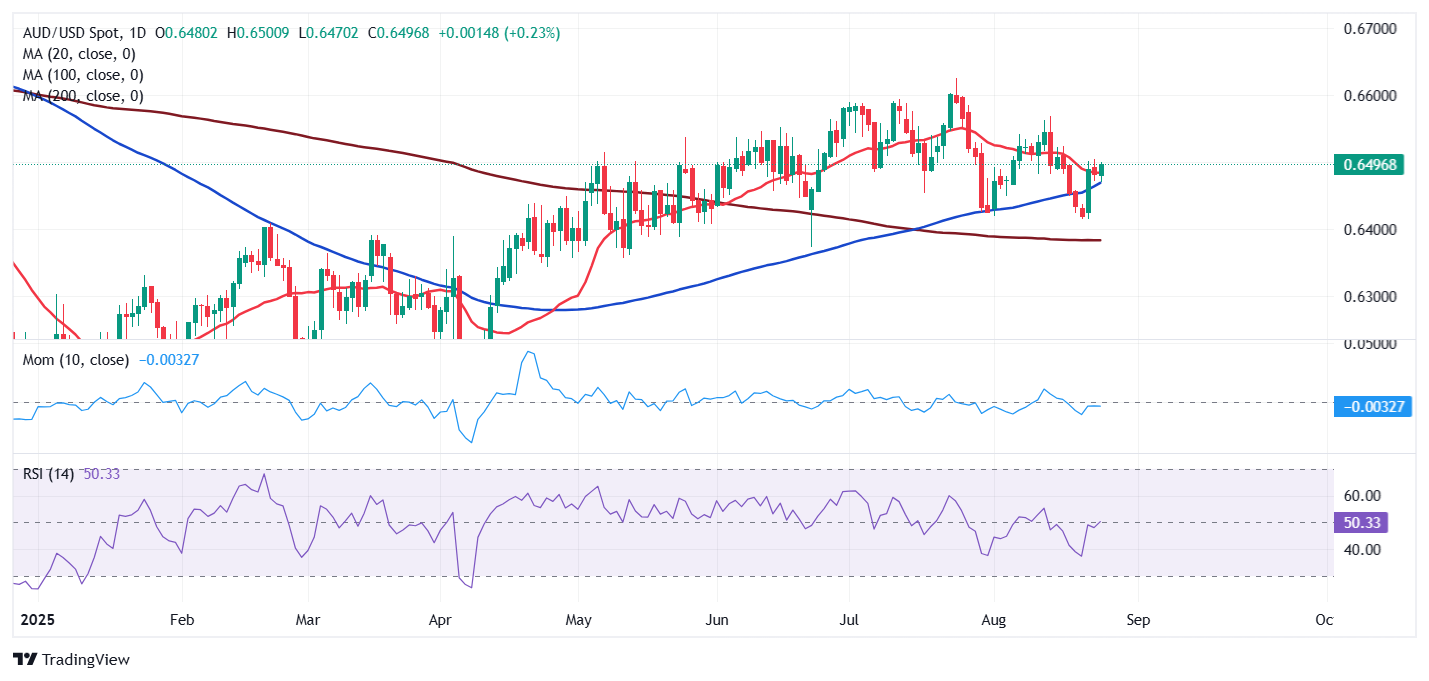
  • AUD/USD aims to extend its advance beyond the 0.6505 weekly peak.

The AUD/USD pair changed course in the mid-European session, recovering from an intraday low of 0.6470, as the US Dollar (USD) lost its fear-inspired momentum. The Greenback advanced late Monday/early Tuesday, as comments from United States (US) President Donald Trump revived concerns about the Federal Reserve (Fed) independence while threatening more tariffs.

American traders, however, shrugged off the dismal mood and Wall Street advances, following negative closes across Asian and European indexes. US data partially helped lift the mood as Durable Goods Orders fell by 2.8% in July, better than the previous -9.3% and the expected -4%. Additionally, the CB Consumer Confidence index printed at 97.4 in a August easing a revised 98.7 in July, but beating the expected 96.4.

Australia will release the July Westpac Leading Index and the Monthly Consumer Price Index (CPI) for the same month early on Wednesday. Annualized inflation in the country is foreseen at 2.3%, higher than the 1.9% posted in June.

Technical outlook

AUD/USD approaches its weekly peak of 0.6505 ahead of the Asian opening, with a modest near-term bullish bias according to intraday charts. Beyond the mentioned high, the pair has room to extend its advance towards the 0.6570 region, where the pair topped so far in August. Additional advances expose the yearly high at 0.6625. Near-term support, on the contrary, can be found at 0.6470, followed by the 0.6430 price zone.
Author

FXStreet Team

Composed of a group of economic journalists and FX experts, the FXStreet content team produces and oversees all content published on FXStreet. It provides a purely journalistic approach to the Forex market.


More from FXStreet Team
Share:

Editor's Picks

AUD/USD falls to near 0.7100 after slipping below 50-day EMA

AUD/USD depreciates after registering minor gains in the previous day, trading around 0.7120 during the Asian hours. The technical analysis of the daily chart shows the pair consolidating sideways within a rectangle pattern, as neither bulls nor bears gain control. The AUD/USD pair is holding a slight bearish tone however as it sits beneath both the nine-day and 50-day EMAs.

160.00: USD/JPY back near intervention territory after upbeat US jobs report

US Nonfarm Payrolls beat expectations by a wide margin in May, with 172K jobs added. The US Dollar rebounds after the release, helping USD/JPY recover from its intraday lows. Warnings from Japanese authorities continue to limit upside potential near the 160.00 threshold.

Gold remains offered below $4,500 following US Payrolls

Gold prices trade with a bearish bias and still remain below the key $4,500 mark per troy ounce at the end of the week. The slighlty softer tone in the US Dollar alongside mixed US Treasury yields across the curve also keep the yellow metal’s downside somewhat contained.


Cardano hits five-year low even as Hoskinson clarifies "break" isn't an exit

Cardano (ADA) price is down 10% at press time on Friday, extending losses over 30% so far this week amid Charles Hoskinson's clarification that "break" isn't an exit.

Week ahead – Fed countdown begins amid US inflation data and geopolitical risks

Fed Chair Warsh’s first meeting approaches as key US inflation data could reshape expectations. Oil prices remain elevated as US-Iran talks continue; tariffs also return to the spotlight. ECB is expected to hike; will it be a one-off move or is July live?

The US economy defies the rules: 100 days into the Oil shock and the recession signal is still missing

More than three months after the start of the Iran war and the resulting disruption to global energy markets, the US economy continues to display remarkable resilience. The conflict has triggered a sharp rise in Oil prices, reignited inflationary pressures and fueled widespread concerns about a potential economic slowdown.