AUD/USD hidden bearish divergence opens risk to 0.7315
- AUD/USD is at the mercy of external factors for the week ahead.
- AUD/USD is on the verge of correcting from the recent rally as it starts to decelerate.
- The neckline of the W-formation has a confluence with both the 21-day moving average and the 61.8% golden ratio.

AUD/USD is starting out flat in the open in a quiet start to the week, so far. At the time of writing, AUD/USD is trading at 0.7414 and oscillating within a few pips of a range sat on the 1-hour 10 smoothed moving average.
Conditions for commodity currencies have been positive for AUD which has enjoyed the inflation hedge taking place in forex since the Federal reserve turned a lot more hawkish of late. There has also been a specific notice paid to both offshore equities and US rates. In this regard, US stocks retained their firmer bias on Friday, with investors cheering better-than-expected Retail Sales growth for September as well as positive earnings results.
Stagflation concerns soothed
Stagflation concerns have been a thorn in the side for markets recently as the Federal Reserve has started to acknowledge that inflation may not be so transitory after all. This same at a time when data had started to tale off as well lead into a potentially cold winter and in the wake of the global energy crisis, underpinning stagflation fears. However, the better data and performances of US stocks coupled with softer core September CPI and PPI data earlier in the week went a long way to soothe those fears and to support risk related forex, such as AUD.
In markets, the S&P 500 ended higher by 0.8%, the Euro Stoxx 50 up 0.8% and the FTSE 100 rose 0.4%. The yield on the US 10-year note rose 6bps to 1.57% with bond prices feeling the pinch of a better risk tone. Meanwhile, Oil prices continued to be problematic with WTI rising a further 1.7% to USD82.7/bbl. On the other hand, iron ore futures found support from renewed supply-side issues. ''Rio Tinto downgraded its expectations for iron ore exports this year to 320-325m tonnes from 325-340m tonnes, due to labour shortages in Western Australia,'' analysts at ANZ Bank said in a note today.''
However, there are dark clouds forming over the Australian economy despite the news that the nations second-largest city will see an easing of restrictions later this week. Instead, there is a watchful eye over Evergrande contagion, a housing sector meltdown in China and negative ramifications for Australia's export-dependent economy. When Cina sneezes, Australia catches a cold. In this regard, investors will be watching key economic data from China today (including Gross Domestic Product) for any signs of weakness amid the energy shortages.
External factors to impact AUD this week
Meanwhile, markets largely overlooked some quite grim jobs data in Australia, which clearly showed the deep impact of recent Covid-19 restrictions in the country. With that being said, the markets are not expecting the Reserve Bank of Australia to be so concerned for the outcome considering it has already been factoring some anticipated poor results pertaining to the summer covid crisis.
The RBA has already pledged to keep policy on hold until February. However, there will be some focus on the October RBA policy meeting minutes in this regard but external factors, such as Chines data will be key. On a poor outcome, AUD/USD may struggle towards the 0.7460 September high.
AUD/USD technical analysis
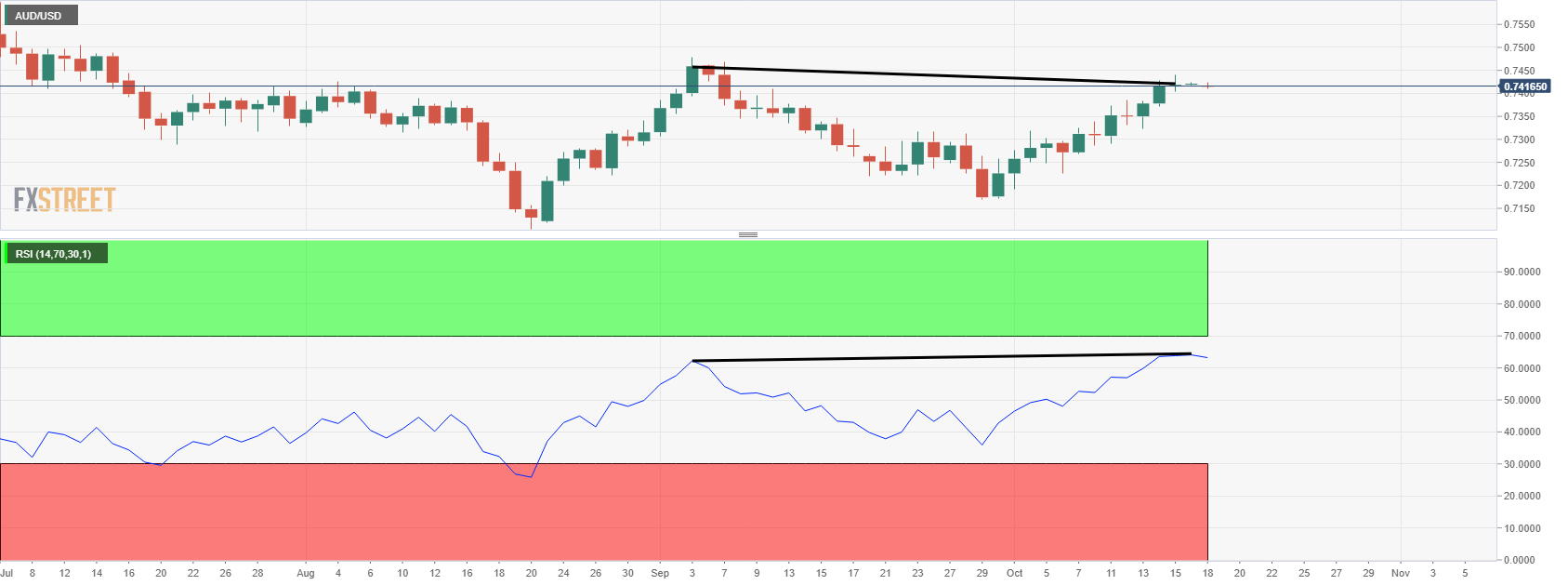
From a technical perspective, we have some hidden bearish RSI divergence on the daily chart as follows:
We saw the same not long ago which lead to a downside continuation in the trend as follows:
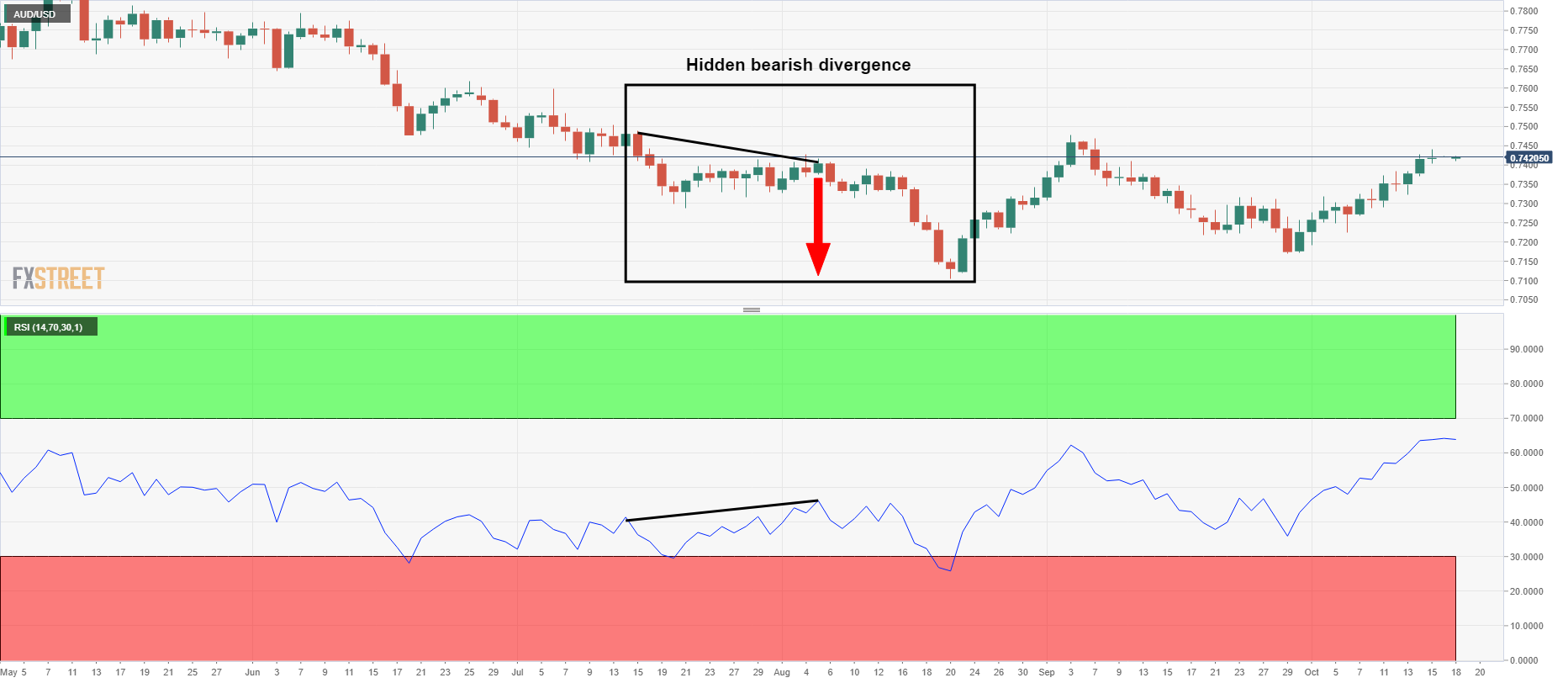
As illustrated, the HBD led to a fresh low in the cycle. HBD is a continuation leading indicator that traders can use to help them to make trading decisions. In this regard, there are prospects of the following playing out in the next few days:
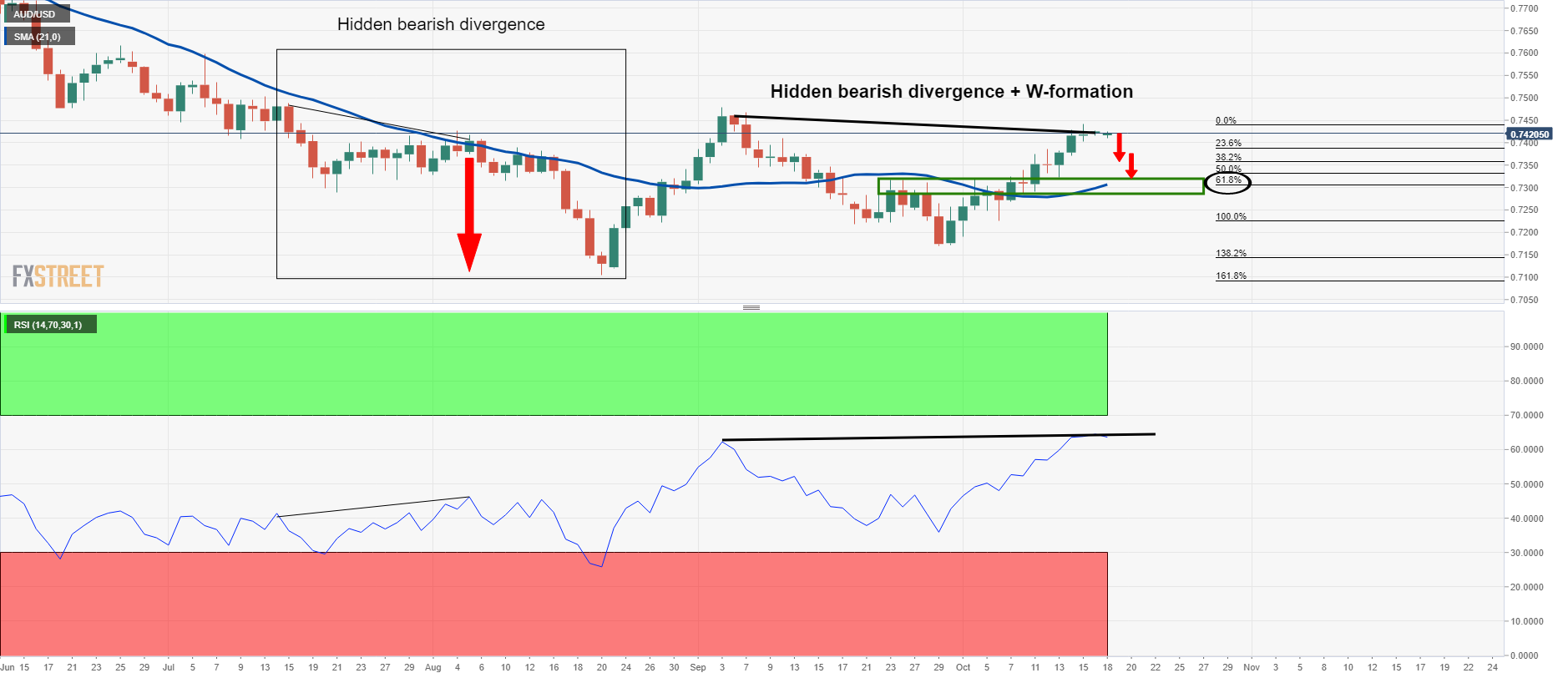
AUD/USD is on the verge of correcting from the recent rally as it starts to decelerate. This exposes the neckline of the W-formation that has a confluence with both the 21-day moving average, the 61.8% golden ratio and within hidden bearish divergence. 0.7315 is eyed.
Author

Ross J Burland
FXStreet
Ross J Burland, born in England, UK, is a sportsman at heart. He played Rugby and Judo for his county, Kent and the South East of England Rugby team.

















