AUD/USD falters as RBA rate cut expectations and fading momentum weigh
- AUD/USD falters at 0.6500 as markets price in a third consecutive RBA rate cut.
- Rejection of 0.6600 resistance and fading momentum highlight a possible bearish trend reversal.
- Key support at 0.6435–0.6428 under threat; breakdown risks grow ahead of RBA decision.


AUD/USD extended losses on Monday, falling over 0.87% on the day to trade near 0.6487 at the time of writing.
With markets currently pricing in a likely rate cut from the Reserve Bank of Australia (RBA) on Tuesday, risk sentiment has deteriorated ahead of the US tariff deadline.
According to a Reuters survey released on Friday, a strong majority of 31 out of 37 economists expect the central bank to implement a third consecutive 25-basis-point rate cut on Tuesday. This would bring the official cash rate down to 3.60%.
This anticipated move reflects the RBA’s response to moderating inflation and a slowing domestic economy. Meanwhile, the Federal Reserve (Fed) has maintained interest rates within the 4.25% to 4.50% range, providing some support to the US Dollar.
The AUD/USD is showing signs of a bearish reversal after being rejected at the key psychological level of 0.6600, which lies above the 61.8% Fibonacci retracement of the January–April decline at 0.6550.
The pair is now testing a critical support zone defined by the 50-day Exponential Moving Average (EMA) at 0.6472, the 200-day EMA at 0.6435, and the 50% Fibonacci retracement at 0.6428. A decisive close below these levels, particularly beneath the 200-day EMA and the round-number 0.6400 handle.
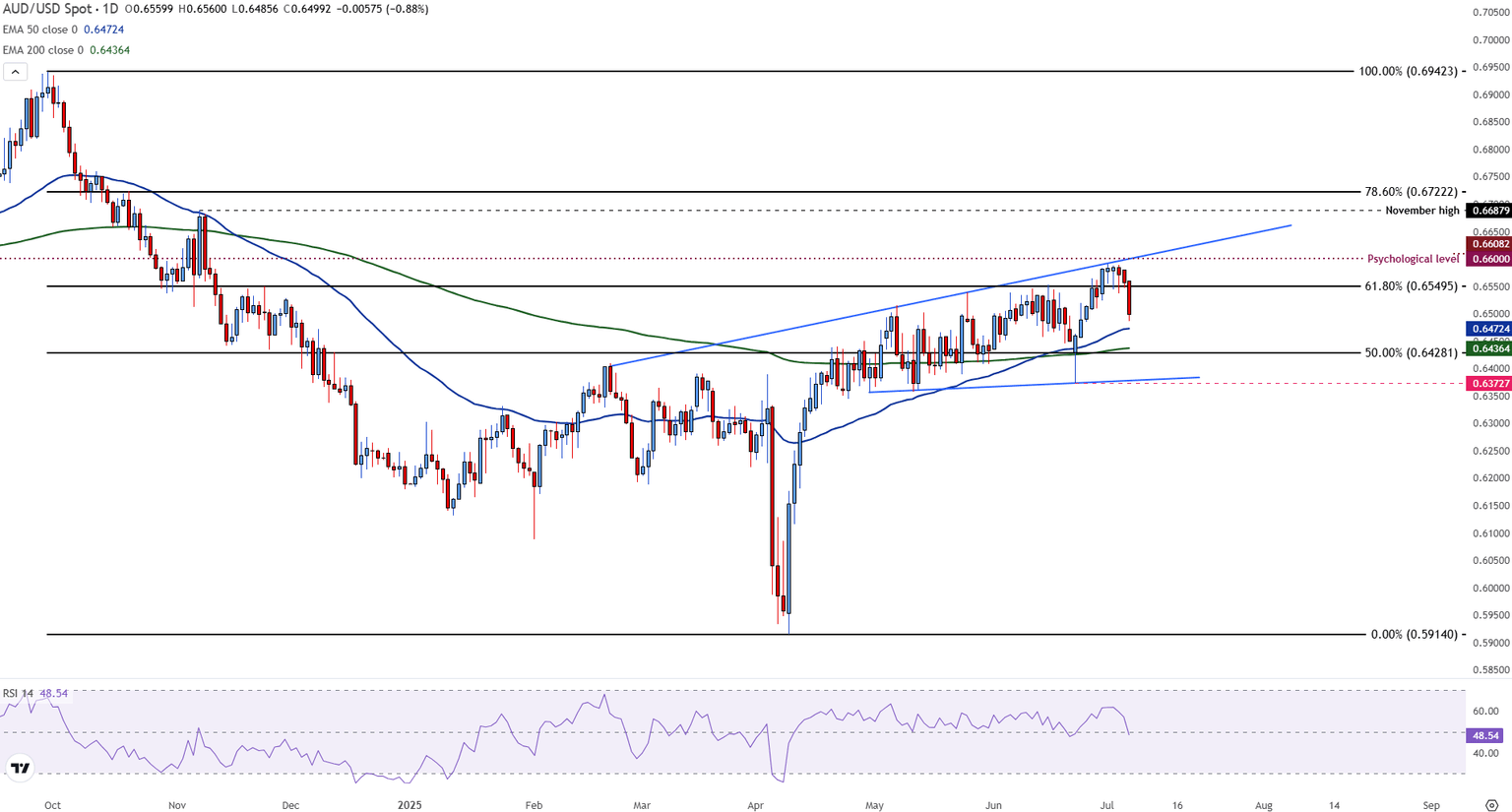
A move lower would mark a breakdown of the ascending trendline drawn from the April lows, undermining the broader bullish structure.
At the same time, momentum is fading, with the Relative Strength Index (RSI) falling to 47, indicating neutral but deteriorating sentiment. Further downside pressure could emerge if the RSI continues toward the 40 level, signaling growing bearish momentum.
Australian Dollar FAQs
One of the most significant factors for the Australian Dollar (AUD) is the level of interest rates set by the Reserve Bank of Australia (RBA). Because Australia is a resource-rich country another key driver is the price of its biggest export, Iron Ore. The health of the Chinese economy, its largest trading partner, is a factor, as well as inflation in Australia, its growth rate and Trade Balance. Market sentiment – whether investors are taking on more risky assets (risk-on) or seeking safe-havens (risk-off) – is also a factor, with risk-on positive for AUD.
The Reserve Bank of Australia (RBA) influences the Australian Dollar (AUD) by setting the level of interest rates that Australian banks can lend to each other. This influences the level of interest rates in the economy as a whole. The main goal of the RBA is to maintain a stable inflation rate of 2-3% by adjusting interest rates up or down. Relatively high interest rates compared to other major central banks support the AUD, and the opposite for relatively low. The RBA can also use quantitative easing and tightening to influence credit conditions, with the former AUD-negative and the latter AUD-positive.
China is Australia’s largest trading partner so the health of the Chinese economy is a major influence on the value of the Australian Dollar (AUD). When the Chinese economy is doing well it purchases more raw materials, goods and services from Australia, lifting demand for the AUD, and pushing up its value. The opposite is the case when the Chinese economy is not growing as fast as expected. Positive or negative surprises in Chinese growth data, therefore, often have a direct impact on the Australian Dollar and its pairs.
Iron Ore is Australia’s largest export, accounting for $118 billion a year according to data from 2021, with China as its primary destination. The price of Iron Ore, therefore, can be a driver of the Australian Dollar. Generally, if the price of Iron Ore rises, AUD also goes up, as aggregate demand for the currency increases. The opposite is the case if the price of Iron Ore falls. Higher Iron Ore prices also tend to result in a greater likelihood of a positive Trade Balance for Australia, which is also positive of the AUD.
The Trade Balance, which is the difference between what a country earns from its exports versus what it pays for its imports, is another factor that can influence the value of the Australian Dollar. If Australia produces highly sought after exports, then its currency will gain in value purely from the surplus demand created from foreign buyers seeking to purchase its exports versus what it spends to purchase imports. Therefore, a positive net Trade Balance strengthens the AUD, with the opposite effect if the Trade Balance is negative.
Author
Tammy Da Costa, CFTe®
FXStreet
Tammy is an economist and market analyst with a deep passion for financial markets, particularly commodities and geopolitics.