|

AUD/USD extends weekly losses and drops below 0.7300

  • The AUD/USD continues falling despite an improved market sentiment on news from Ukraine.
  • Ukraine would not insist on joining NATO – AFP.
  • AUD/USD Price Forecast: In the long-term neutral-upward biased but might print a leg down towards the 50% Fibo, confluence with the 0.7200 mark.

The AUD/USD slides for the second consecutive day, despite improved mood in the financial markets was spurred by an announcement of Ukraine not insisting on joining NATO, as reported by AFP. However, at the time of writing, the AUD/USD is trading at 0.7280, still down 0.47%.

Earlier in the day, the market mood was dismal, weighed by no advancement on negotiations between Russia-Ukraine. However, recent developments linked to one of Russian President Vladimir Putin’s conditions to a ceasefire, appear to have been fulfilled, in what seems to be a nod to Russia to remain neutral.

US equity markets jumped off the lows and reacted positively to the headlines, with main indexes gaining between 1.06% and 2.13%. Gold retraced from daily highs in the commodities complex, while US crude oil benchmark WTI is almost flat, though above $121 per barrel. Meanwhile, as portrayed by the US Dollar Index, the greenback drops 0.30%, sitting at 99.000.

In the overnight session, news from the European Union (EU) getting ready to jointly issue a bond on a considerable scale to finance energy easied the market mood some. However, demand for safe-haven peers and rising US Treasury yields put a lid on the AUD/USD.

The economic docket for both countries lacks the market-moving news expected by market players. Around 22:30 GMT, Reserver Bank of Australia (RBA) Governor Lowe would cross the wires, while on Wednesday, the US economic docket would feature JOLTs Jobs Openings, expected at 10.96M.

AUD/USD Price Forecast: Technical outlook

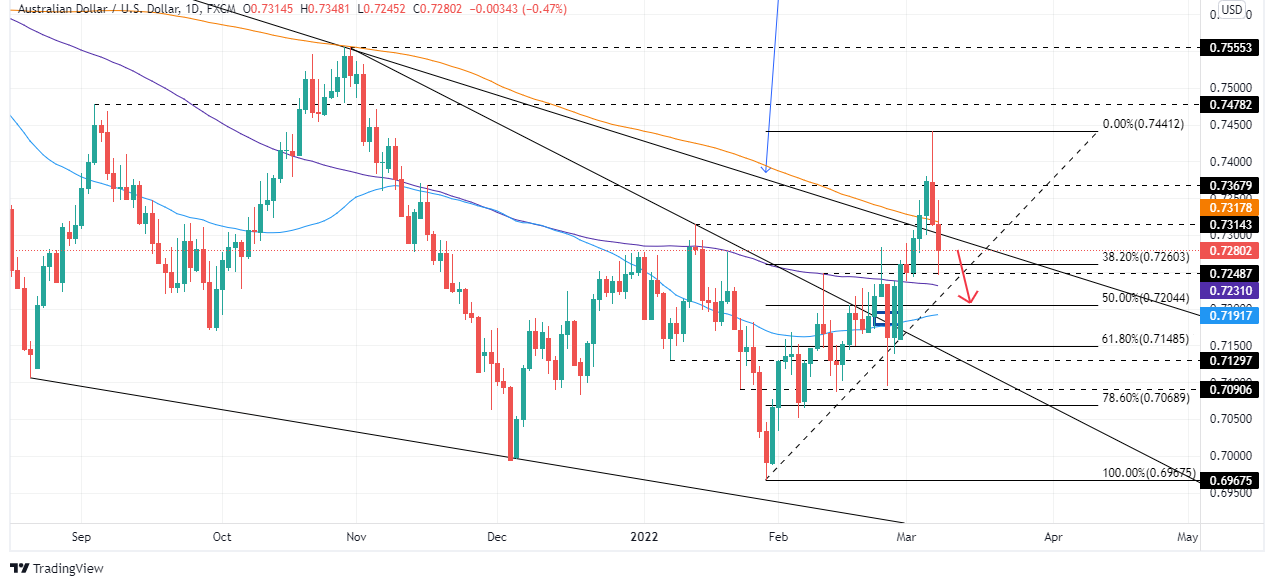
During the overnight session for North American traders, the AUD/USD jumped off Monday’s lows around 0.7313, reached a daily high around 0.7347, subsequently dipped below the S1 daily pivot point at 0.7244, to then stabilize around 0.7280.

The AUD/USD remains neutral-upward biased, but in the near-term, a leg down to the 50% Fibonacci retracement at 0.7204, an area that confluences with the 100 and the 50-day moving averages (DMAs), might be on the cards. That said, the AUD/USD first support would be the 38.2% Fibonacci level at 0.7260. Once cleared, the AUD/USD would reach the abovementioned level.
AUD/USD

Overview
Today last price0.7280
Today Daily Change-0.0045
Today Daily Change %-0.53
Today daily open0.7318
 
Trends
Daily SMA200.7217
Daily SMA500.7192
Daily SMA1000.7235
Daily SMA2000.7322
 
Levels
Previous Daily High0.7441
Previous Daily Low0.731
Previous Weekly High0.7381
Previous Weekly Low0.7158
Previous Monthly High0.7286
Previous Monthly Low0.7032
Daily Fibonacci 38.2%0.7361
Daily Fibonacci 61.8%0.7391
Daily Pivot Point S10.7272
Daily Pivot Point S20.7226
Daily Pivot Point S30.7141
Daily Pivot Point R10.7403
Daily Pivot Point R20.7487
Daily Pivot Point R30.7534

Author

Christian Borjon Valencia

Markets analyst, news editor, and trading instructor with over 14 years of experience across FX, commodities, US equity indices, and global macro markets.


More from Christian Borjon Valencia
Share:

Editor's Picks

AUD/USD hangs close to monthly lows, still defends 0.7100 ahead of Fed decision

AUD/USD retains its negative bias for the third straight day, defending 0.7100 while trading close to a monthly low in Wednesday's Asian session on Wednesday. The US Dollar stands firm near a two-week high as the anticipated Fed rate hike and oil-driven inflation fears continue to push US bond yields to a multi-year high. Furthermore, escalating Middle East tensions benefit the safe-haven buck and weigh on the risk-sensitive Aussie.

USD/JPY holds firm above 155.00, awaits Fed policy announcements

USD/JPY climbs to a fresh one-week high above 155.00 in the Asian session on Wednesday amid a bullish US Dollar. Oil-driven inflation fears, along with the anticipated Fed rate hike, continue to support surging US bond yields. Moreover, rising US-Iran tensions underpin the USD's reserve currency status. The pair, however, remains below the mid-155.00s as bulls seem hesitant ahead of the Fed decision later today and the BoJ meeting, starting on Thursday.

Gold traders seem noncommittal below $4,350; eyes Fed rate decision

Gold clings to modest intraday gains through the first half of the European session, albeit it lacks follow-through buying and remains below $4,350. The US Dollar eases from a two-week high amid some profit-taking, offering support to the commodity. Traders, however, seem hesitant to place aggressive directional bets and opt to wait on the sidelines heading into the key central bank event risk.

Cardano's bearish breakout warns of a 15% downside risk
Cardano (ADA) hovers around $0.1900 at press time on Wednesday after a 6% decline the previous day, breaking below a crucial support level. Declining on-chain activity across the Cardano ecosystem, with reduced transaction count and Real Economic Value (REV), suggests waning user demand.
Fed decision in focus

Starting with the most important, the Fed decision. Heading into the event, data showed a rather punchy US August jobs report, which, you will likely recall, triggered a hawkish Fed rate repricing in rates markets. However, the recent US August CPI print mattered more.

How Japan became the World's Banker and why that era may be ending

Japan's ultra-low interest rates helped finance trillions of dollars in global investments for more than a decade, making the Japanese Yen one of the world’s cheapest sources of funding. With the Bank of Japan expected to tighten policy again this week, that advantage may be entering a new phase. While most major economies raised interest rates, Japan remained the world's outlier.