AUD/USD drifts to 0.6550 as concerns about US tariffs resurface
- The Aussie Dollar depreciates for the second consecutive day amid growing risk aversion.
- Global trade uncertainty grows with US trading partners awaiting a letter from Trump announcing unilateral tariffs.
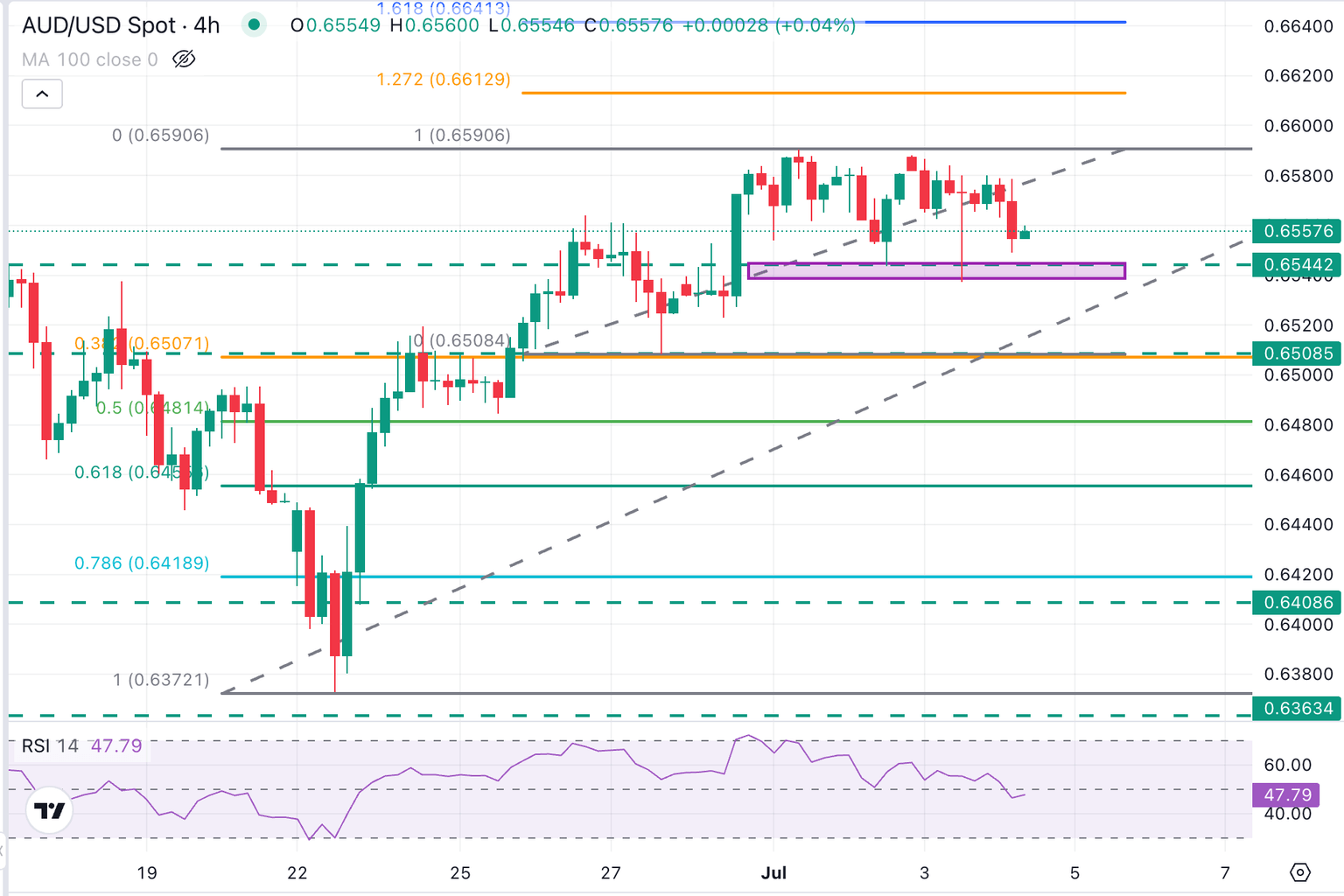
- AUD/USD approaches the neckline of a Double Top pattern at the 0.6535-0.6545 area.


The Australian Dollar is trading lower for the second day in a row, retreating from year-to-date highs, at 0.6590, with risk-sensitive assets weighed by growing tariff uncertainty as the July 9 deadline comes closer.
US President Donald Trump affirmed on Thursday that he will start sending letters to partners informing them about the tariffs that will be applied to their products. This news put investors on edge about a serious disruption of global trade and casts a shadow on net exporter countries, like Australia.
The pair had turned lower somewhat earlier, as a stronger-than-expected US Nonfarm Payrolls report eased concerns about the country’s labour market and crushed hopes of imminent rate cuts by the US Federal Reserve.
Technical Analysis: A Double Top at 0.6590 might be anticipating a deeper correction
,
From a technical perspective, the pair is consolidating gains after last week’s bullish move, but the double top at 0.6590, coupled with a lower high on Thursday and the 4-hour Relative Strength index crossing below the 50 level, suggests that bears are taking over
The pair should breach the 0.6535-06545 area (July 2,3 lows), to activate the DT pattern and confirm a deeper correction. The figure’s measured target is the confluence of the 38.2% Fibonacci retracement of the June 23-July 1 rally and June 27 low, at 0.6510.
On the upside, the pair should breach the mentioned July 1 and 2 high, at 0.6590, to resume the broader bullish trend and set its focus on the 127.2% and 161.8% Fibonacci extensions of the June 27 - July 1 upleg, at 0.6610 and 0.6640, respectively.
Tariffs FAQs
Tariffs are customs duties levied on certain merchandise imports or a category of products. Tariffs are designed to help local producers and manufacturers be more competitive in the market by providing a price advantage over similar goods that can be imported. Tariffs are widely used as tools of protectionism, along with trade barriers and import quotas.
Although tariffs and taxes both generate government revenue to fund public goods and services, they have several distinctions. Tariffs are prepaid at the port of entry, while taxes are paid at the time of purchase. Taxes are imposed on individual taxpayers and businesses, while tariffs are paid by importers.
There are two schools of thought among economists regarding the usage of tariffs. While some argue that tariffs are necessary to protect domestic industries and address trade imbalances, others see them as a harmful tool that could potentially drive prices higher over the long term and lead to a damaging trade war by encouraging tit-for-tat tariffs.
During the run-up to the presidential election in November 2024, Donald Trump made it clear that he intends to use tariffs to support the US economy and American producers. In 2024, Mexico, China and Canada accounted for 42% of total US imports. In this period, Mexico stood out as the top exporter with $466.6 billion, according to the US Census Bureau. Hence, Trump wants to focus on these three nations when imposing tariffs. He also plans to use the revenue generated through tariffs to lower personal income taxes.
Author
Guillermo Alcala
FXStreet
Graduated in Communication Sciences at the Universidad del Pais Vasco and Universiteit van Amsterdam, Guillermo has been working as financial news editor and copywriter in diverse Forex-related firms, like FXStreet and Kantox.