AUD/NZD Price Analysis: Depressed between 100-DMA and 50-DMA ahead of RBA
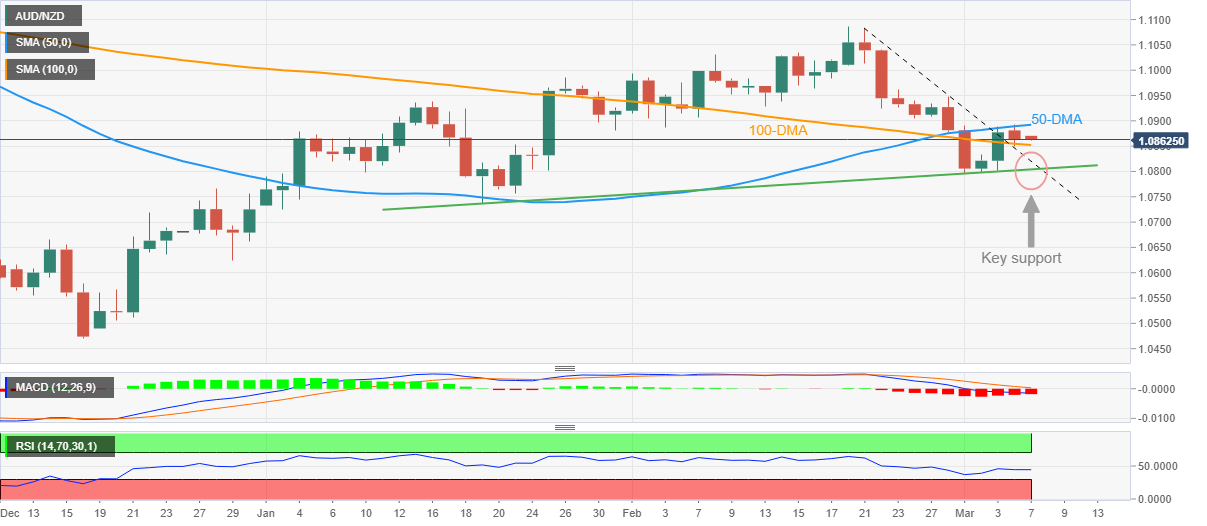
- AUD/NZD remains pressured within the key DMA envelope, defends the previous day’s pullback from one-week high.
- Convergence of six-week-old ascending trend line, previous resistance line from February 21 appears a tough nut to crack for bears.
- Downbeat MACD, RSI join repeated failure to cross 50-DMA to keep bears hopeful.


AUD/NZD holds lower grounds near 1.0860 as traders await the key Reserve Bank of Australia (RBA) Interest Rate Decision during early Tuesday. In doing so, the exotic pair remains between the 100-DMA and the 50-DMA.
Also read: Reserve Bank of Australia Preview: AUD/USD set to suffer on a dovish outlook
Not only the key DMAs but contrasting trading signals by the breakout of a two-week-old resistance line, now support, as well as sustained trading below the 50-DMA and bearish MACD signals, also challenge the AUD/NZD pair traders ahead of the key event.
As a result, the pair needs to overcome the 1.0890-50 trading range for clear directions.
That said, a downside break of the 100-DMA, around 1.0850 isn’t an open invitation to the AUD/NZD bears as a convergence of the previous resistance line from February 21 and a six-week-old ascending support line, around 1.0810, appears a tough nut to crack for the bears.
Following that, a slump toward the January 19 swing low of 1.0737 can’t be ruled out.
Meanwhile, the AUD/NZD pair’s recovery beyond the 50-DMA hurdle of 1.0890 needs validation from the 1.0900 threshold to convince the bulls.
In that case, highs marked during early January and February, around 1.0935 and 1.1030 respectively, could challenge the upside momentum before highlighting the previous monthly peak of 1.1087.
AUD/NZD: Daily chart
Trend: Limited downside expected
Author
Anil Panchal
FXStreet
Anil Panchal has nearly 15 years of experience in tracking financial markets. With a keen interest in macroeconomics, Anil aptly tracks global news/updates and stays well-informed about the global financial moves and their implications.