AUD/JPY Price Forecast: Fails near descending channel resistance, around mid-96.00s
- AUD/JPY gains positive traction amid the emergence of heavy JPY selling on Friday.
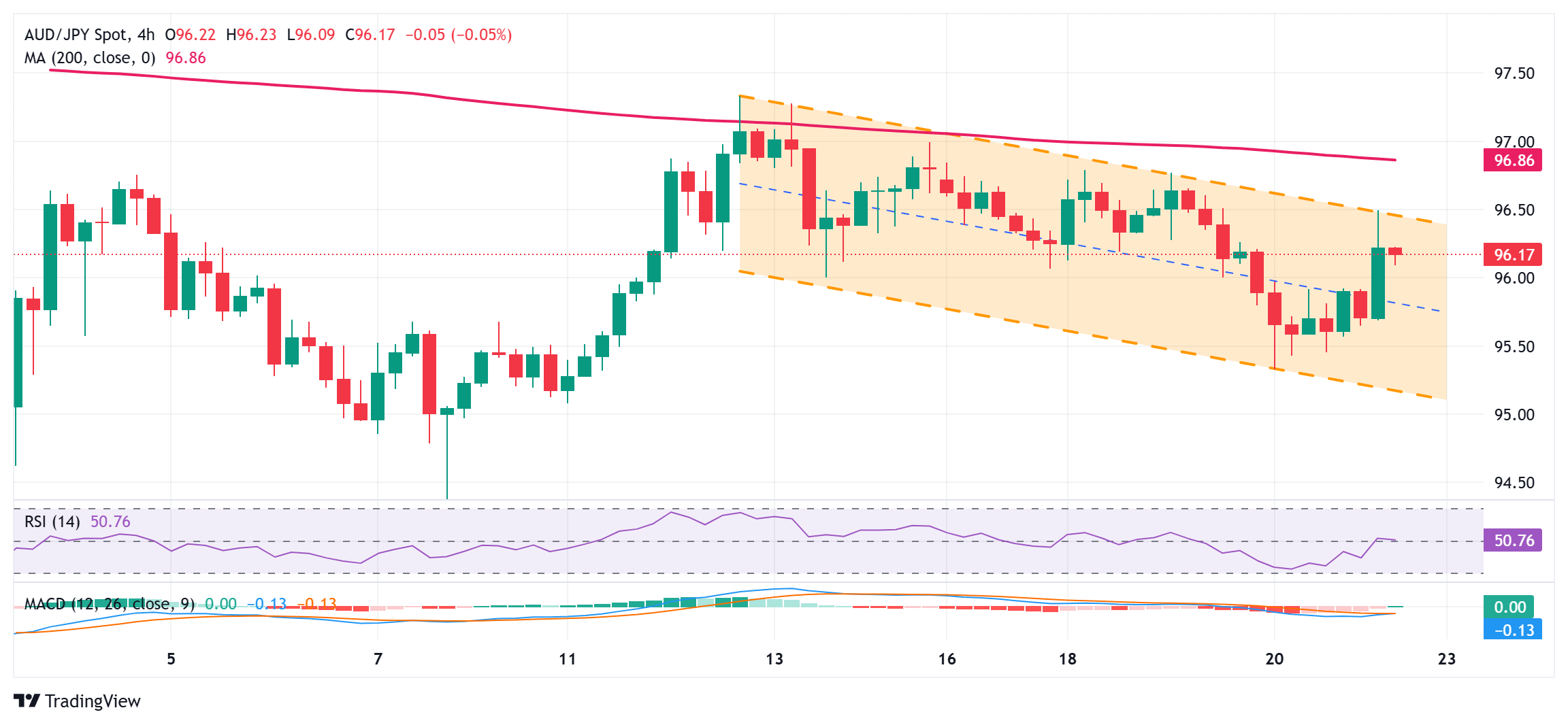
- The intraday momentum stalls near the top end of a one-week-old descending channel.
- A sustained strength beyond the said barrier should pave the way for additional gains.


The AUD/JPY cross builds on the previous day's late bounce from the 95.35-95.30 area, or over a one-week low, and gains strong positive traction during the Asian session on Friday. Spot prices, however, struggle to capitalize on the move beyond mid-96.00 and retreat to the 96.15 region in the last hour, still up for the first time in three days.
The Japanese Yen (JPY) weakened after Bank of Japan (BoJ) Governor Kazuo Ueda signaled a potential bond market intervention to curb any further rise in the Japanese government bond (JGB) yields. Apart from this, the Reserve Bank of Australia's (RBA) cautious rate cut earlier this week continues to underpin the Aussie and offers additional support to the AUD/JPY cross. That said, expectations of continued BoJ rate hikes, bolstered by Japan's strong National CPI, help limit the JPY losses and cap the currency pair.
From a technical perspective, the sharp intraday move-up stalls near a resistance marked by the top end of over a one-week-old descending trend channel. The said barrier is pegged near the 96.45-96.50 area and should now act as a pivotal point. Some follow-through buying could lift the AUD/JPY cross to the 200 period Simple Moving Average (SMA) on the 4-hour chart, around the 97.00 neighborhood. This is followed by last week's swing high, around the 97.30-97.35 area, which if cleared should pave the way for additional gains.
The AUD/JPY cross might then resume its recent goodish recovery move from the lowest level since September 2024 touched earlier this month and aim towards reclaiming the 98.00 mark. The momentum could extend further towards the next relevant hurdle near the mid-98.00s en route to the 98.75-98.80 supply zone and year-to-date peak, around the 99.10-99.15 region touched in January.
On the flip side, the 95.70 area now seems to protect the immediate downside ahead of the overnight swing low, around the 95.35-95.30 region, and the 95.00 psychological mark. A convincing break below the latter would be seen as a fresh trigger for bearish traders and make the AUD/JPY cross vulnerable to retesting the multi-month low, around the 94.40-94.35 region before dropping to the 94.00 round-figure mark.
AUD/JPY 4-hour chart
Bank of Japan FAQs
The Bank of Japan (BoJ) is the Japanese central bank, which sets monetary policy in the country. Its mandate is to issue banknotes and carry out currency and monetary control to ensure price stability, which means an inflation target of around 2%.
The Bank of Japan embarked in an ultra-loose monetary policy in 2013 in order to stimulate the economy and fuel inflation amid a low-inflationary environment. The bank’s policy is based on Quantitative and Qualitative Easing (QQE), or printing notes to buy assets such as government or corporate bonds to provide liquidity. In 2016, the bank doubled down on its strategy and further loosened policy by first introducing negative interest rates and then directly controlling the yield of its 10-year government bonds. In March 2024, the BoJ lifted interest rates, effectively retreating from the ultra-loose monetary policy stance.
The Bank’s massive stimulus caused the Yen to depreciate against its main currency peers. This process exacerbated in 2022 and 2023 due to an increasing policy divergence between the Bank of Japan and other main central banks, which opted to increase interest rates sharply to fight decades-high levels of inflation. The BoJ’s policy led to a widening differential with other currencies, dragging down the value of the Yen. This trend partly reversed in 2024, when the BoJ decided to abandon its ultra-loose policy stance.
A weaker Yen and the spike in global energy prices led to an increase in Japanese inflation, which exceeded the BoJ’s 2% target. The prospect of rising salaries in the country – a key element fuelling inflation – also contributed to the move.
Author
Haresh Menghani
FXStreet
Haresh Menghani is a detail-oriented professional with 10+ years of extensive experience in analysing the global financial markets.