AUD/JPY Price Forecast: Approaches all-time high near 109.40
- AUD/JPY jumps to near 106.46 amid continued underperformance from the Japanese Yen.
- Japan’s PM Takaichi is expected to dissolve the parliament’s lower house later this month.
- Investors await China’s Trade Balance data for December.

The AUD/JPY pair trades 0.3% higher to near 106.46 during the European trading session on Tuesday. The pair jumps higher as the Japanese Yen (JPY) underperforms its peers amid uncertainty surrounding Japan’s political outlook.
Japanese Yen Price Today
The table below shows the percentage change of Japanese Yen (JPY) against listed major currencies today. Japanese Yen was the weakest against the British Pound.
| USD | EUR | GBP | JPY | CAD | AUD | NZD | CHF | |
|---|---|---|---|---|---|---|---|---|
| USD | -0.01% | -0.06% | 0.46% | 0.00% | 0.16% | 0.04% | 0.09% | |
| EUR | 0.01% | -0.04% | 0.48% | 0.02% | 0.17% | 0.05% | 0.10% | |
| GBP | 0.06% | 0.04% | 0.49% | 0.07% | 0.22% | 0.09% | 0.14% | |
| JPY | -0.46% | -0.48% | -0.49% | -0.44% | -0.28% | -0.42% | -0.36% | |
| CAD | -0.01% | -0.02% | -0.07% | 0.44% | 0.15% | 0.02% | 0.07% | |
| AUD | -0.16% | -0.17% | -0.22% | 0.28% | -0.15% | -0.12% | -0.07% | |
| NZD | -0.04% | -0.05% | -0.09% | 0.42% | -0.02% | 0.12% | 0.05% | |
| CHF | -0.09% | -0.10% | -0.14% | 0.36% | -0.07% | 0.07% | -0.05% |
The heat map shows percentage changes of major currencies against each other. The base currency is picked from the left column, while the quote currency is picked from the top row. For example, if you pick the Japanese Yen from the left column and move along the horizontal line to the US Dollar, the percentage change displayed in the box will represent JPY (base)/USD (quote).
Japan’s news agency Kyodo reported earlier in the day that Prime Minister Sanae Takaichi had conveyed to a ruling party executive her intention to dissolve parliament’s lower house at the outset of its regular session scheduled to start on January 23, which strengthens the odds of an early snap election.
Ahead of elections, polls state PM Takaichi to achieve a decisive electoral victory that has propelled hopes of higher fiscal stimulus by the government, Reuters reports. The scenario could be favorable for the Japanese stock market, but negative for the Japanese Yen, assuming big spending plans could derail the Bank of Japan’s (BoJ) plans to remain on the monetary tightening path.
Meanwhile, the Australian Dollar (AUD) trades broadly calm ahead of China’s Trade Balance data, releasing on Wednesday.
AUD/JPY technical analysis
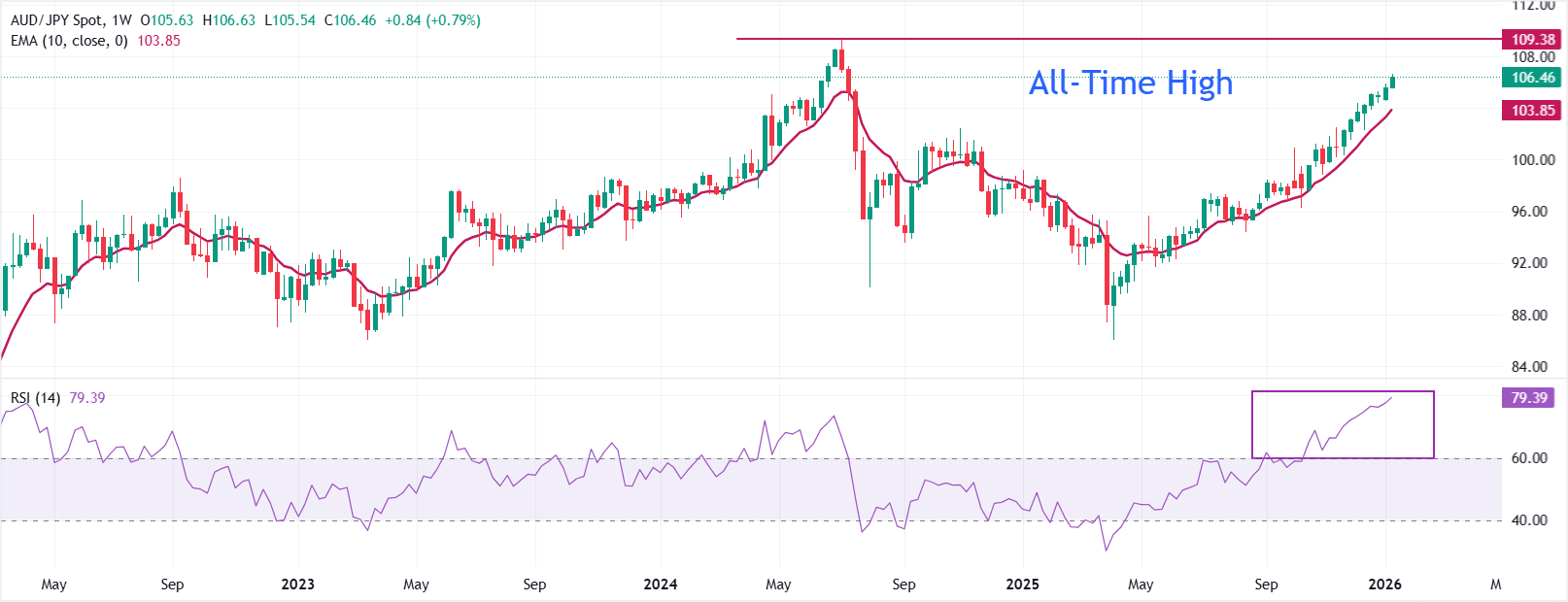
AUD/JPY trades higher near 106.46. The 10-week Exponential Moving Average (EMA) at 103.85 rises and supports the advance as the price holds above it. Staying above this gauge would preserve the uptrend and keep pullbacks contained.
The 14-week Relative Strength Index (RSI) at 79.39 is overbought, signaling stretched momentum. Overbought conditions could spur consolidation, yet the bullish bias would persist while the pair respects the rising 10-week EMA. A close below that dynamic support would open room for a deeper retracement.
(The technical analysis of this story was written with the help of an AI tool.)
Australian Dollar FAQs
One of the most significant factors for the Australian Dollar (AUD) is the level of interest rates set by the Reserve Bank of Australia (RBA). Because Australia is a resource-rich country another key driver is the price of its biggest export, Iron Ore. The health of the Chinese economy, its largest trading partner, is a factor, as well as inflation in Australia, its growth rate and Trade Balance. Market sentiment – whether investors are taking on more risky assets (risk-on) or seeking safe-havens (risk-off) – is also a factor, with risk-on positive for AUD.
The Reserve Bank of Australia (RBA) influences the Australian Dollar (AUD) by setting the level of interest rates that Australian banks can lend to each other. This influences the level of interest rates in the economy as a whole. The main goal of the RBA is to maintain a stable inflation rate of 2-3% by adjusting interest rates up or down. Relatively high interest rates compared to other major central banks support the AUD, and the opposite for relatively low. The RBA can also use quantitative easing and tightening to influence credit conditions, with the former AUD-negative and the latter AUD-positive.
China is Australia’s largest trading partner so the health of the Chinese economy is a major influence on the value of the Australian Dollar (AUD). When the Chinese economy is doing well it purchases more raw materials, goods and services from Australia, lifting demand for the AUD, and pushing up its value. The opposite is the case when the Chinese economy is not growing as fast as expected. Positive or negative surprises in Chinese growth data, therefore, often have a direct impact on the Australian Dollar and its pairs.
Iron Ore is Australia’s largest export, accounting for $118 billion a year according to data from 2021, with China as its primary destination. The price of Iron Ore, therefore, can be a driver of the Australian Dollar. Generally, if the price of Iron Ore rises, AUD also goes up, as aggregate demand for the currency increases. The opposite is the case if the price of Iron Ore falls. Higher Iron Ore prices also tend to result in a greater likelihood of a positive Trade Balance for Australia, which is also positive of the AUD.
The Trade Balance, which is the difference between what a country earns from its exports versus what it pays for its imports, is another factor that can influence the value of the Australian Dollar. If Australia produces highly sought after exports, then its currency will gain in value purely from the surplus demand created from foreign buyers seeking to purchase its exports versus what it spends to purchase imports. Therefore, a positive net Trade Balance strengthens the AUD, with the opposite effect if the Trade Balance is negative.
Author

Sagar Dua
FXStreet
Sagar Dua is associated with the financial markets from his college days. Along with pursuing post-graduation in Commerce in 2014, he started his markets training with chart analysis.