Gold bulls not ready to give up amid Fed rate cut bets, trade jitters, geopolitics
- Gold attracts heavy selling on Tuesday and reverses a major part of the previous day’s gains.
- A modest USD uptick and signs of stability in the equity markets undermine the commodity.
- Fed rate cut bets, trade jitters, and geopolitical risks could limit losses for the precious metal.

Gold (XAU/USD) sticks to modest intraday losses below the monthly peak touched earlier this Tuesday, though it lacks follow-through selling and holds above the $5,150 level through the early European session.

Following the previous day's knee-jerk fall in reaction to US President Donald Trump's new global tariffs and the subsequent bounce, the US Dollar (USD) attracts fresh buyers in the wake of the US Federal Reserve's (Fed) hawkish outlook. This, in turn, is seen as a key factor exerting downward pressure on the commodity.
In fact, minutes from the January FOMC meeting showed last week that several Fed officials judged that additional policy easing may not be warranted until there was a clear indication that the progress of disinflation was firmly back on track. Adding to this, Governor Christopher Waller said on Monday that he was open to leaving interest rates on hold at the March meeting if the upcoming February jobs data indicates the US labor market had "pivoted to a more solid footing" after a weak 2025.
However, the CME Group's FedWatch Tool indicates that traders are still pricing in the possibility of three 25-basis-point (bps) rate cuts by the Fed this year, which should act as a tailwind for the non-yielding Gold. Moreover, concerns about the potential economic fallout from Trump's trade policies might keep a lid on any meaningful USD appreciation and contribute to limiting the downside for the precious metal, warranting some caution for bearish traders and positioning for deeper losses.
Apart from this, worries about potential military conflict in the Middle East could help limit the downside for the safe-haven Gold ahead of the third round of US-Iran nuclear talks. This, in turn, makes it prudent to wait for strong follow-through selling before confirming the XAU/USD pair's one-week-old uptrend has run out of steam. Traders now look forward to the US macro data, which, along with speeches from influential FOMC members, could provide some impetus later this Tuesday.
(This story was corrected on February 24 at 04:06 GMT to say that speeches from influential FOMC members could provide some impetus later this Tuesday, not Thursday.)
XAU/USD 4-hour chart
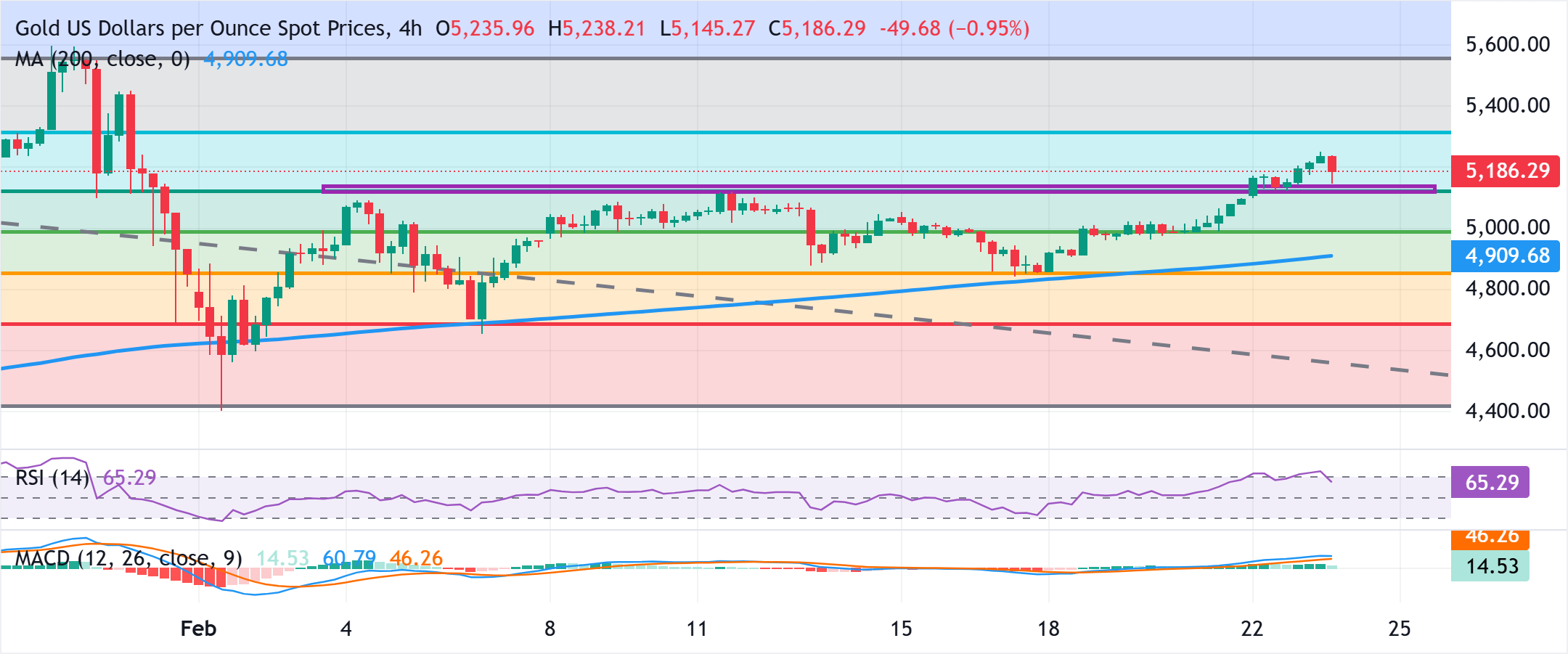
Gold holds above $5,100 resistance breakpoint; bullish potential intact
Against the backdrop of the recent rebounds from the 200-period Simple Moving Average (SMA), the overnight breakout above the $5,100-$5,110 horizontal barrier was seen as a fresh trigger for the XAU/USD bulls. The said area coincides with the 61.8% Fibonacci retracement level of a sharp corrective pullback from the all-time peak and should act as a key pivotal point.
The Moving Average Convergence Divergence (MACD) remains in positive territory but has cooled from recent peaks, hinting at moderating upside momentum. The Relative Strength Index (RSI) prints 65.78, easing from overbought and aligning with a slower ascent. Hence, the 78.6% Fibonacci retracement at $5,314.49 could now act as the important resistance to clear.
A 4-hour close above the latter would open further gains, which a failure to maintain traction above $5,123.17 would signal fading momentum and risk a deeper pullback toward the moving average. As long as the Gold holds above the rising 200-period SMA at $4,909.70, the path of least resistance stays higher.
(The technical analysis of this story was written with the help of an AI tool.)
Fed FAQs
Monetary policy in the US is shaped by the Federal Reserve (Fed). The Fed has two mandates: to achieve price stability and foster full employment. Its primary tool to achieve these goals is by adjusting interest rates. When prices are rising too quickly and inflation is above the Fed’s 2% target, it raises interest rates, increasing borrowing costs throughout the economy. This results in a stronger US Dollar (USD) as it makes the US a more attractive place for international investors to park their money. When inflation falls below 2% or the Unemployment Rate is too high, the Fed may lower interest rates to encourage borrowing, which weighs on the Greenback.
The Federal Reserve (Fed) holds eight policy meetings a year, where the Federal Open Market Committee (FOMC) assesses economic conditions and makes monetary policy decisions. The FOMC is attended by twelve Fed officials – the seven members of the Board of Governors, the president of the Federal Reserve Bank of New York, and four of the remaining eleven regional Reserve Bank presidents, who serve one-year terms on a rotating basis.
In extreme situations, the Federal Reserve may resort to a policy named Quantitative Easing (QE). QE is the process by which the Fed substantially increases the flow of credit in a stuck financial system. It is a non-standard policy measure used during crises or when inflation is extremely low. It was the Fed’s weapon of choice during the Great Financial Crisis in 2008. It involves the Fed printing more Dollars and using them to buy high grade bonds from financial institutions. QE usually weakens the US Dollar.
Quantitative tightening (QT) is the reverse process of QE, whereby the Federal Reserve stops buying bonds from financial institutions and does not reinvest the principal from the bonds it holds maturing, to purchase new bonds. It is usually positive for the value of the US Dollar.
Author

Haresh Menghani
FXStreet
Haresh Menghani is a detail-oriented professional with 10+ years of extensive experience in analysing the global financial markets.