|

AUD/JPY Price Analysis: Gains capped near key resistance as bearish backdrop persists

  • AUD/JPY trades near the 90.30 zone after modest gains on Friday
  • Momentum remains weak as indicators lean neutral-to-bearish
  • Resistance at 90.86 and bearish pressure from key moving averages limit upside

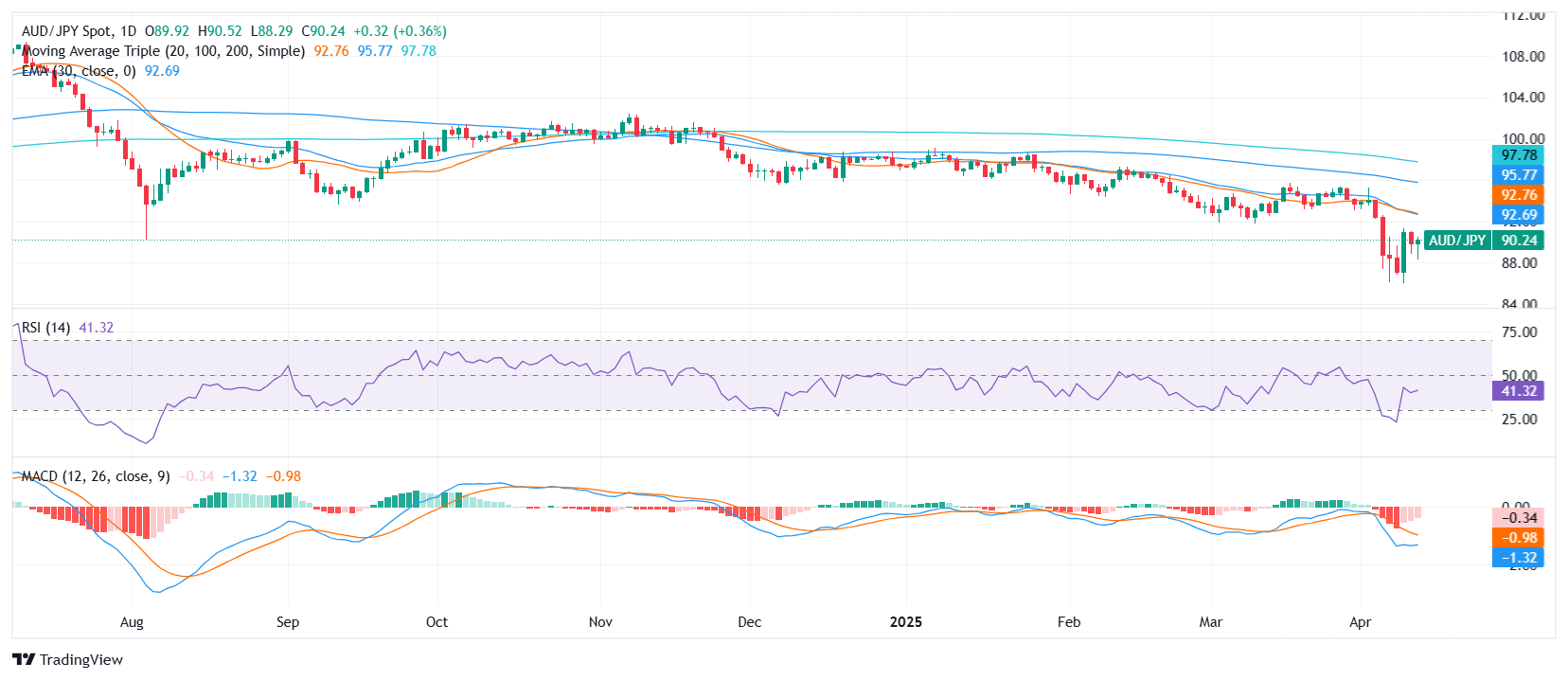
The AUD/JPY pair posted a mild advance on Friday’s session, moving toward the 90.30 zone after notching a gain of over 0.30%. Despite the intraday rise, the overall technical picture remains bearish, with the pair still struggling beneath several key resistance levels and longer-term moving averages.

While price action approached the top of the daily range (88.287–90.516), momentum indicators reveal limited conviction behind the move. The Relative Strength Index (RSI) remains neutral at 42.15, while the MACD continues to flash a sell signal. Similarly, both the Bull Bear Power (-3.748) and Commodity Channel Index (CCI) at -92.800 offer neutral reads, pointing to a potential loss of bullish traction.

Trend-based indicators continue to favor sellers. The 20-day simple moving average (SMA) at 92.780, along with the 100-day SMA at 95.861 and the 200-day SMA at 97.903, all tilt downward. Bearish signals are further confirmed by the 10-day exponential moving average (EMA) at 90.867 and 10-day SMA at 90.985.

Looking ahead, support is seen at 89.341, with resistance levels aligned at 90.867, 90.899, and 90.985. A sustained break above this confluence would be needed to weaken the current bearish bias, though the broader trend remains under pressure.

Daily chart
Author

Patricio Martín

Patricio is an economist from Argentina passionate about global finance and understanding the daily movements of the markets.


More from Patricio Martín
Share:

Editor's Picks

GBP/USD climbs to two-day highs past 1.3200

GBP/USD picks up extra pace and surpasses the 1.3200 threshold on Thursday. That said, Cable manages to shrug off initial weakness and regain balance on the back of the fresh selling pressure hurting the Greenback.

EUR/USD softens toward 13‑month low near 1.1350 as rising US PCE inflation lifts US Dollar

The EUR/USD pair loses ground to around 1.1365 during the early Asian trading hours on Friday. The major remains near a 13-month low as market expectations for US interest rate hikes have risen. Traders brace for the release of the Michigan Consumer Sentiment Index report, which will be released later on Friday.

Gold drifts lower as Hormuz risks revive USD demand

Gold struggles to build on the overnight bounce from its lowest level since November 2025 as geopolitical risks stemming from an attack on a cargo vessel in the Strait of Hormuz support the US Dollar. Meanwhile, mostly in-line US inflation data eased bets for Fed rate hikes this year, capping the USD and helping the non-yielding bullion to hold above $4,000 during the Asian session. Nevertheless, the commodity remains on track to record losses for the fourth consecutive week.

Uniswap adds $150M in Spark stablecoin liquidity, launches no-code token auction tool
Uniswap received $150 million in stablecoin liquidity from Spark, with the assets set to transition to DualPool, a new custom liquidity hook, according to an announcement on Thursday. Under the new setup, liquidity providers will be able to earn swap fees while their underlying assets continue generating yield, eliminating the need to choose between the two.
Micron prints perfect, and now the chart has to answer
Memory’s biggest name just delivered the cleanest quarter of its life, and the most interesting thing about it is that the stock isn’t sure what to do with it. Micron closed out fiscal Q3 with revenue of $41.5 billion, up 346% on the year, a fifth straight record. Gross margin came in at 84.9%, up from 39% the same quarter a year ago. Earnings landed at $25.11 against a Street sitting near $20.49.
Regime change: Inside Kevin Warsh's first move to make the Fed unreadable on purpose

The rate did not move. That was the least interesting thing about Kevin Warsh's first meeting in charge of the Fed. The FOMC held its benchmark at 3.50%-3.75% for the fourth straight meeting, exactly as priced, and then the new chair used his first press conference to dismantle the machinery the market has leaned on for a decade.















