AUD/JPY hovers above 95.00 with markets anticipating further RBA easing
- The Aussie Dollar remains pinned near the 95.00 against a firmer Japanese Yen.
- Hopes of further RBA monetary easing next week are weighing on the Australian Dollar
- In Japan the minutes of the BoJ meeting reveal that the bank maintains its commitment to hike raes further

The Australian Dollar remains trapped within a tight range above 95.00 against the Japanese Yen. Market expectations that the Reserve Bank of Australia will cut interest rates further after next week's meeting are keeping Aussie’s upside attempts limited.
The RBA meets next week and is expected to ease its monetary policy further amid the uncertain global trade outlook, with Trump’s tariffs coming into effect this week. Recent data show that Australian inflation has moderated further, which gives more leeway to the bank to adopt a more accommodative monetary policy.
In Japan, the minutes of the latest BoJ meeting revealed that the bank remains committed to tightening its monetary policy further if the bank’s economic forecasts are confirmed. The Yen appreciated across the board following the release of the minutes.
Technical analysis: Double top above 97.00
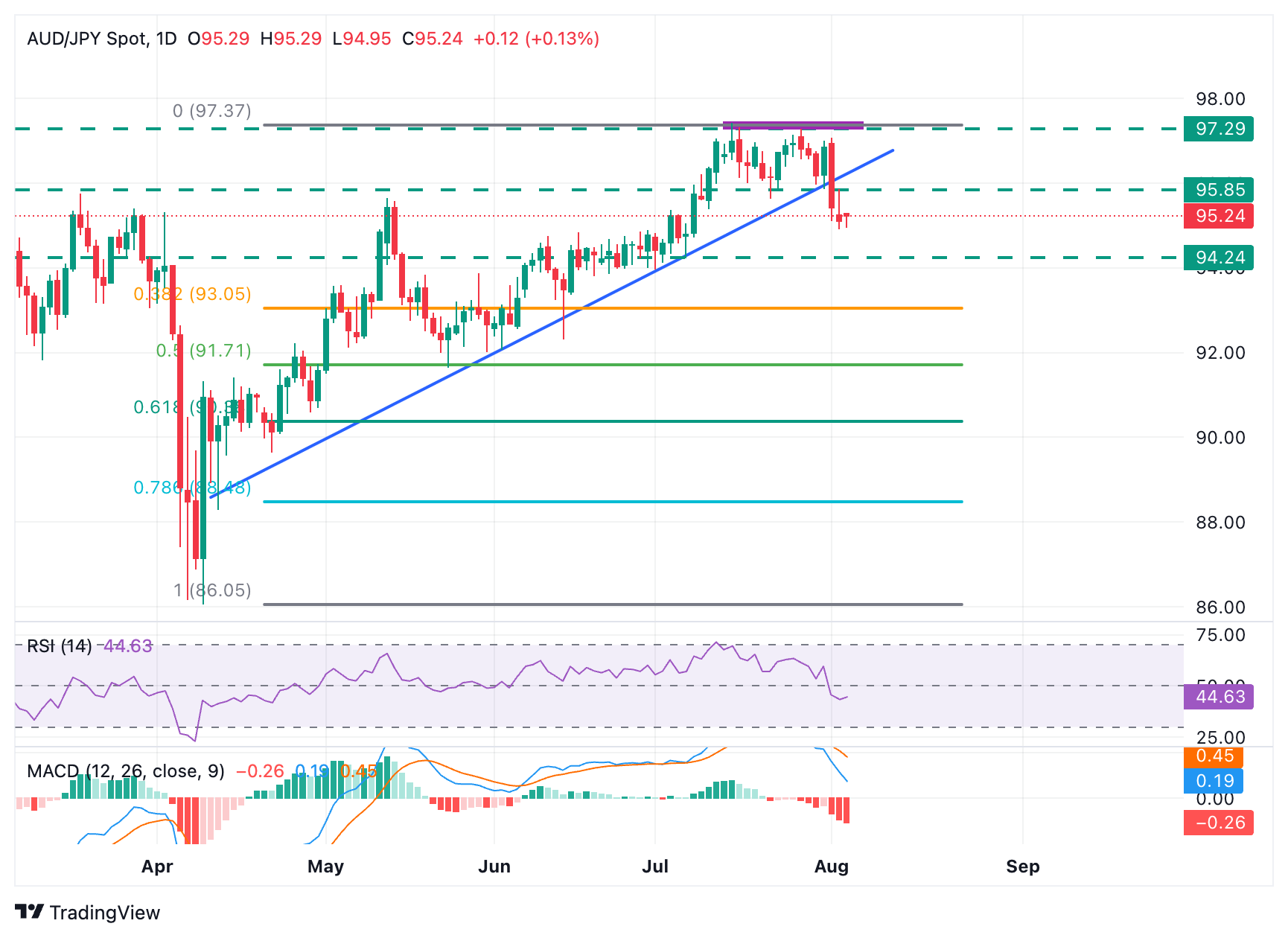
From a technical perspective, a double top at the 97.30-97.45 area in late July suggests that the pair’s bullish trend from early April’s low has come to an end, and bears are taking control.
The confirmation below the confluence of the DT’s neckline and the ascending trendline, at the 96.00 area is giving hopes for sellers while the pair remains pinned near the 95.00 support area. Further down, the next targets are the July 7 low, at 94.25 and the 38.2 Fibonacci retracement, at 93.00.
On the upside, the mentioned support, at 95.90 (Jul 30, 31 lows) will probably act as a resistance ahead of the reverse trendline, now at 96.30. Above here, the bearish view would be cancelled and the focus would be shifted back to 97.30-97.45 July 15, 16 and 28 highs.
RBA FAQs
The Reserve Bank of Australia (RBA) sets interest rates and manages monetary policy for Australia. Decisions are made by a board of governors at 11 meetings a year and ad hoc emergency meetings as required. The RBA’s primary mandate is to maintain price stability, which means an inflation rate of 2-3%, but also “..to contribute to the stability of the currency, full employment, and the economic prosperity and welfare of the Australian people.” Its main tool for achieving this is by raising or lowering interest rates. Relatively high interest rates will strengthen the Australian Dollar (AUD) and vice versa. Other RBA tools include quantitative easing and tightening.
While inflation had always traditionally been thought of as a negative factor for currencies since it lowers the value of money in general, the opposite has actually been the case in modern times with the relaxation of cross-border capital controls. Moderately higher inflation now tends to lead central banks to put up their interest rates, which in turn has the effect of attracting more capital inflows from global investors seeking a lucrative place to keep their money. This increases demand for the local currency, which in the case of Australia is the Aussie Dollar.
Macroeconomic data gauges the health of an economy and can have an impact on the value of its currency. Investors prefer to invest their capital in economies that are safe and growing rather than precarious and shrinking. Greater capital inflows increase the aggregate demand and value of the domestic currency. Classic indicators, such as GDP, Manufacturing and Services PMIs, employment, and consumer sentiment surveys can influence AUD. A strong economy may encourage the Reserve Bank of Australia to put up interest rates, also supporting AUD.
Quantitative Easing (QE) is a tool used in extreme situations when lowering interest rates is not enough to restore the flow of credit in the economy. QE is the process by which the Reserve Bank of Australia (RBA) prints Australian Dollars (AUD) for the purpose of buying assets – usually government or corporate bonds – from financial institutions, thereby providing them with much-needed liquidity. QE usually results in a weaker AUD.
Quantitative tightening (QT) is the reverse of QE. It is undertaken after QE when an economic recovery is underway and inflation starts rising. Whilst in QE the Reserve Bank of Australia (RBA) purchases government and corporate bonds from financial institutions to provide them with liquidity, in QT the RBA stops buying more assets, and stops reinvesting the principal maturing on the bonds it already holds. It would be positive (or bullish) for the Australian Dollar.
Author

Guillermo Alcala
FXStreet
Graduated in Communication Sciences at the Universidad del Pais Vasco and Universiteit van Amsterdam, Guillermo has been working as financial news editor and copywriter in diverse Forex-related firms, like FXStreet and Kantox.