AstraZeneca’s Tagrisso shows promise in combating advanced lung cancer

Lung cancer is a major global health concern and ranks as the deadliest type of cancer, accounting for approximately one in five cancer-related deaths, according to the World Health Organization. In 2020 alone, there were approximately 2.2 million new diagnoses of lung cancer. Therefore, the news about AstraZeneca’s new drug Tagrisso could be great for the global fight against cancer and AstraZeneca’s outlook.
Tagrisso has been reported on by Bloomberg to demonstrate its ability to delay the progression of advanced lung cancer when combined with chemotherapy. This would mark a significant advancement in the treatment of this deadly disease. The study’s findings indicate that the combination of Tagrisso and chemotherapy extended the time before the worsening of advanced non-small cell lung tumors by an impressive nine months compared to Tagrisso alone. Additionally, this combination therapy reduced the risk of death or disease progression by 38% when compared to Tagrisso used as a single therapy.
These results are expected to set a new standard for delaying the progression of the disease, according to Susan Galbraith, Executive Vice President of Oncology Research and Development at AstraZeneca. Tagrisso is already the UK-based pharmaceutical company’s best-selling drug, generating $5.4 billion in revenue and contributing significantly to the company’s 2022 earnings.
David Fredrickson, Executive Vice President of Oncology at AstraZeneca, emphasized the importance of advancing treatment options beyond monotherapy, highlighting Tagrisso as the cornerstone of lung cancer treatment for patients with a specific genetic mutation known as EGFR.
According to the study, patients receiving the combination therapy experienced a median survival time of 25.5 months (by investigator assessment) and 29.4 months (by blinded independent central review) before the cancer progressed. In contrast, those who received Tagrisso alone had median survival times of 16.7 months and 19.9 months, respectively. Although overall survival data is still preliminary, the results favour Tagrisso combined with chemotherapy.
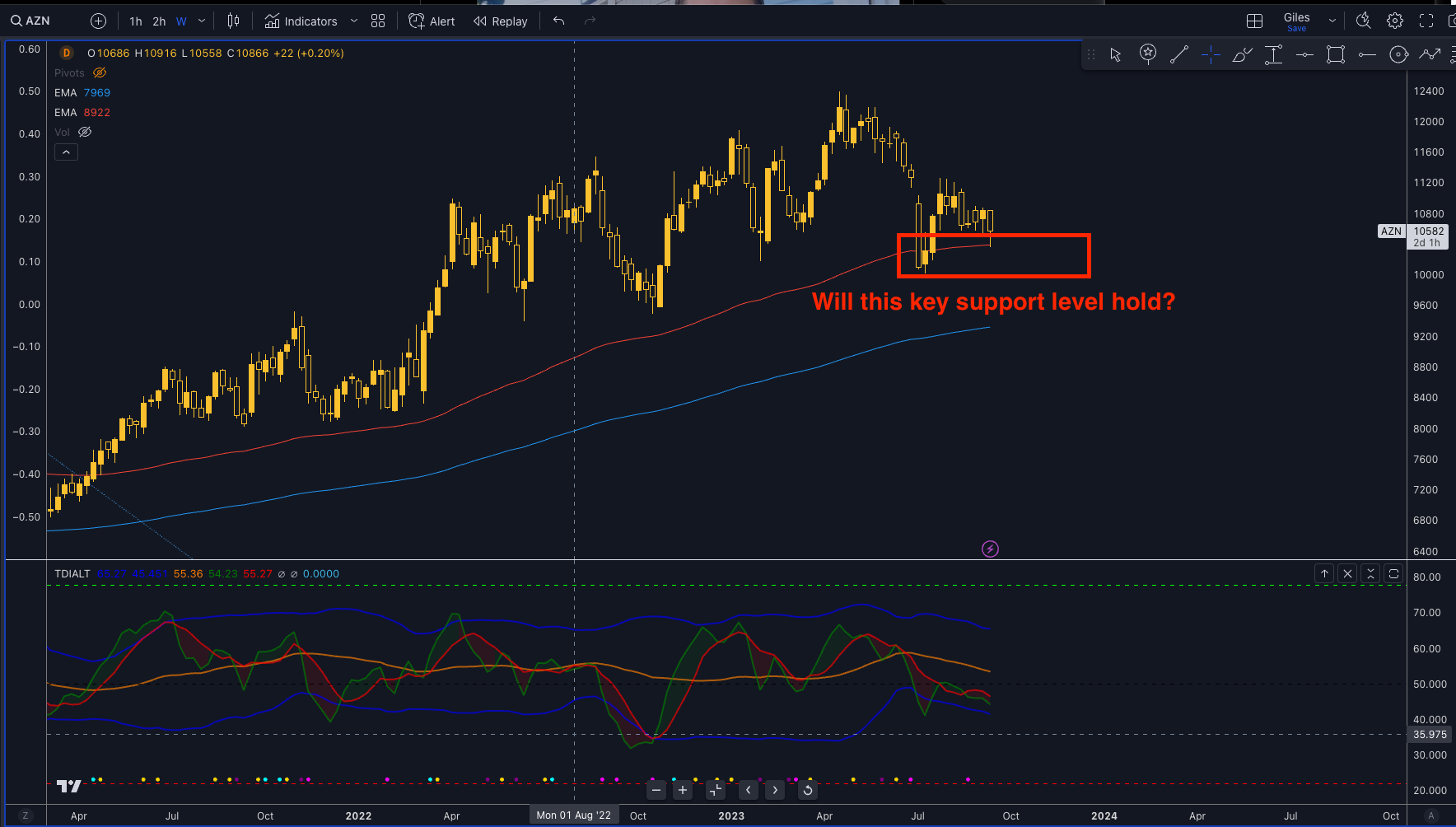
Despite this positive development, analysts from Bloomberg Intelligence, John Murphy and Sam Fazeli, noted that the study’s results present a mixed message and create a competitive landscape for rival pharmaceutical companies like Johnson & Johnson. They highlighted the significant success of AstraZeneca in achieving the primary endpoint of the trial but expressed concern about the absence of a clear trend favouring an overall survival benefit. So, to the extent this significant progress impacts AstraZeneca’s share price still remains to be seen.
Author

Giles Coghlan LLB, Lth, MA
Financial Source
Giles is the chief market analyst for Financial Source. His goal is to help you find simple, high-conviction fundamental trade opportunities. He has regular media presentations being featured in National and International Press.
















