Apple stock loses support at $200 in second day of tariff turmoil
- Apple stock sinks to June 2024 levels on Friday.
- UBS calls Trump's tariffs a $700B tax on US consumers.
- Apple production will be hit hard by the new tariff regime.
- AAPL stock likely headed to $184 or $180 next.
Apple (AAPL) stock, which cratered 9.25% on Thursday, lost another 4% or more in Friday’s premarket. The Trump administration’s drastic tariff policy, announced late Wednesday, continues to wreak havoc across markets.
Apple uses a number of factories and suppliers across China and Taiwan, which received additional tariffs of 34% and 32%, respectively, from the Trump administration. Apple has invested in new production infrastructure in India, but that nation received 26% tariffs from the Trump administration.
The futures market projects another day of pain for equity investors. Dow Jones Industrial Average futures have sunk 2.8%, while the NASDAQ Composite and S&P 500 are both down 2.9% at the time of writing. Nvidia (NVDA) stock also lost its $100 price level anchor on Friday.
Apple stock news
“From the Dot.com bubble and burst to the financial crisis to Europe debt crisis to COVID-19 lows in March 2020... never have we (or others that have covered the markets for 50 years+) seen a self-inflicted debacle of epic proportions like the Trump tariff slate over the last 36 hours,” wrote Wedbush Securities’ Dan Ives on Friday.
Besides Apple’s own proximity to the new tariff regime, the tariffs themselves are likely to become a major drag to demand for its products. Many observers expect to see a recession in the US this year if the tariffs remain in place. Goldman Sachs has raised the chances of a US recession to 35% from the previous 20%.
UBS calls the new Trump tariffs a $700 billion tax on US consumers. Though importers are the ones who pay the import tax, tariffs normally get passed on to consumers through higher prices.
What’s more, other countries are likely to respond with their own reciprocal tariffs. China emerged on Friday, possibly the first nation to respond, with its own 34% matching tariff on US goods. This will make Apple products further out of reach for the average Chinese consumer.
Of course, Apple CEO Tim Cook has promised to invest $500 billion in US manufacturing over the next few years, a fact that Trump highlighted in his Rose Garden speech on Wednesday. But that investment, if it's even serious, will take years to materialize. In the meantime, Apple will likely see demand for its flagship iPhone diminish and its much-heralded gross margins collapse.
Apple stock forecast
Apple stock is trading down 4.77% to $193.49, a level it hasn’t seen in about nine months or June 2024. This is interesting. Not only did the AAPL stock price fail to stop at the psychological level of $200, but the share price also fell through historical support from June and August of last year when the $196 level acted as both resistance and support.
Here in the $193s, Apple stock is poised to push on to the 161.8% Fibonacci Extension at $184.12 or past support surrounding $180.00.
Most traders will note that the 50-day Simple Moving Average (SMA), like so many other Magnificent 7 stocks at the moment, is about to crash below its 200-day counterpart. This will signal a bearish Death Cross that foreshadows an extended downturn.
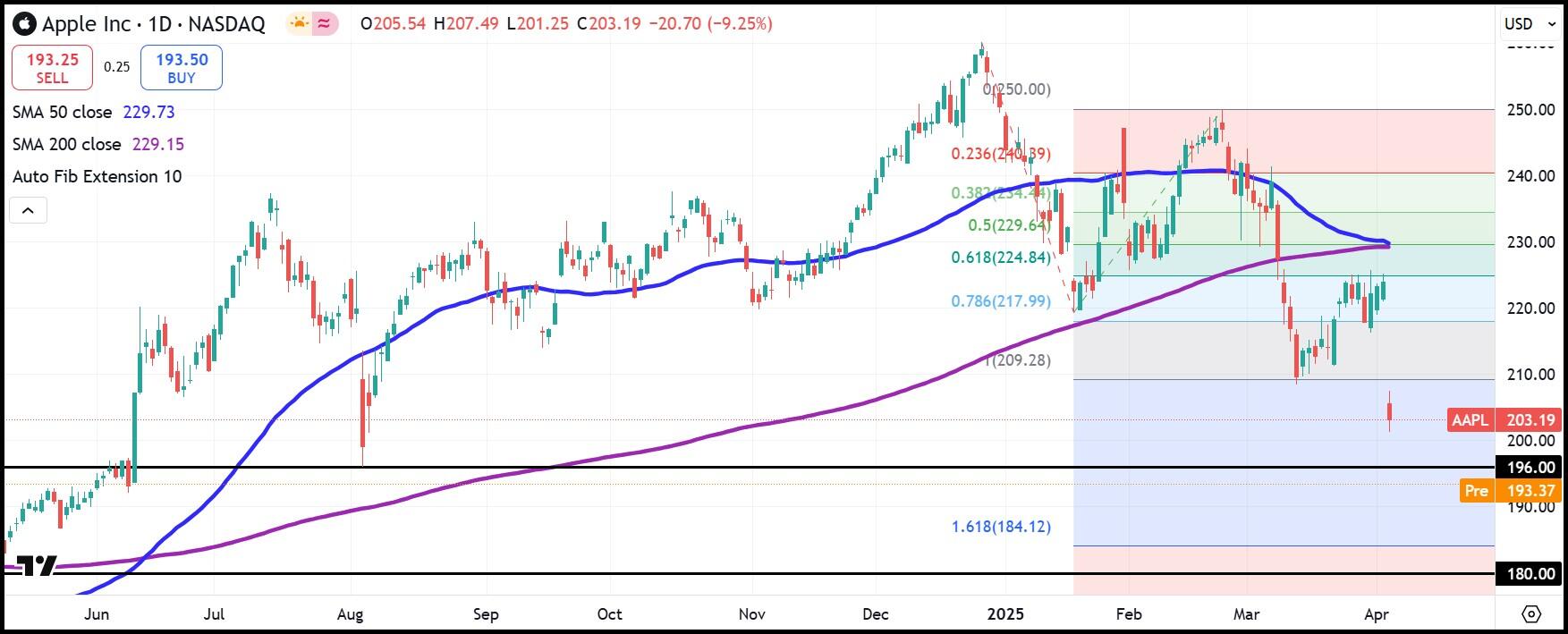
AAPL daily stock chart
Author

Clay Webster
FXStreet
Clay Webster grew up in the US outside Buffalo, New York and Lancaster, Pennsylvania. He began investing after college following the 2008 financial crisis.

















