|

AMC Share Price: Stock tumbles as Iceberg Research reports it owns a short position

  • NYSE:AMC fell 4.17% on Friday, during another red day for meme stocks.
  • Iceberg Research discloses it now has a short position in AMC.
  • With Robinhood set to go public, some are calling an end to meme stocks.

NYSE:AMC continued its descent on Friday, and it's unclear whether or not a hot weekend at the ticket booth can save the stock again. Shares of AMC fell by 4.17% to close the trading session at $51.96 heading into the July 4th weekend. The recent short squeeze is definitely running out of gas after the parabolic rise of AMC’s price has sent the stock higher than what the underlying fundamentals of the company can reasonably support.


Stay up to speed with hot stocks' news!


One investing firm that will definitely agree with that statement is Iceberg Research, a notorious short-seller that disclosed on Friday that it now held a short position in AMC. While it is risky business disclosing short positions in a meme stock these days, Iceberg’s lead investor Arnaud Vagner believes that the reliance on call options in hopes of a gamma squeeze is not sustainable, stating that the volume of call options is steadily declining. Vagner also called out AMC’s fundamentals, citing that the company still has hurdles in terms of the movie industry ever returning to pre-pandemic levels. 

AMC stock forecast
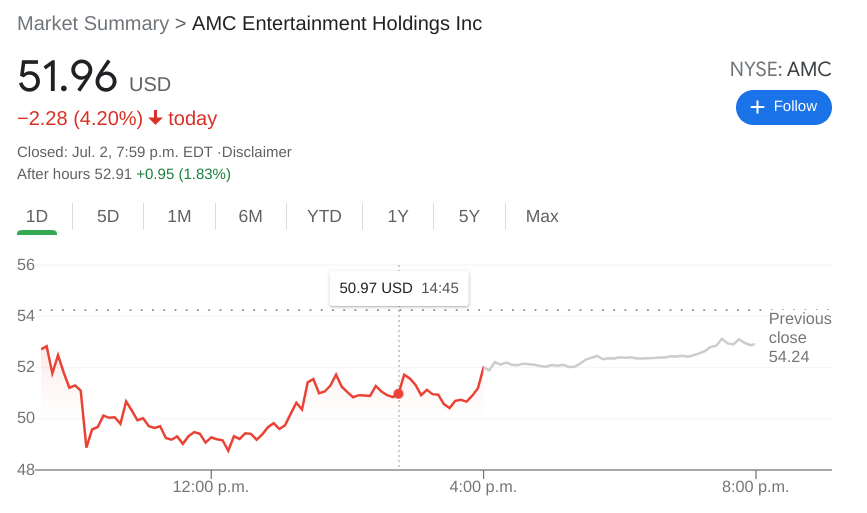
With the announcement of retail trading platform Robinhood going public in the near future, many in the industry are calling for an end to the meme stock phenomenon. According to some analysts, the top of the crypto markets came when Coinbase (NASDAQ:COIN) went public, and there are expectations that the same may happen to meme stocks once Robinhood is publicly traded. With higher regulations for public companies as well as keeping shareholders happy, it would be best for Robinhood to avoid these controversies moving forward. 

Author

More from Stocks Reporter
Share:

Editor's Picks

GBP/USD edges lower below 1.3650, with eyes on US PCE data

GBP/USD trades with a negative bias below 1.3650 in the European session on Wednesday, eroding a part of the previous day's strong gains. The pair, however, remains within striking distance of a six-month top, set last Friday, as traders keenly await the release of the US Personal Consumption Expenditures (PCE) Price Index data for a fresh impetus.

EUR/USD holds lower ground near 1.1650 ahead of key US data

EUR/USD is holding lower ground toward 1.1650 in Wednesday's European session. The US Dollar is recovering modestly amid profit-taking and Middle East uncertainty. US inflation, tracked by the PCE, and another revision of Q2 GDP data should keep investors entertained on Wednesday.

Gold remains depressed below $4,650 on firmer USD; looks to US PCE for Fed rate outlook

Gold sticks to modest losses below $4,650 heading into the European session, though it lacks bearish conviction and remains confined within the previous day's broader range. The US Dollar regains positive traction amid some repositioning ahead of the US Personal Consumption Expenditures Price Index and is seen as weighing on the commodity. Adding to this, Federal Reserve Chair Kevin Warsh's remarks at the Jackson Hole Symposium on Friday might offer more cues about the interest rate path.

Dogecoin, Shiba Inu, Pepe: Profit-taking cools last week’s rally

Meme coins, including Dogecoin (DOGE), Shiba Inu (SHIB), and Pepe (PEPE), are losing their bullish momentum after last week’s double-digit gains. Facing downside pressure amid profit-taking, DOGE and PEPE risk further decline while SHIB holds at a support level.

America’s self‑inflicted trade wound
I’m conflicted about the trade war that the U.S. has started with Canada. Let’s be clear: any representation that Canada has been taking unfair advantage of the U.S. or that they have been treating us badly for years is a bogus characterization. In reality, the shoe is on the other foot. It’s the U.S. that has been behaving badly.
Canada hits US goods with tariffs; The rate market sees a problem
On September 8, Canada begins charging its own importers 15%, 25% and 50% on roughly 700 lines of American goods. The measure is billed as dollar for dollar, and on the arithmetic of covered trade it is. What it is not is a tax on the United States.