Amazon stock slides over 3% on NFP jobs miss
- Amazon stock gave back 3.65% on Friday.
- August US NFP data showed a hiring miss, while June and July figures were revised lower.
- Mainstream view still expects 25 bps cut on September 18, but JPMorgan calls for 50 bps.
- Analyst expects Magnificent Seven, especially AMZN, to sink on slowing EPS growth in Q3.

Amazon (AMZN) was injured more than most of the Magnificent 7 stocks on Friday, ending the day 3.65% lower. The culprit was the Nonfarm Payrolls (NFP) print for August that came in 11% below expectations.
The wider market also fell victim to the bad hiring figure in the US, which came in 18K below consensus at 142K. The Dow Jones lopped off 1% of its value, while the NASDAQ drained by 2.55%.
Amazon stock news: Downward hiring revisions worry market
The good news is that the Federal Reserve (Fed) is almost certainly set to begin its rate-cutting cycle on September 18. The bad news is that it may be 50 bps since the US labor market looks uncharacteristically weak. It would seem that the past two years of a high interest rate environment have finally taken their toll.
Based on the August NFP report, released Friday morning, the US economy added 142K net new jobs, which was better than July but fell below the 160K consensus of Wall Street. The US Unemployment Rate ticked down by a tenth of a percentage point to 4.2%, but healthy job growth in the US is normally above 200K.
What’s more, July’s already worrisome figure of 114K was revised down to 89K. Likewise, June’s 179K figure was revised lower to 118K, so traders are beginning to sense a serious pattern.
At one point on Friday, bets on a 50 bps cut in September, what would be the first cut since the Fed began raising rates in 2022, shot up to the majority opinion on the CME Group’s FedWatch Tool. However, they ended the day at 31% after several banks released client notes stressing that 25 bps remained the clear beat.
Still, as prominent a shop as JPMorgan said 50 bps was “the right thing to do”.
"The August employment report reinforced the sense of waning vigor in labor market activity," JPMorgan's Michael Feroli wrote in a client note. He added that, “Policy is restrictive, downside employment risks are growing, and upside inflation risks are ebbing.”
Amazon is at risk as any other company of a general economic slowdown, which would mean lower purchasing power across its millions of customers. The NFP report showed that construction and healthcare employment are still growing, while manufacturing employment is generally hurting.
In unrelated news, Ned Davis Research released an intriguing note dispelling the idea that the Magnificent Seven stocks could continue growing earnings per share (EPS) at their current level.
Ed Clissold, the chief US strategist at Ned Davis, wrote that most of these mega-caps were "suffering from the law of large numbers” and do not, therefore, deserve their current exquisite valuations.
Amazon was listed as the stock with the largest difference between its second-quarter YoY EPS growth and what analysts are expecting from Q3. Wall Street expects Amazon to earn $1.13 in adjusted EPS in Q3, a 20% gain YOY. However, Q2 saw an outsized 94% YoY gain with adjusted EPS of $1.26.
Amazon stock forecast
Amazon stock is now trading beneath its 200-day Simple Moving Average (SMA), which is clearly a bad sign for bulls. What's more, the 50-day SMA has just tilted below the 100-day SMA.
The April 25 low of $166.32 sits nearby, but that seems like an unlikely level to hold since on that specific occasion AMZN recovered quickly off the 100-day SMA, which it is currently far below.
The more likely points of support are the $152 level from the August 5 dive and the $145 level that formed support in January.
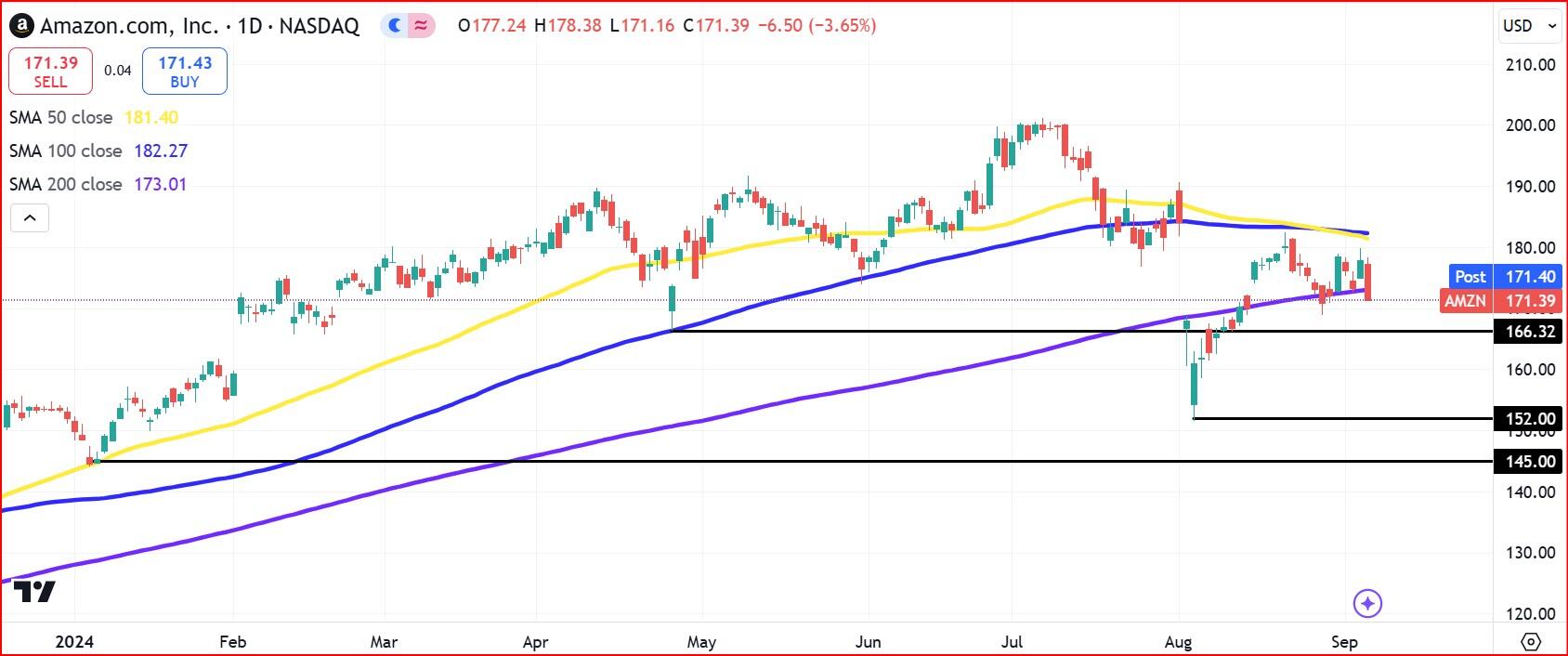
AMZN daily stock chart
Author

Clay Webster
FXStreet
Clay Webster grew up in the US outside Buffalo, New York and Lancaster, Pennsylvania. He began investing after college following the 2008 financial crisis.