AI without the bubble: A strategic lens for 2026

Key points
- AI leadership is broadening beyond mega-cap tech into semiconductors, industrial automation and power infrastructure - the real “picks and shovels” of the AI buildout.
- A disciplined screen focusing on profitability, cash flow and sensible valuations narrows the global universe to just 15 companies that appear to combine AI exposure with financial resilience.
- 2026 may reward “AI with receipts” - companies delivering earnings, not just narratives, making balance-sheet strength and execution key differentiators as the cycle matures.
As we step into 2026, the conversation around AI is shifting. The question is no longer whether AI investment will continue—global capex plans, data-centre buildouts and electrification needs suggest it will—but how to participate without getting caught in the frothier corners of the market.
This is where fundamentals matter again. After a cycle dominated by narratives, 2026 is shaping up to reward balance-sheet strength, cash-flow visibility and the companies building the infrastructure that AI actually relies on, rather than those simply riding sentiment.
To explore this theme, we have built a simple Bloomberg framework that screens for AI-adjacent businesses with real earnings, real cash flow and reasonable valuations. This isn’t a stock list or a set of recommendations. It’s a framework to help investors recognise the financial signals, such as earnings quality, free cash flow and valuation discipline, that often differentiate real AI execution from noise.
The logic behind the screen: AI is a capital cycle, not just a story cycle
AI is no longer a single-sector story. The buildout now spans chips and hardware, industrial automation, software, and even utilities powering data centres. To reflect this broader ecosystem, the screen focuses on four BICS segments that sit at the core of the AI economy:
- Technology Hardware & Semiconductors.
- Software.
- Industrial Automation.
- Utilities.
These sectors represent the practical backbone of AI – compute, storage, automation and electrification.
But exposure alone isn’t enough. 2026 may be a year where dispersion widens within AI: some companies will compound, others may struggle to meet optimistic expectations. So the goal was to identify companies showing financial resilience alongside AI relevance.
What the filter looks for
1. Strong profitability (ROE > 12%)
Companies must meaningfully earn on the capital they deploy. This is a first line of defence against speculative growth stories.
2. Real free cash flow (positive T12M and margin > 3%)
Cash generation remains the cleanest signal of operational health, especially in capex-heavy AI ecosystems.
3. Low financial stress (Net Debt/EBITDA < 2 and Interest-coverage > 5x)
AI buildouts are expensive; heavily leveraged players may be vulnerable if funding costs rise again.
4. Consistent earnings growth (5-yr adjusted EPS CAGR > 8%)
This avoids cyclical blow-ups and screens for companies with some track record of delivery.
5. Valuation discipline (P/E < 30, PEG between 0 and 2, EV/EBITDA < 25)
These are not “cheap” companies - AI rarely is - but they are not priced for perfection either.
Taken together, these filters lean toward AI recipients rather than AI hopes—businesses with both the balance-sheet capacity and operational traction to benefit from the structural investment cycle.
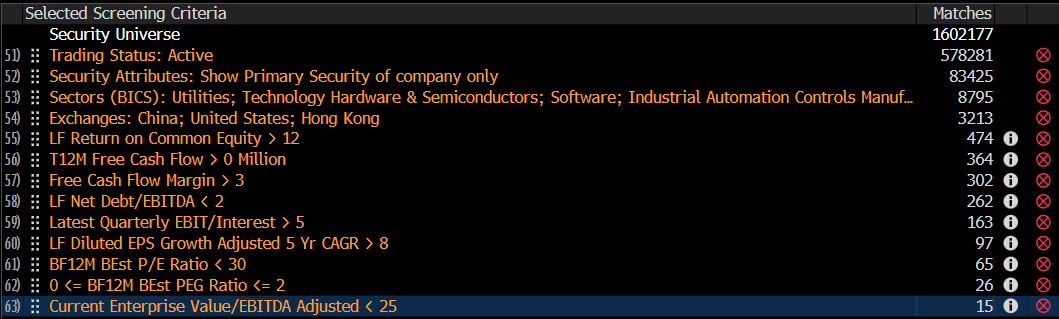
What survived the filter: Fifteen companies across hardware, software, automation and power
The screen narrowed over 1.6 million securities to just 15 names—a small, globally diversified mix spanning US, China, Hong Kong and Europe.
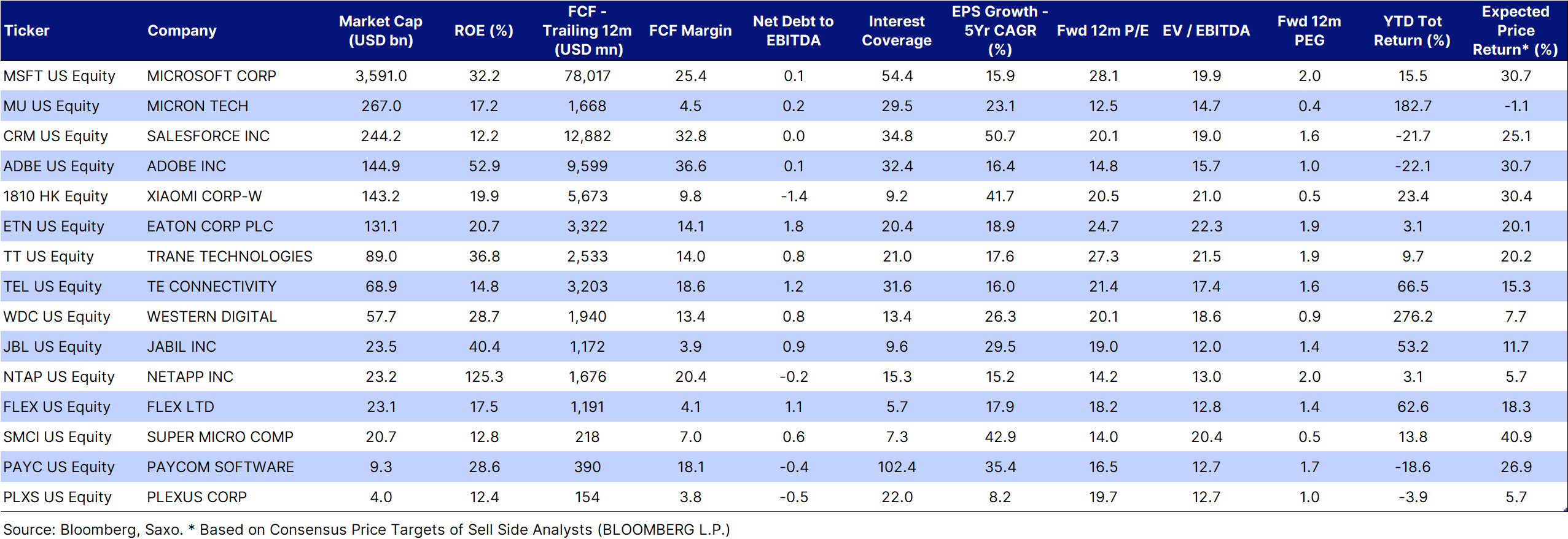
These include:
Semis and compute infrastructure
Where the capex bottlenecks are tightening. These companies sit at the heart of memory, compute platforms and advanced manufacturing—the plumbing beneath the AI boom.
- Micron Technology.
- Super Micro Computer.
- Western Digital.
- Jabil.
Software and enterprise automation
Where AI adoption meets recurring revenue. These firms combine strong margins with sticky customer ecosystems, making them potential AI productivity beneficiaries
- Adobe
- Salesforce
- Paycom
- Plexus
Industrial automation and connectivity
The overlooked winners of the AI physical buildout. Here the link to AI is indirect but powerful: data-centre cooling, thermal systems, interconnects and robotics.
- TE Connectivity
- Trane Technologies
- Flex Ltd
Consumer AI and smart devices
This is a segment benefiting from the physical interface between consumers and AI services.
- Xiaomi Corp
Power and electrification
The future bottleneck of AI. AI’s biggest constraint is no longer algorithms – it’s electricity. Utilities and electrification specialists could play an increasingly central role.
- Eaton Corp
Two names that bridge categories
- Microsoft (reflecting its hyperscale positioning)
- NetApp (high-performance storage, strong ROE)
The presence of both reinforces that the screen captures AI enablers with receipts, not hype cycles.
What this list tells us about the market narrative
Three messages stand out:
The AI trade is broadening
The survivors are not just chipmakers or megacaps. Industrial automation, cooling, connectivity and power systems show up strongly—evidence that AI is becoming a real-world capex cycle.
Cash flow is the differentiator
Many companies with impressive AI narratives failed the screen purely on free cash flow or leverage. 2026 could reward delivery, not declarations.
Valuation discipline matters again
Despite strong growth profiles, the median P/E of the group is below 20x and PEG around 1.3—suggesting growth at a reasonable price rather than runaway multiples.
How investors might use this framework
This is not a call to buy any of these companies. Instead, the screen can help frame a few strategic questions for 2026:
- Is my AI exposure anchored in companies that generate cash?
- Am I relying too much on high-multiple narrative stocks?
- Am I positioned for the physical buildout of AI—power, thermal, automation—not just the software layer?
- Where are valuations most vulnerable if cost of capital stays elevated?
2026 could be the year AI shifts from hype to hard economics. A screen like this is simply one way to focus on companies that appear better equipped, financially and operationally, to navigate that transition.
A closing thought
The risk of an AI bubble hasn’t gone away. But the opportunity set is broader, deeper and more industrial than the headlines imply. By filtering for profitability, cash generation and valuation sanity, this framework aims to show that AI exposure doesn’t have to mean speculation. It can also mean fundamental resilience.
Read the original analysis: AI without the bubble: A strategic lens for 2026
Author

Saxo Research Team
Saxo Bank
Saxo is an award-winning investment firm trusted by 1,200,000+ clients worldwide. Saxo provides the leading online trading platform connecting investors and traders to global financial markets.
















