Trump tariff threats seemingly fall on deaf ears – Focus turns to Fed and Aussie CPI

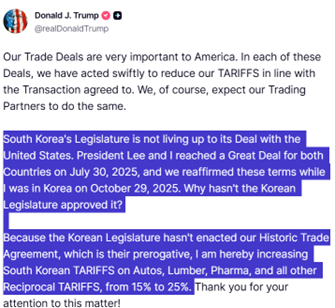
US President Donald Trump ramped up trade tensions with South Korea yesterday after stating that Seoul is ‘not living up to its deal with the US’, as shown below via his Truth Social platform. This also follows threats to impose 100% tariffs on imported Canadian goods over the weekend should Canada pursue closer trade arrangements with China.
However, as I am sure you have seen, the South Korean KOSPI index has rallied to fresh record highs overnight, seemingly brushing off recent tariff threats, and I have not seen much from the CAD.
The data docket is light today, with limited tier-1 event risk to work with. We do have the January consumer confidence number from the Conference Board landing at 3:00 pm GMT. However, attention is squarely on tomorrow’s Fed meeting, and the Aussie CPI print.
Fed meeting centres on Powell
As for the Fed, while a rate hold is a done deal – keeping the target rate on hold at 3.50% - 3.75% – the focus falls on the tone and substance of Chairman Jerome Powell's press conference. Although I will be closely watching for any hint about where we are headed in terms of policy trajectory, Powell may well sidestep specifics and defer judgment to future meetings.
To be frank, I am unsure whether his presser will be focussed more on Fed independence concerns or on where policy is headed – I am willing to bet that the first question will be regarding the former, given the recent legal threats. Time will tell.
I recently noted that ‘if Powell pushes back against political pressure – suggesting a firmer stance that defends Fed independence – this might trigger short-term USD upside, while indicating support for gradual easing could prompt further downside’.
Aussie CPI inflation to seal the deal for a rate hike?
Ahead of tomorrow’s Australian CPI inflation data, investors have assigned a 60% chance that the RBA will hike the cash rate by 25 bps at next week’s February meeting, largely fuelled by the recent stronger jobs data.
Solid inflation numbers would likely cement rate-hike expectations for the upcoming meeting and trigger an AUD bid. However, what would catch the market off guard is a meaningful downside miss – given economists expect elevated inflation – potentially prompting a strong unwind in AUD long positions as markets price out the hike.
Market snapshot
As for US Stock benchmarks on Monday, we ended in the green, with most companies settling higher. The S&P 500 added 34 points (0.5%) rallying to 6,950, along with the Nasdaq 100 climbing 107 points (0.4%) to 25,713. In terms of the sector performance, gains were largely concentrated in Information technology, with consumer discretionary taking the biggest hit.
In the FX space, the pace of JPY longs decelerated yesterday, following Friday’s one-sided decline in USD/JPY amid talks of a coordinated intervention effort between the US and Japan. Overnight, the pair has reclaimed the majority of Monday’s losses, up 0.2%. As for the USD index, recent flow concluded down 0.4% in the shape of an indecision candle, with little movement seen in Asia Pacific trading. The 96.22 low for 2025 is on the radar for the DXY, and a breakout lower could swing the pendulum in favour of targeting levels not seen since early 2022. The downtrend in the buck remains in play, and selling rallies continue to be a key theme.
Across precious metals, both Spot Gold and Silver pencilled in another leg higher yesterday, bolstered by the decline in the USD, Fed easing expectations, government debt, and, of course, geopolitical drama. Rallies in both metals have been parabolic!
Gold cruised through the widely watched US$5,000 barrier, reaching an all-time high north of US$5,100, though ended the session off best levels, delivering what many technical eyes will acknowledge as a bearish shooting star pattern. Despite this, the yellow metal is up 1.3% as of writing. For Silver, it was a similar picture, reaching all-time record highs of US$117.73 before easing into the close, though today’s session is up 5.2%. The upside in Silver has just been phenomenal – we have rallied more than 50% YTD, and we are not even in February yet.
Author

Aaron Hill
FP Markets
After completing his Bachelor’s degree in English and Creative Writing in the UK, and subsequently spending a handful of years teaching English as a foreign language teacher around Asia, Aaron was introduced to financial trading,














