The British Pound (GBP) falls slightly against the US Dollar (USD) at the time of writing on Thursday, to around 1.3430 (-0.1%), after several sessions of high volatility in the United Kingdom’s (UK) Bond market.
Traders are now awaiting Friday’s official UK Retail Sales figures from the Office for National Statistics (ONS) for August, a key indicator for gauging the health of British consumption, which is set to be released at 06:00 GMT.
This data will be decisive for the direction of the currency, especially as it comes after eleven consecutive months of falling sales volumes reported by the Confederation of British Industry (CBI), pointing to a sector in serious difficulty.
Against this backdrop, the GBP in the Forex today is poised between a resilience fuelled by the rate differential between the Bank of England (BoE) and other central banks, and persistent concerns over domestic demand.
GBP/USD technical analysis
According to the 1-hour chart, the GBP/USD pair has been in a downtrend since peaking at 1.3590 on August 14, and trades within a descending channel below its 200-hour Simple Moving Average (SMA), confirming its short-term bearish bias.
Note that the recent rebound from the 1.3340 area is finding resistance at 1.3460, just below the 200-hour moving average currently at 1.3472. A breach of this resistance zone could then encourage a more significant upward movement to the upper boundary of the descending channel pattern near 1.3540.
Conversely, a return below support at 1.3420 could encourage a sharper short-term decline.
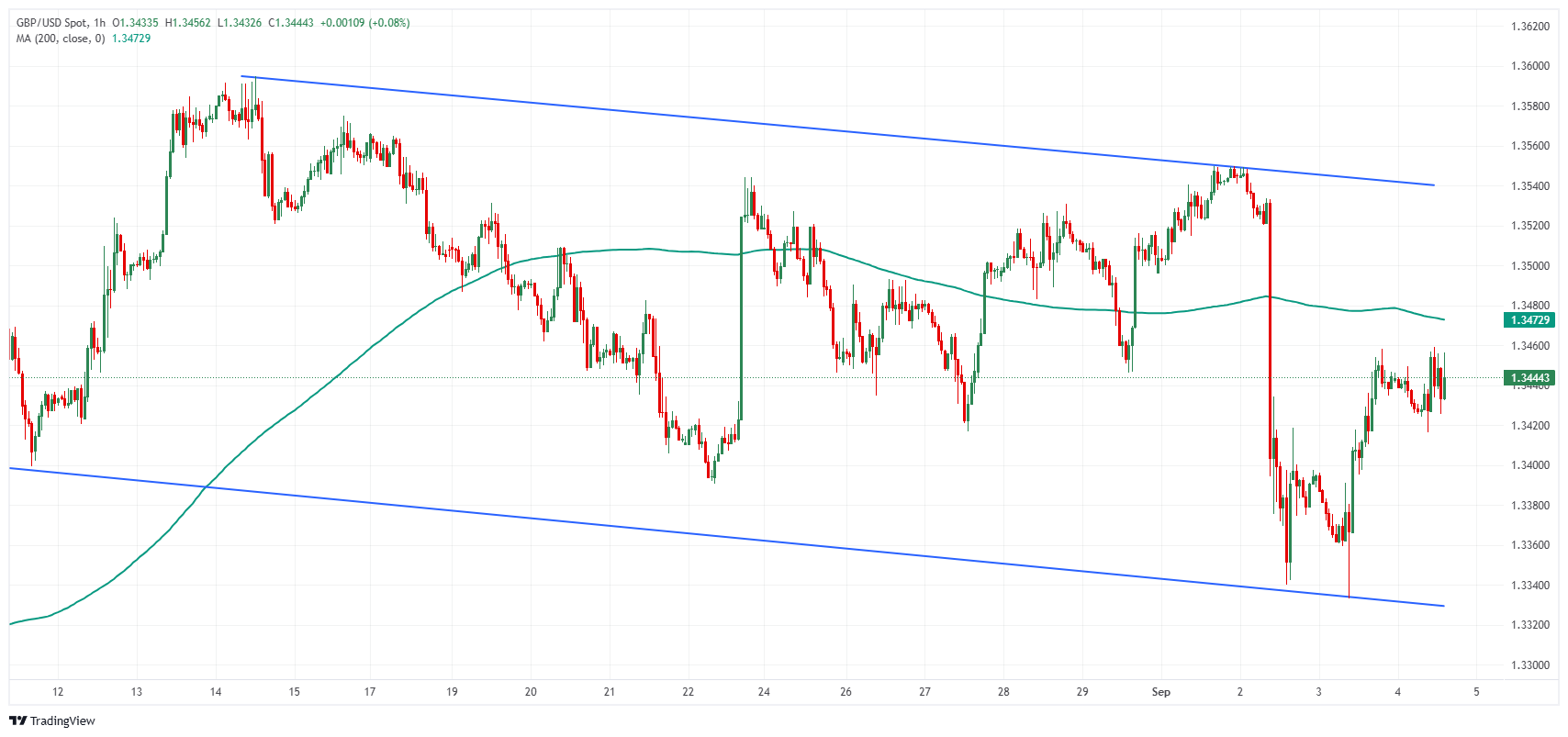
GBP/USD 1-hour chart. Source: FXStreet
Friday's retail sales data could then offer a catalyst for GBP/USD, on both the upside and the downside.
Pound Sterling Price Today
The table below shows the percentage change of British Pound (GBP) against listed major currencies today. British Pound was the strongest against the Australian Dollar.
| USD | EUR | GBP | JPY | CAD | AUD | NZD | CHF | |
|---|---|---|---|---|---|---|---|---|
| USD | 0.17% | 0.07% | 0.28% | 0.19% | 0.36% | 0.36% | 0.26% | |
| EUR | -0.17% | -0.08% | 0.14% | 0.03% | 0.27% | 0.20% | 0.05% | |
| GBP | -0.07% | 0.08% | 0.32% | 0.11% | 0.34% | 0.30% | 0.14% | |
| JPY | -0.28% | -0.14% | -0.32% | -0.15% | -0.05% | 0.06% | -0.07% | |
| CAD | -0.19% | -0.03% | -0.11% | 0.15% | 0.14% | 0.18% | 0.03% | |
| AUD | -0.36% | -0.27% | -0.34% | 0.05% | -0.14% | -0.06% | -0.20% | |
| NZD | -0.36% | -0.20% | -0.30% | -0.06% | -0.18% | 0.06% | -0.11% | |
| CHF | -0.26% | -0.05% | -0.14% | 0.07% | -0.03% | 0.20% | 0.11% |
The heat map shows percentage changes of major currencies against each other. The base currency is picked from the left column, while the quote currency is picked from the top row. For example, if you pick the British Pound from the left column and move along the horizontal line to the US Dollar, the percentage change displayed in the box will represent GBP (base)/USD (quote).
UK Consumption under pressure
UK Retail Sales are an essential barometer of the economy, accounting for a large share of business activity. After a solid rebound in June (+0.9% MoM), economists are expecting a marked slowdown in July, with growth limited to 0.2% MoM and 1.3% YoY.
Excluding fuels, growth is expected to reach 0.4% MoM and 1.2% YoY, according to forecasts compiled by analysts.
For TD Securities, this moderation reflects contrasting dynamics: "Warm weather has supported food and fuel sales, but the slowdown in summer footfall in clothing and household goods stores should bring growth back to a more modest pace", explain the bank's economists.
At the same time, advanced data from the CBI point to an even more fragile situation. In August, the employers' organization reported a -32% drop in sales volumes, the eleventh consecutive month of decline.
Martin Sartorius, CBI Principal Economist, said: "Retailers endured another tough month in August, with annual sales volumes falling for the eleventh consecutive month."
"Weak demand and higher labour costs continue to put pressure on margins, dampening sentiment across the retail and wider distribution sector. This downbeat outlook is reflected in firms' plans to scale back investment and hiring," Sartorius added.
Macro environment and monetary policy
While domestic consumption is a cause for concern, the Sterling's momentum also remains dictated by the Bank of England’s monetary policy.
BoE Governor Andrew Bailey recently stressed that "the risk of persistent inflation has increased", reports Reuters, justifying a more cautious tone on possible rate cuts. This stance has helped limit expectations of rapid policy easing, providing partial support for the currency.
However, fiscal uncertainties continue to weigh heavily. Yields on 30-year Gilts reached their highest level since 1998 (5.75%) on Tuesday, fuelling doubts about the sustainability of public finances.
"These fiscal concerns are once again becoming a determining factor in the Pound's performance," points out Lee Hardman, FX analyst at MUFG.
For their part, Scotiabank's strategists note that the market is "regaining some calm after the bond storm", but warn that "the road ahead remains fraught with pitfalls as the autumn budget approaches".
In the short term, the outcome will largely depend on the ONS Retail Sales figures. A better-than-expected figure would support the view that consumption remains resilient, and could give the Pound a boost. Conversely, a disappointing figure would reinforce the perception of a flagging economy, risking renewed selling pressure.
In the meantime, the GBP is on a slippery slope. As ING's Francesco Pesole sums up: "The Pound will remain hard to attract in the months ahead, with a downward bias as long as the budget debate and consumer uncertainties dominate."
Information on these pages contains forward-looking statements that involve risks and uncertainties. Markets and instruments profiled on this page are for informational purposes only and should not in any way come across as a recommendation to buy or sell in these assets. You should do your own thorough research before making any investment decisions. FXStreet does not in any way guarantee that this information is free from mistakes, errors, or material misstatements. It also does not guarantee that this information is of a timely nature. Investing in Open Markets involves a great deal of risk, including the loss of all or a portion of your investment, as well as emotional distress. All risks, losses and costs associated with investing, including total loss of principal, are your responsibility. The views and opinions expressed in this article are those of the authors and do not necessarily reflect the official policy or position of FXStreet nor its advertisers. The author will not be held responsible for information that is found at the end of links posted on this page.
If not otherwise explicitly mentioned in the body of the article, at the time of writing, the author has no position in any stock mentioned in this article and no business relationship with any company mentioned. The author has not received compensation for writing this article, other than from FXStreet.
FXStreet and the author do not provide personalized recommendations. The author makes no representations as to the accuracy, completeness, or suitability of this information. FXStreet and the author will not be liable for any errors, omissions or any losses, injuries or damages arising from this information and its display or use. Errors and omissions excepted.
The author and FXStreet are not registered investment advisors and nothing in this article is intended to be investment advice.
Recommended content
Editors’ Picks

US Dollar surges post-Fed, uncertainty remains
The EUR/USD pair closed the week below 1.1500, not far above a fresh multi-week low of 1.1454. The US Dollar (USD) rallied following the Federal Reserve’s (Fed) monetary policy announcement, the sole market catalyst this past week.

Gold: Bulls regain control; the next leg higher remains uncertain
The precious metal started the week in quite a bearish mood, further extending the almost uninterrupted leg lower after August tops near the $4,700 mark per troy ounce. However, market sentiment made a U-turn in the second half of the week. It was not the Federal Reserve (Fed), reignited geopolitical tensions, the US Dollar (USD) or Treasury yields.

BoJ Recap: Not as hawkish as expected
The Bank of Japan (BoJ) raised its short-term interest-rate target to 1.25% from 1.00% in a 7-2 vote, marking another step in the normalisation of monetary policy and widely matching what everyone has been expecting for weeks.

Bitcoin: BTC shrugs off CLARITY Act setback and hawkish Fed
Bitcoin (BTC) price action has remained resilient this week, trading above $78,000 at the time of writing on Friday, heading toward a key resistance zone. Institutional demand shows early signs of weakness, with spot Exchange Traded Funds (ETFs) on track for a second straight week of outflows, with over $420 million recorded through Thursday amid escalating Middle East tensions.

Forecasting the upcoming week: Trump, Xi, oil, tariffs and PMIs
A very positive week saw the US Dollar (USD) climb to new seven-week tops, mostly backed by the hawkish tilt at the FOMC event on Wednesday while unabated strength in Crude Oil prices have also underpinned the move during the first half of the week.

WTI rises to near $90.00 on escalating US-Iran conflict
West Texas Intermediate gains ground after registering losses in the previous trading day, hovering around $90.00 per barrel during Asian hours on Monday. Crude oil prices climb following a fresh escalation of military strikes between the United States and Iran, raising widespread fears of prolonged disruptions to Middle Eastern energy supplies.