 Gabe Velázquez
Online Trading Academy
In many respects, successful market speculation is about outsmarting other market participants. In the trading arena, much like in the jungle, only the strong survive and the weak perish. When referring to the strong in the trading realm, strength translates into having a proven strategy, discipline, focus and flexibility. For those that are lacking in any of the aforementioned, let’s just say, they end up at the bottom of the food chain.
The strong market speculator not only understands how other traders think but how all the pieces of the puzzle come together for the ideal opportunity. Like a sleuth following the clues of the market they rely on facts, not hearsay, rumor or innuendo. The market always leaves clues, but most traders are too busy looking for confirmatory information thus losing their objectivity. Any good detective will tell you that they only rely on the facts, and never on what people tell them. That’s because people will often not tell the truth, while facts almost always lead them to their culprit. The same can be said of all the pundits out there; only the charts are factual and a good resource for market speculation.
All these aspects of trading are what make trading challenging and at the same time very interesting. Because trading is extremely competitive, knowing how the most profitable players (the institutions) operate is critical to surviving. Like good market detectives, uncovering the footprints that are left by these big players is a big part of our core strategy here at Online Trading Academy. In addition, those that lose money consistently (retail traders) also leave evidence behind. This information is just as valuable for enhancing probabilities.
As an XLT instructor, I put my detective’s hat on and look for trades that students can benefit from. On September 13th, I was conducting an XLT Futures session and, as I do in all of these sessions, I was looking for clues that would afford us low risk opportunities in the futures markets. I noticed that the BP (British Pound) futures were approaching a good quality demand level. I told students that I was taking the trade and that if the risk was appropriate for them they could take it as well. The image below shows the entry, stop and target.
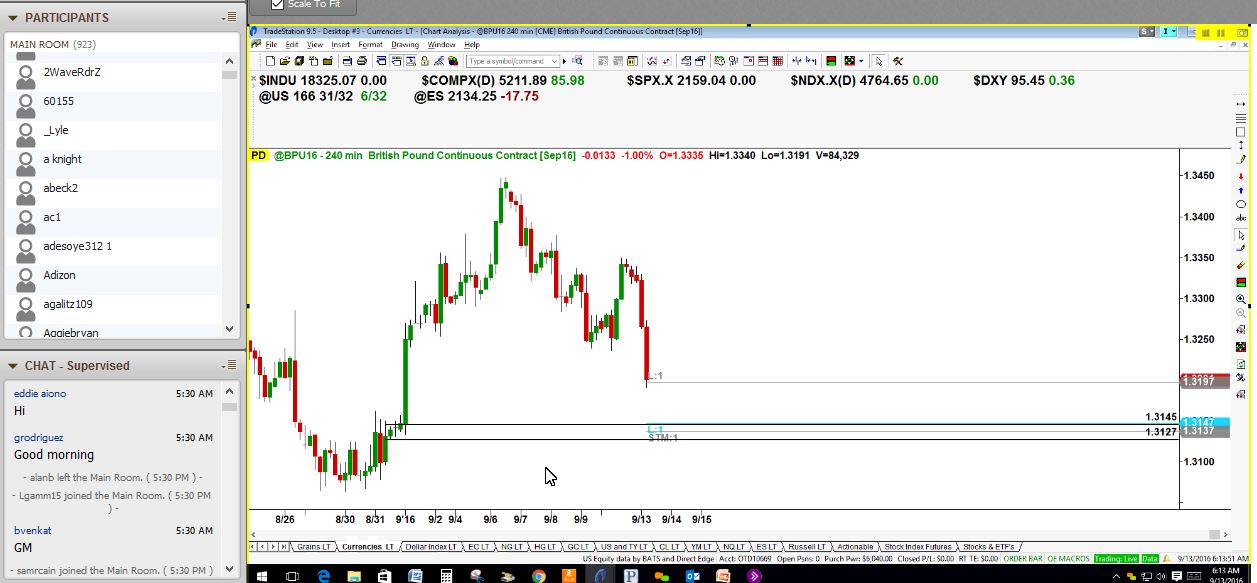
The fact that the BP (British Pound) was coming into a demand level was only one piece of the puzzle. I made the observation to the students that the odds of this trade working were increased because of another important factor: An inversely correlated market was hitting its supply level at the same time. Doesn’t it make sense that if markets that trade in opposite directions both hit their respective supply and demand zones simultaneously, the odds would be high? The answer of course is yes, and that is what detective work does for you.
In addition, we now have to WAIT for BP to hit our level as we ANTICIPATE that at the demand zone it will stop falling and rally away. This is different than what most traders do. The majority will not feel comfortable doing this. Instead they will need confirmation or will short as the downside momentum accelerates into the demand zone. This is not low risk. In fact, I would argue that this is high risk trading.
As we can see below, the British Pound indeed stopped falling and turned higher and hit the target later that evening.
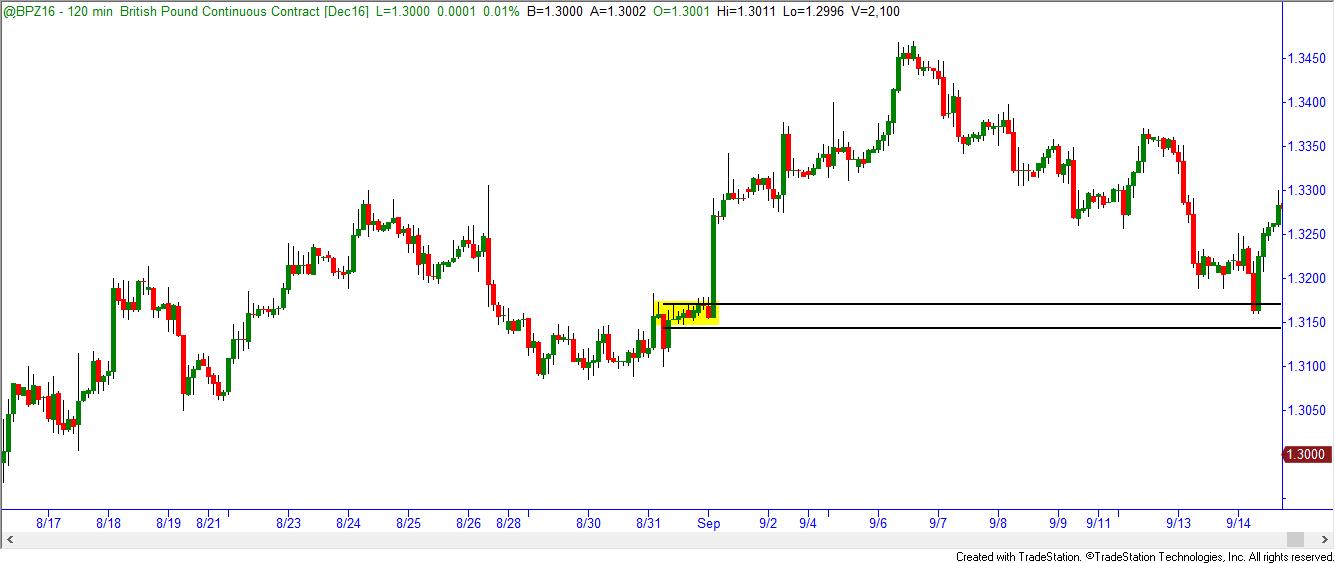
The lesson here is that market speculation requires traders to be like good detectives who stay detached from their personal views and biases while investigating a case. In the end the market doesn’t care about your hopes or wishes, but time and again it will leave plenty of clues for those market speculators that are watching through an objective lens. Once all the clues are in place we wait for the market to come to us and anticipate that the market is likely going to turn where we have our orders. This is not easy. As Tom Petty aptly put it, “The waiting is the hardest part.” So have patience because, generally, good things come to those the wait.
Until next time, I hope everyone has a great week.
This content is intended to provide educational information only. This information should not be construed as individual or customized legal, tax, financial or investment services. As each individual's situation is unique, a qualified professional should be consulted before making legal, tax, financial and investment decisions. The educational information provided in this article does not comprise any course or a part of any course that may be used as an educational credit for any certification purpose and will not prepare any User to be accredited for any licenses in any industry and will not prepare any User to get a job. Reproduced by permission from OTAcademy.com click here for Terms of Use: https://www.otacademy.com/about/terms
Editors’ Picks

EUR/USD holds firm above 1.1900 as US NFP looms
EUR/USD holds its upbeat momentum above 1.1900 in the European trading hours on Wednesday, helped by a broadly weaker US Dollar. Markets could turn cautious later in the day as the delayed US employment report for January will takes center stage.

GBP/USD recovers losses despite rising UK political risks, BoE rate cut bets
Pound Sterling advances against the US Dollar after registering modest losses in the previous session, trading around 1.3650 during the Asian hours on Wednesday. The pair could extend losses as the Pound Sterling faces pressure from rising political risks in the UK and growing expectations of near-term Bank of England rate cuts.

USD/JPY remains heavy around 153.00 on firmer Japanese Yen
USD/JPY is sustaining its three-day rout at around 153.00 in the European session on Wednesday, awaiting the closely-watched US NFP report. Rising bets on Fed rate cuts keep the US Dollar depressed. In contrast, expectations that PM Takaichi's policies will boost the economy and allow the BoJ to stick to its hawkish stance bolster the Japanese Yen, weighing on the pair amid intervention fears.
Editors’ Picks
EUR/USD holds firm above 1.1900 as US NFP looms
EUR/USD holds its upbeat momentum above 1.1900 in the European trading hours on Wednesday, helped by a broadly weaker US Dollar. Markets could turn cautious later in the day as the delayed US employment report for January will takes center stage.
USD/JPY remains heavy around 153.00 on firmer Japanese Yen
USD/JPY is sustaining its three-day rout at around 153.00 in the European session on Wednesday, awaiting the closely-watched US NFP report. Rising bets on Fed rate cuts keep the US Dollar depressed. In contrast, expectations that PM Takaichi's policies will boost the economy and allow the BoJ to stick to its hawkish stance bolster the Japanese Yen, weighing on the pair amid intervention fears.

Gold sticks to gains near $5,050 as focus shifts to US NFP
Gold holds moderate gains near the $5,050 level in the European session on Wednesday, reversing a part of the previous day's modest losses amid dovish US Federal Reserve-inspired US Dollar weakness. This, in turn, is seen as a key factor acting as a tailwind for the non-yielding yellow metal ahead of the critical US NFP release.

US Nonfarm Payrolls expected to show modest job gains in January
The United States Bureau of Labor Statistics will release the delayed Nonfarm Payrolls data for January on Wednesday at 13:30 GMT. Investors expect NFP to rise by 70K following the 50K increase recorded in December.

Dollar drops and stocks rally: The week of reckoning for US economic data
Following a sizeable move lower in US technology Stocks last week, we have witnessed a meaningful recovery unfold. The USD Index is in a concerning position; the monthly price continues to hold the south channel support.
RECOMMENDED LESSONS
Making money in forex is easy if you know how the bankers trade!

I’m often mystified in my educational forex articles why so many traders struggle to make consistent money out of forex trading. The answer has more to do with what they don’t know than what they do know. After working in investment banks for 20 years many of which were as a Chief trader its second knowledge how to extract cash out of the market.
5 Forex News Events You Need To Know

In the fast moving world of currency markets where huge moves can seemingly come from nowhere, it is extremely important for new traders to learn about the various economic indicators and forex news events and releases that shape the markets. Indeed, quickly getting a handle on which data to look out for, what it means, and how to trade it can see new traders quickly become far more profitable and sets up the road to long term success.
Top 10 Chart Patterns Every Trader Should Know

Chart patterns are one of the most effective trading tools for a trader. They are pure price-action, and form on the basis of underlying buying and selling pressure. Chart patterns have a proven track-record, and traders use them to identify continuation or reversal signals, to open positions and identify price targets.
7 Ways to Avoid Forex Scams

The forex industry is recently seeing more and more scams. Here are 7 ways to avoid losing your money in such scams: Forex scams are becoming frequent. Michael Greenberg reports on luxurious expenses, including a submarine bought from the money taken from forex traders. Here’s another report of a forex fraud. So, how can we avoid falling in such forex scams?
What Are the 10 Fatal Mistakes Traders Make
Trading is exciting. Trading is hard. Trading is extremely hard. Some say that it takes more than 10,000 hours to master. Others believe that trading is the way to quick riches. They might be both wrong. What is important to know that no matter how experienced you are, mistakes will be part of the trading process.
The challenge: Timing the market and trader psychology

Successful trading often comes down to timing – entering and exiting trades at the right moments. Yet timing the market is notoriously difficult, largely because human psychology can derail even the best plans. Two powerful emotions in particular – fear and greed – tend to drive trading decisions off course.