Using Elliott Wave To Trade Forex Markets

by Jay Kaeppel
In terms of the total value of all transactions, the forex market has become the largest market in the world. As the economies of countries across the globe become more and more intertwined, the relationship between the currencies of various countries grows in importance. It is this development that continues to drive interest in the forex markets. This article will examine a method to trade forex markets using the Elliott Wave Theory.
The Elliott Wave Theory
The Elliott Wave Theory is a method of analysis developed by Ralph Nelson Elliott (1871-1948) that is based on the theory that, in nature, many things happen in a five-wave pattern. As applied to the financial markets, the assumption is that a given market will advance in a pattern of five waves – three up waves, numbered 1, 3 and 5 - which are separated by two down waves, number 2 and number 4. The theory further holds that each five-wave up-move will be followed by a down-move also consisting of five waves – this time, three down waves, numbered 1, 3 and 5, separated by two up waves numbered two and four.
In addition, the theory holds that each of the countertrend waves – i.e., wave number 2 and number 4 – will unfold in an ABC pattern. In other words, during waves 2 and 4 of a five-wave uptrend, the security in question will retrace part of the wave 1 advance in a pattern consisting of two smaller down waves (labeled A and C) separated by one up wave (labeled B). Likewise, during waves 2 and 4 of a five-wave down-trend, the security in question will retrace part of the wave one decline in a pattern consisting of two smaller up-waves (labeled A and C) separated by one down-wave (labeled B).
In reality, things typically do not unfold in such a neat, clean, and easy to follow five-wave pattern. As a result, many individuals who espouse a belief in Elliott Wave analysis nevertheless end up interpreting the current wave count differently than other adherents. And in fact, it can be argued that the Elliott Wave is as much an art as it is a science, and that various interpretations are to be expected.
As such, one important thing to note is that this article is not so much about how to generate an Elliott Wave count – since so many individuals end up with different interpretations – but rather about how to trade forex markets using the Elliott Wave as the driving force. For the purposes of this article, I will use the Elliott Wave count as generated objectively by ProfitSource source software by Hubb. The software has an automated algorithm for generating and displaying the wave count.
It should be noted that the preferred count can change dramatically from one day to the next based on the built-in algorithm, and that another person or program may arrive at a different interpretation of the wave count and any given point in time. Still the benefit of using this method is that for better or worse, the count is calculated using an objective algorithm and is not open to subjective interpretation.
Laying Out the Steps of a Plan
Before embarking on any trading campaign it is essential to have a plan in place. So let's set up a straightforward plan for using Elliott Wave as a basis for trading forex markets. Here are the steps that we will employ:
- Step 1. Select a method for generating an Elliott Wave count.
This may be based on your own analysis, or via some charting or analysis software. As mentioned, we will use the wave count generated by ProfitSource software by HUBB.
- Step 2. Wait for a wave 5 to begin.
In ProfitSource this occurs when a wave marked as "3" changes to a wave marked as "4" (this actually indicates the end of wave 4 and the start of wave 5). Waiting for this to occur can be the toughest part, for this step can require a great deal of patience. A given single forex market may experience the setup that we are looking for only a few times a year.
- Step 3. Look for confirmation of the trend using another indicator or indicators.
Long Setup Confirmation: Once a wave 3 above the price bar changes to a wave 4 marked below the price bar we will then assess the following indicators to confirm that a long trade should be made:
- 90-day Commodity Channel Index (CCI) is positive (i.e., greater than zero)
- The three-day relative strength index reverses to upside for one day.
These two confirming actions do not have to take place on the day that the wave number changes from 3 to 4. As long as the both occur at some point prior to the wave count being something other than 4, then a confirmation is considered to be in force and we will enter a long trade.
Short Setup Confirmation: Once a wave 3 below the price bar changes to a wave 4 marked above the price bar we will then assess the following indicators to confirm that a short trade should be made:
- 90-day CCI is negative (i.e., greater than zero)
- The three-day RSI reverses to downside for one day
These two confirming actions do not have to take place on the day that the wave number changes from 3 to 4. As long as the both occur at some point prior to the wave count being something other than 4, then a confirmation is considered to be in force and we will enter a short trade.
- Step 4. Identify a reasonable stop-loss point.
For a long setup we will subtract three times the three-day average true range from the low established leading up to the trade as our initial stop-loss point. For a short setup we will add three times the three-day average true range to the high established leading up to the trade, and use this as our initial stop-loss point (See example to follow).
- Step 5. Enter trade and stop-loss order.
We will assume that a trade is entered at the next day's open price. The stop-loss order will also be placed. This order is a trailing stop and we be updated each day that the trade is open.
- Step 6. Consider taking some profits on first good move and trail a stop for the rest of the position.
Trade Exit Plan
1. If stop-loss order is hit then the entire trade is exited.
2. If the three-day RSI reaches 85 or higher for a long trade, or 15 or lower for a short trade, or if the wave count changes from 4 to 5, we will sell half and adjust our trailing stop as follows:
- For a long trade we will use a trailing stop that subtracts one times the three-day average true range from the previous day's low.
- For a short trade we will use a trailing stop that adds one times the three-day average true range to the previous day's high.
3. If the wave count changes to something other than a wave 5, we will simply exit the trade on the next day.
Example Setup and Trade
In Figure 1 we see the setup for a short trade. On the most recent trading day, the blue number 4 first appeared above the price bar. Prior to the day, a blue number 3 had appeared below each price bar for the past several days. This suggests that a wave 5 decline may be setting up.
Below the bar chart you can see that the three-day RSI ticked lower on the day and that the 90-day CCI is in negative territory. This confirms the setup and constitutes a sell short signal, so we also calculate our stop-loss price by adding three times the average true range over the last three days to the current day's high price. On the next day the euro/yen cross was sold short at 112.63 and a trailing stop was entered at 117.74.
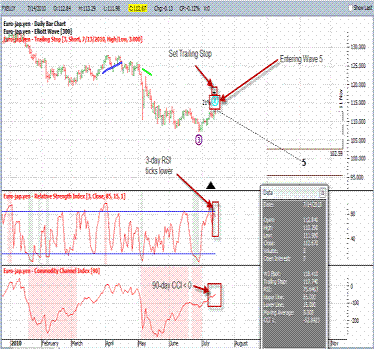
Figure 1 – A sell short setup for the euro/yen cross is completed.
In Figure 2 you can see that roughly a month later the three-day RSI registered a reading below 15. As a result, on the next day we would have bought back half of our position at 109.50 and also adjusted our trailing stop to only one times (rather than three times) the average true range over the past three days added to the current day's high, thus generating a much tighter trailing stop (this tighter stop does not appear until Figure 3).
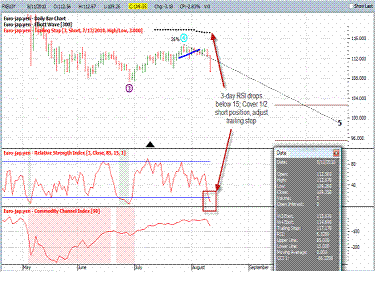
Figure 2 – Three-day RSI signal profit-taking opportunity; half of short position is covered and trailing stop is tightened.
Finally, in Figure 3 you can see that the euro/yen cross worked slightly lower over the next several weeks, but ultimately our trailing stop was hit and the remaining portion of our original short position was closed out at 109.44.
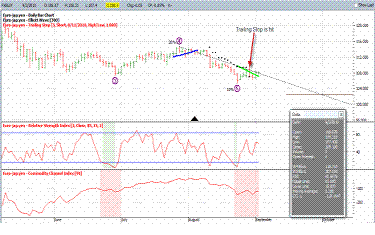
Figure 3 – Trailing top is hit; trade is exited.
Summary
There are many ways to interpret an Elliott Wave count. There are also many methods for entering and exiting trades once a signal is deemed to have occurred. This article serves as an example of just one way to go about performing these tasks. Whatever method one ultimately chooses the keys to successful implementation are to:
- Develop some objective way to interpret the current Elliott Wave count. Consider employing some sort of filter or filters to ensure a valid trading signal.
- Always have a stop-loss point.
- Consider taking profits on the first good move in the expected direction and then letting the rest ride with a trailing stop.
Author

Investopedia Contributors
Investopedia
Investopedia, a division of ValueClick, Inc. is a leading financial information and investing education website, attracting millions of visitors per month.