Trading Leverage – A Real Look at how Traders May Use it Effectively
- Many traders attracted to trading FX due to availability of leverage
- Clearly leverage can increase gains, but it also magnifies losses
- We take a look at the statistics on real traders to learn how we might use leverage effectively

Many traders are attracted to the FX market due to the wide availability of leverage: the ability to control a trading position larger than your available capital. And arguably for good reason; leverage can be an effective tool in allowing an investor to achieve desired returns on trading capital. Yet leverage magnifies losses and represents a key risk, and indeed our data and experience shows that it is often misused and leads to very large losses.
We studied 13 million real trades conducted by users of FXCM’s trading platforms to look for important insights into the use of leverage. Let’s start with what might be obvious: excessive leverage can lead to outsized losses. In fact, our data shows that there’s a fairly negative relationship between average leverage used and trader profitability.
Percentage of Profitable Traders Grouped by Average Effective Leverage Used
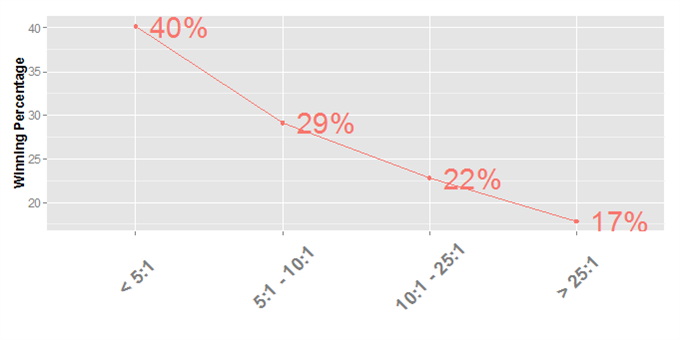
Figure Data source: Derived from FXCM Inc. accounts excluding Eligible Contract Participants, Clearing Accounts, Money Managers, Hong Kong, and Japan subsidiaries from 4/1/2014 to 3/31/2015 across all currency pairs.
To understand Figure 2 we need to introduce the concept of Effective Leverage: Trade Size / Account Equity
As an example, a trader has $10,000 in her account and has opened a position in the USD/JPY with 100,000 units. 100,000 USD/JPY divided by $10,000 = 10:1 Effective Leverage.
Immediately we see a substantial difference in percentage of traders profitable as we vary Effective Leverage. Our data showed that 40 percent of all traders who used an average per-position Effective Leverage of 5:1 or lower turned a profit in the 12 months captured. If we move above 25:1, that ratio drops by more than half to a mere 17 percent.
The data suggests that using more and more leverage has made it significantly less likely that a trader is ultimately profitable. Why might this be the case?
In our first article on the Traits of Successful Traders, we highlighted the significance of trader psychology and why it could ultimately make the difference between profits and losses. Here we see a similar dynamic at play: using excessive leverage made traders less likely to ultimately turn a profit in a given trade.
Trade Winning Percentage Became Worse as Leverage Increased
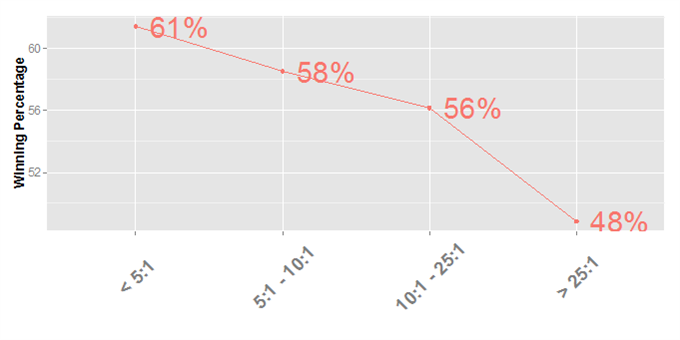
Figure Data source: Derived from FXCM Inc. accounts excluding Eligible Contract Participants, Clearing Accounts, Money Managers, Hong Kong, and Japan subsidiaries from 4/1/2014 to 3/31/2015 across all currency pairs.
Traders were considerably more likely to turn a profit on a given trade than a loss except when using over 25:1 leverage. The chart above shows that trades with leverage below 5:1 were profitable 61 percent of the time. On the opposite end, those with effective leverage above 25:1 were only profitable on 48 percent of all trades—a significant difference.
Excessive leverage can have key detrimental effects related to the mechanics of trading and a trader’s psychology. In terms of trade mechanics, using excessive leverage will give a trader has a smaller capital buffer against losses. If the trade initially goes against the trader there is a higher probability that the trader will run out of excess margin and receive a margin call. The trade does not have full room to draw down before it might ultimately move in the trader’s direction.
From a psychological perspective, controlling outsized positions can force a trader to act differently and less rationally than they would otherwise. In our first article we highlighted why natural human emotion might get in the way of trading success. With greater leverage comes greater individual risk on a trade—likely amplifying the effect of this key psychological bias. How might we look for a solution?
How Might we Fix This?
There are two inputs to the Effective Leverage equation: Trade Size and Equity. By varying either we can change the Effective Leverage used. What precisely might this mean? Let’s say that a trader opens an account with $10,000 in equity. A maximum of 5:1 or even 10:1 leverage would mean opening positions no larger than $50,000 and $100,000 at a time. Another way to manage Effective Leverage is the second input: Equity.
Given what we know about the relationship between trader profitability and Effective Leverage, it should be relatively little surprise to see a fairly clear link between average equity used and trader performance. At the low end, a mere 21 percent of traders with average equity $1,000 turned a profit in the 12-month sampling period.
Percentage of Profitable Traders Grouped by Average Trading Equity
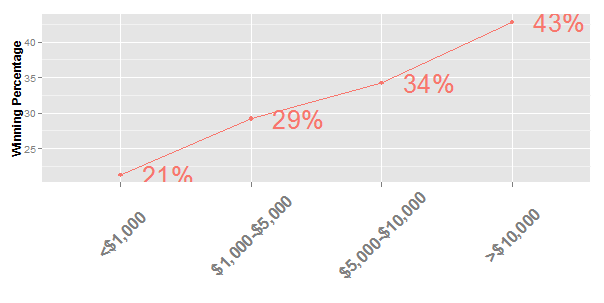
Figure Data source: Derived from FXCM Inc. accounts excluding Eligible Contract Participants, Clearing Accounts, Money Managers, Hong Kong, and Japan subsidiaries from 4/1/2014 to 3/31/2015 across all currency pairs.
Those with more than $10,000 in average equity were more than twice as likely to be profitable at 43 percent. These stats look very similar to those on Effective Leverage and they’re almost certainly related. And indeed, those with under $1,000 in average equity used an average of 28:1 Effective Leverage, while traders with over $10,000 used an average of 5:1.
Average Effective Leverage Used by Average Trading Equity
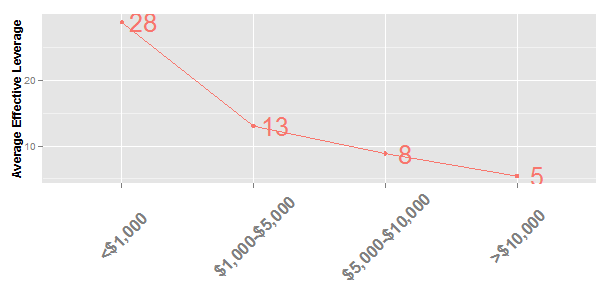
Figure Data source: Derived from FXCM Inc. accounts excluding Eligible Contract Participants, Clearing Accounts, Money Managers, Hong Kong, and Japan subsidiaries from 4/1/2014 to 3/31/2015 across all currency pairs.
It makes sense that there’s a link between average Effective Leverage used an equity, but what does this ultimately mean for the trader? Put simply: know how much you expect to risk and set trading capital accordingly.
Manage Position Size and Equity According to Risk
In our first article we described a critical reason on why it’s so important to manage risk, and the takeaway was simple: always stand to gain at least as much as you stand to lose. In this sense we can manage trade size, equity, and ultimately Effective Leverage.
Let’s use an example to illustrate this point further. If a trader looks to open EUR/USDposition sizes of 100,000 units, each pip move in the EUR/USD will be worth $10. A Euro move from $1.1500 to $1.1600 would be a difference of 100 pips. In this example a 100,000-unit trade would generate a profit or loss of $10 x 100 pips = $1,000.
Keeping our profit target in pips and dollars constant, we get a sense from our data that we want to use Effective Leverage below 10:1 or even 5:1. Our 100,000-unit EUR/USD represents $115,000 (100k * EUR/USD at $1.15), and thus we would want at least $11,500 in equity to control such a position. Equity below this level or a position size above 10 times trading would put us into a very high-risk category and as such we’ll look to avoid.
We likewise saw that there was a positive link between account size and success rates. We can reasonably expect that many of those with greater account equity are those with more trading experience. And yet it’s difficult to ignore the fairly clear link between average Effective Leverage used and ultimate success rates.
Leverage used isn’t the only factor in ultimate trader success, but our data suggests that it can certainly work against the trader. And indeed many of our most successful traders operate on lower levels of Effective Leverage.
Author

David Rodríguez
DailyFX
David Rodriguez specializes in algorithmic trading systems. He has appeared in the Wall Street Journal, TheStreet.com, Reuters Insider, Marketwatch, and other major outlets.