 Brandon Wendell, CMT
Brandon Wendell
Investors are taught to buy and hold stocks and other investments. We are conditioned to make profits in the markets as they move upwards in price. However, when someone buys a stock don’t they need someone to sell it to them? Who is doing all of this selling and what is in it for them? More importantly, is there a way to profit in the markets when prices drop?
The answer to all of the above is short selling! Short sellers can offer added liquidity to the markets, their selling orders match the buying orders of others and allow transactions to happen. And short selling profits when the prices of securities fall.
What is short selling?
A short sale occurs when a trader sells or promises stock to a purchaser without owning any of said shares. How can a trader sell something they do not actually own? Isn’t that fraud? When you sell stock, you actually have to have shares to sell. When you are selling shares you do not own, you are selling shares that you have borrowed. When you open a margin account with a broker, they not only allow you to trade with leverage but also will lend you shares that you can use for short selling.
The process that occurs when you short sell is that the broker allocates a certain number of shares from their own inventory or from the account of one or more of their customers. They lend these shares to you so you can sell the shares to someone in the market. You are responsible for returning the shares at some point in the future. The money you collect from selling the shares and a deposit from your account is held by the broker until the conclusion of the trade.
Should the shares drop in value after you shorted them, you can buy them back in the open market for less. When you give the shares back to the broker, you keep the difference in the price of where you shorted and where you bought.
Let’s imagine that you believed that the price of Apple (AAPL) was moving up into a Supply Zone. You could borrow 100 shares from your broker and sell them for a total of $15,620 (100 shares x $156.20 per share). If you are correct and the price falls, you are able to replace the borrowed shares by buying them back a few days later for only $15,000 (100 shares at $150/share). The broker only wants you to replace the shares, you get to keep the extra $620!
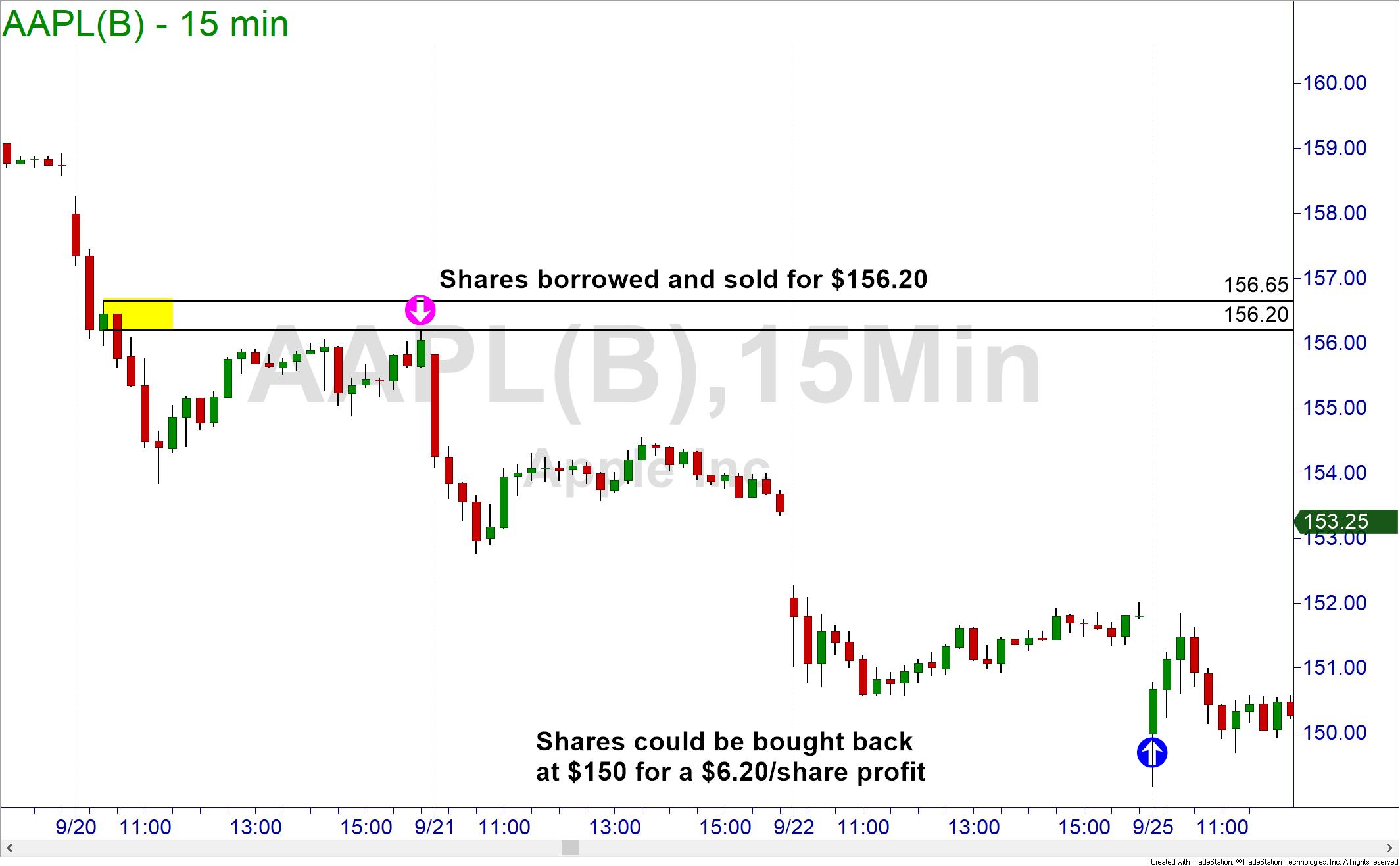
We are programmed that buying low and selling high is the way to make money in the markets. But smart traders know that with short selling you do not have to do the buy first. When prices are high, you are able to short them and profit from selling high and buying low. The key is knowing when prices are too high and are ready to drop and how far they are going to drop.
To learn more about how shorting works, come visit your local Online Trading Academy center and enroll in a workshop today!
Neither Freedom Management Partners nor any of its personnel are registered broker-dealers or investment advisers. I will mention that I consider certain securities or positions to be good candidates for the types of strategies we are discussing or illustrating. Because I consider the securities or positions appropriate to the discussion or for illustration purposes does not mean that I am telling you to trade the strategies or securities. Keep in mind that we are not providing you with recommendations or personalized advice about your trading activities. The information we are providing is not tailored to any individual. Any mention of a particular security is not a recommendation to buy, sell, or hold that or any other security or a suggestion that it is suitable for any specific person. Keep in mind that all trading involves a risk of loss, and this will always be the situation, regardless of whether we are discussing strategies that are intended to limit risk. Also, Freedom Management Partners’ personnel are not subject to trading restrictions. I and others at Freedom Management Partners could have a position in a security or initiate a position in a security at any time.
Editors’ Picks

EUR/USD struggles near 1.1850, with all eyes on US CPI data
EUR/USD holds losses while keeping its range near 1.1850 in European trading on Friday. A broadly cautious market environment paired with a steady US Dollar undermines the pair ahead of the critical US CPI data. Meanwhile, the Eurozone Q4 GDP second estimate has little to no impact on the Euro.

GBP/USD recovers above 1.3600, awaits US CPI for fresh impetus
GBP/USD recovers some ground above 1.3600 in the European session on Friday, though it lacks bullish conviction. The US Dollar remains supported amid a softer risk tone and ahead of the US consumer inflation figures due later in the NA session on Friday.

USD/JPY rebounds above 153.00 ahead of US inflation data
USD/JPY stages a comeback and regains 153.00 in the Asian session, snapping a four-day losing streak amid some repositioning ahead of the US CPI report. However, expectations that Japan's PM Sanae Takaichi could be more fiscally responsible, along with bets that the BoJ will stick to its policy normalization path and the risk-off mood, could support the safe-haven Japanese Yen, capping the pair's upside.
Editors’ Picks
EUR/USD struggles near 1.1850, with all eyes on US CPI data
EUR/USD holds losses while keeping its range near 1.1850 in European trading on Friday. A broadly cautious market environment paired with a steady US Dollar undermines the pair ahead of the critical US CPI data. Meanwhile, the Eurozone Q4 GDP second estimate has little to no impact on the Euro.
GBP/USD recovers above 1.3600, awaits US CPI for fresh impetus
GBP/USD recovers some ground above 1.3600 in the European session on Friday, though it lacks bullish conviction. The US Dollar remains supported amid a softer risk tone and ahead of the US consumer inflation figures due later in the NA session on Friday.

Gold remains below $5,000 as US inflation report looms
Gold retreats from the vicinity of the $5,000 psychological mark, though sticks to its modest intraday gains in the European session. Traders now look forward to the release of the US consumer inflation figures for more cues about the Fed policy path. The outlook will play a key role in influencing the near-term US Dollar price dynamics and provide some meaningful impetus to the non-yielding bullion.

US CPI data set to show modest inflation cooling as markets price in a more hawkish Fed
The US Bureau of Labor Statistics will publish January’s Consumer Price Index data on Friday, delayed by the brief and partial United States government shutdown. The report is expected to show that inflationary pressures eased modestly but also remained above the Federal Reserve’s 2% target.

A tale of two labour markets: Headline strength masks underlying weakness
Undoubtedly, yesterday’s delayed US January jobs report delivered a strong headline – one that surpassed most estimates. However, optimism quickly faded amid sobering benchmark revisions.
RECOMMENDED LESSONS
Making money in forex is easy if you know how the bankers trade!

I’m often mystified in my educational forex articles why so many traders struggle to make consistent money out of forex trading. The answer has more to do with what they don’t know than what they do know. After working in investment banks for 20 years many of which were as a Chief trader its second knowledge how to extract cash out of the market.
5 Forex News Events You Need To Know

In the fast moving world of currency markets where huge moves can seemingly come from nowhere, it is extremely important for new traders to learn about the various economic indicators and forex news events and releases that shape the markets. Indeed, quickly getting a handle on which data to look out for, what it means, and how to trade it can see new traders quickly become far more profitable and sets up the road to long term success.
Top 10 Chart Patterns Every Trader Should Know

Chart patterns are one of the most effective trading tools for a trader. They are pure price-action, and form on the basis of underlying buying and selling pressure. Chart patterns have a proven track-record, and traders use them to identify continuation or reversal signals, to open positions and identify price targets.
7 Ways to Avoid Forex Scams

The forex industry is recently seeing more and more scams. Here are 7 ways to avoid losing your money in such scams: Forex scams are becoming frequent. Michael Greenberg reports on luxurious expenses, including a submarine bought from the money taken from forex traders. Here’s another report of a forex fraud. So, how can we avoid falling in such forex scams?
What Are the 10 Fatal Mistakes Traders Make
Trading is exciting. Trading is hard. Trading is extremely hard. Some say that it takes more than 10,000 hours to master. Others believe that trading is the way to quick riches. They might be both wrong. What is important to know that no matter how experienced you are, mistakes will be part of the trading process.
The challenge: Timing the market and trader psychology

Successful trading often comes down to timing – entering and exiting trades at the right moments. Yet timing the market is notoriously difficult, largely because human psychology can derail even the best plans. Two powerful emotions in particular – fear and greed – tend to drive trading decisions off course.