One asset category that is not very well understood is what we refer to as the credit markets. In the futures market, these encompass all debt instruments such as U.S. Treasury Bills, Notes, and Bonds, and are not limited to derivatives of debt issued by the U.S. treasury. The German debt market can also be traded in the U.S. through most futures brokers on the Eurex exchange. These derivative instruments come with funny names like Schatz, Boble, and Buxl and, finally, the Bund. The different names in all debt instruments are there simply to differentiate the short, medium and long term maturity dates.

These particular European markets are nice to know about, but for those of us in the U.S., they’re not as important as say Greek, Spanish or Italian debt and, of course, the US debt market. Understanding how debt instruments work can gives us important clues not only to the future course of interest rates, but the tone of the U.S. economy, inflation and, by extension, the stock market. The first point about bonds is that their price movement is generally inversely correlated to that of the stock indices. In the chart below, we can clearly see this inverse relationship as the Red line (T-Bond futures) declines while the Blue line representing the S&P E-mini futures rally.
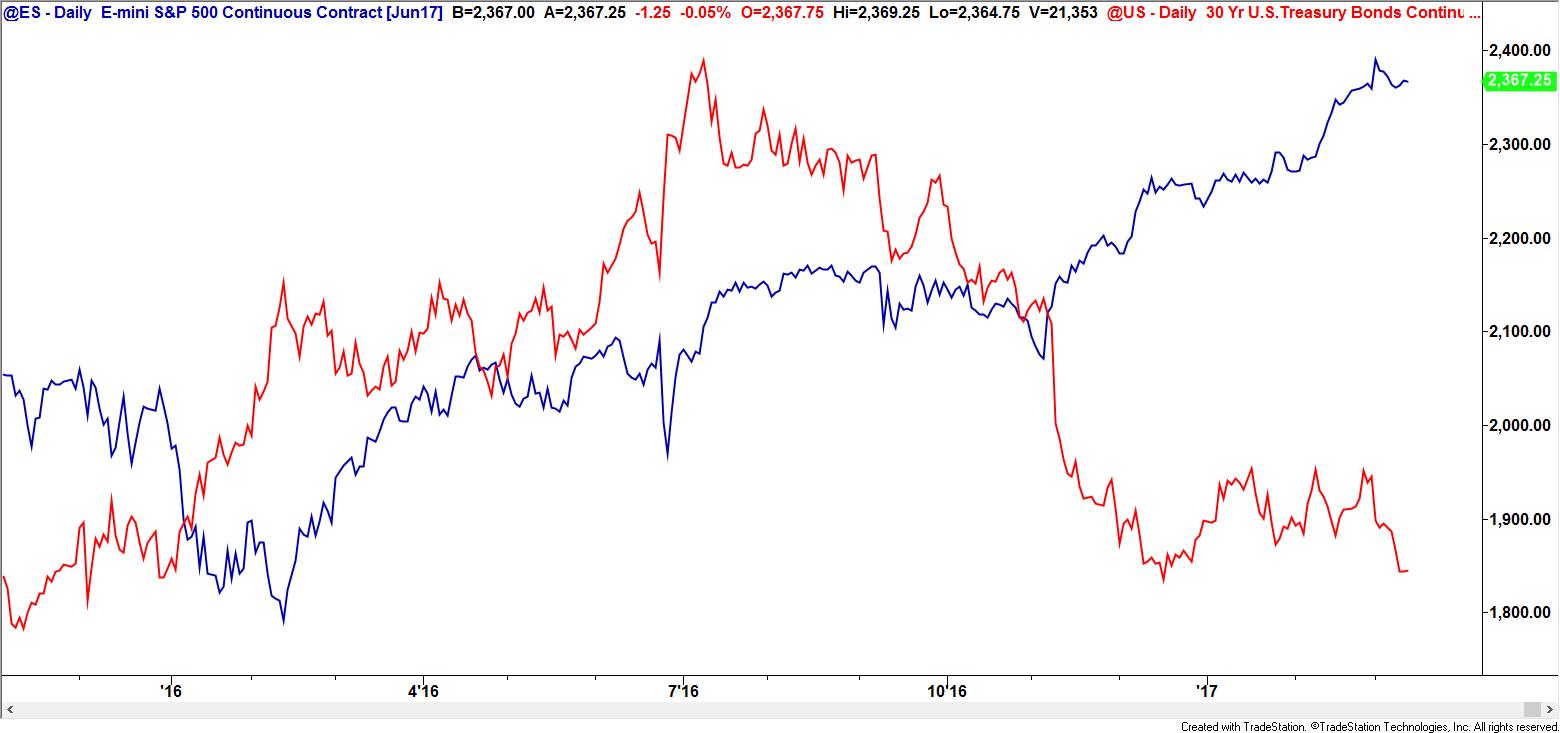
Bond

That’s to say that people move money into what they perceive as a safer investment in times of distress, which is what treasuries provide as they are guaranteed by the full faith and credit of the U.S. Treasury. Regardless of the condition of the U.S. Economy, the fact is these are still considered the safest paper on the globe.

When debt is issued by the Treasury, it has a fixed rate attached to it (otherwise known as coupon) and is issued in denominations of $1000. Let’s say the purchaser of the debt obligation buys a 10-year note at par ($1000) with a 6% coupon. Six months later, prices of treasuries move higher because demand increases. He’ll still receive the coupon, $60.00 a year, but the higher price of the bond will lower the yield as a new buyer of the same paper will spend more for the same coupon. In contrast, if the price of that same paper falls in value, the yield would go up as a new purchaser now will spend less to receive the same coupon.

In the futures market, we trade the notional value of the cash Treasury notes and bonds for which the symbols are (TY) for the 10-year note and (US) for the 30-year bond. U.S Treasury debt is broken into 32 parts; hence, futures prices are quoted in 32nds. That being the case, it would make sense that every tick would be 31.25 ($1000/32=31.25). In the TY (T-Notes), however, they’re broken into half again or 64ths, which makes every tick worth $15.625. I know it seems complicated, but it really isn’t once you get used to the contract.

Since bond prices tend to rally when stocks are declining, Bond traders have earned a reputation for being a glum bunch of guys and gals. Conversely, stock traders are usually over-optimistic, and that can also be problematic.

As I mentioned earlier, the bond market can be helpful as an odds enhancer in timing turning points in the stock index futures, as was the case recently and most likely will be again in the future.

The lesson here is that going forward, the stock market will find it hard to move lower if bonds continue their steep decline. The trick is to know when the odds will increase that bonds will stop falling. Are there times when both of these markets trade in tandem? Yes, but normally not for long; usually something gives.

Until next time, I hope everyone has a great week.

Learn to Trade Now


This content is intended to provide educational information only. This information should not be construed as individual or customized legal, tax, financial or investment services. As each individual's situation is unique, a qualified professional should be consulted before making legal, tax, financial and investment decisions. The educational information provided in this article does not comprise any course or a part of any course that may be used as an educational credit for any certification purpose and will not prepare any User to be accredited for any licenses in any industry and will not prepare any User to get a job. Reproduced by permission from OTAcademy.com click here for Terms of Use: https://www.otacademy.com/about/terms

Editors’ Picks

EUR/USD keeps range near 1.1750 ahead of German/ EU PMI data

EUR/USD keeps range near 1.1750 ahead of German/ EU PMI data

 EUR/USD maintains its range trade at around 1.1750 in European trading on Tuesday. The pair's volatility remains low, with investors awaiting a bunch of top-tier economic data releases from Germany, Eurozone and the US. The immediate focus is on the German and Eurozone preliminary PMI data. 

When is the UK labor market report and how could it affect GBP/USD?

When is the UK labor market report and how could it affect GBP/USD?

The UK Office for National Statistics will publish its labor market report at 07.00 GMT. GBP/USD trades in negative territory on the day in the lead up to the UK labor market data. The pair loses ground as traders turn cautious ahead of the key US economic data, including Nonfarm Payrolls, Retail Sales, and Purchasing Managers Index, which will be released later on Tuesday.

USD/JPY stays in the red below 155.00 amid BoJ rate hike bets, US data awaited

USD/JPY stays in the red below 155.00 amid BoJ rate hike bets, US data awaited

USD/JPY holds moderate losses below 155.00 in the Asian session on Tuesday.  The Japanese Yen gains ground on expectations that the Bank of Japan will raise interest rates at the upcoming policy meeting on Friday. Traders will closely monitor key US data, including Nonfarm Payrolls, Retail Sales, and Purchasing Managers Index, which are due later in the day. 


Editors’ Picks

When is the UK labor market report and how could it affect GBP/USD?

When is the UK labor market report and how could it affect GBP/USD?

The UK Office for National Statistics will publish its labor market report at 07.00 GMT. GBP/USD trades in negative territory on the day in the lead up to the UK labor market data. The pair loses ground as traders turn cautious ahead of the key US economic data, including Nonfarm Payrolls, Retail Sales, and Purchasing Managers Index, which will be released later on Tuesday.

EUR/USD keeps range near 1.1750 ahead of German/ EU PMI data

EUR/USD keeps range near 1.1750 ahead of German/ EU PMI data

 EUR/USD maintains its range trade at around 1.1750 in European trading on Tuesday. The pair's volatility remains low, with investors awaiting a bunch of top-tier economic data releases from Germany, Eurozone and the US. The immediate focus is on the German and Eurozone preliminary PMI data. 

Gold bulls move to the sidelines ahead of delayed US NFP report

Gold bulls move to the sidelines ahead of delayed US NFP report

Gold attracts some sellers during the Asian session on Tuesday and extends the overnight pullback from the $4,350 region, or the vicinity of the highest level since October 21, touched last week. The intraday downtick comes amid optimism over the Russia-Ukraine peace deal, which is seen undermining demand for the traditional safe-haven commodity. 

Sui Price Forecast: Sui slips below $1.50 as network demand and risk appetite wane

Sui Price Forecast: Sui slips below $1.50 as network demand and risk appetite wane

Sui remains under intense bearish pressure, extending losses by 1% at press time on Tuesday for the third straight day.

NFP preview: Complex data release will determine if Fed was right to cut rates

NFP preview: Complex data release will determine if Fed was right to cut rates

The long wait is over, and the Bureau of Labor Statistics in the US will release nonfarm payrolls reports for both November and October at 1330 GMT on Tuesday. The overall NFP figure for October is expected to be -10k, however, it is expected to be influenced by a massive 130k drop in federal department workers. 

RECOMMENDED LESSONS

5 Forex News Events You Need To Know

In the fast moving world of currency markets where huge moves can seemingly come from nowhere, it is extremely important for new traders to learn about the various economic indicators and forex news events and releases that shape the markets. Indeed, quickly getting a handle on which data to look out for, what it means, and how to trade it can see new traders quickly become far more profitable and sets up the road to long term success.

Top 10 Chart Patterns Every Trader Should Know

Chart patterns are one of the most effective trading tools for a trader. They are pure price-action, and form on the basis of underlying buying and selling pressure. Chart patterns have a proven track-record, and traders use them to identify continuation or reversal signals, to open positions and identify price targets.

7 Ways to Avoid Forex Scams

The forex industry is recently seeing more and more scams. Here are 7 ways to avoid losing your money in such scams: Forex scams are becoming frequent. Michael Greenberg reports on luxurious expenses, including a submarine bought from the money taken from forex traders. Here’s another report of a forex fraud. So, how can we avoid falling in such forex scams?

What Are the 10 Fatal Mistakes Traders Make

Trading is exciting. Trading is hard. Trading is extremely hard. Some say that it takes more than 10,000 hours to master. Others believe that trading is the way to quick riches. They might be both wrong. What is important to know that no matter how experienced you are, mistakes will be part of the trading process.

Strategy

Money Management

Psychology

Best Brokers of 2025